
Apple Patents a Way to Sharpen What You're Looking at Through a Headset
When you look through a mixed-reality headset, the camera feed of the real world is often noticeably worse than just... looking with your eyes. Apple's new patent targets that exact frustration by selectively enhancing only the part of the scene you care about.
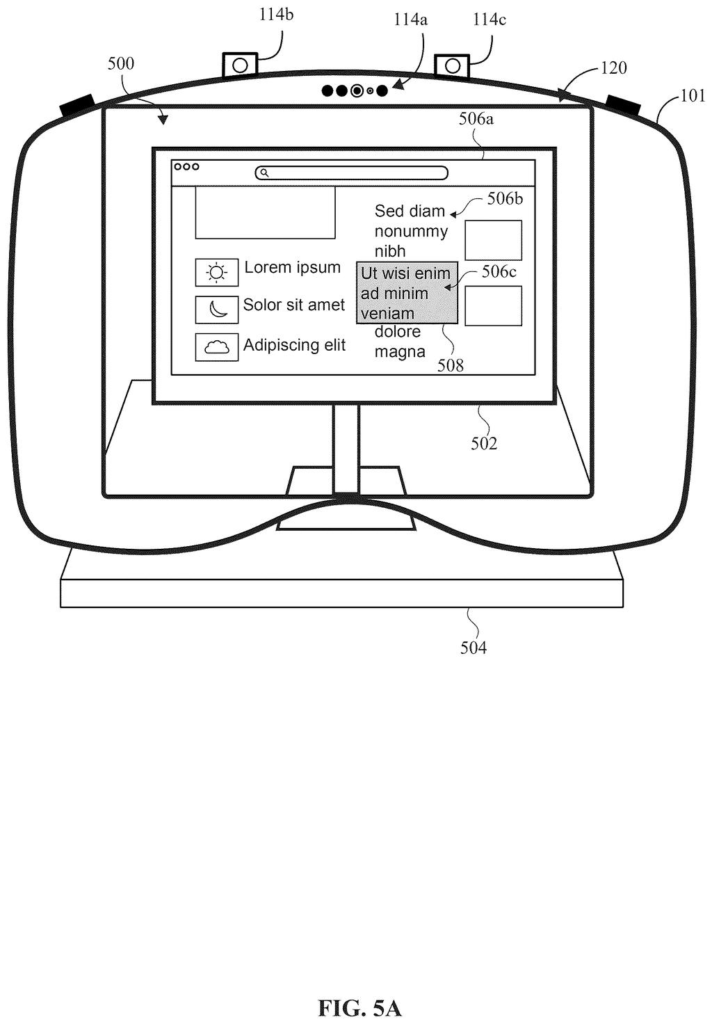
What Apple's passthrough sharpening actually does for you
Every time you glance at something through Apple Vision Pro, the headset's cameras capture the scene and show it to your eyes on tiny displays. That camera-to-display chain is the weak link: the image can look flat, dim, or soft compared to the real thing.
Apple's patent describes a system that watches for a specific region in the space around you, crops just that portion out of the camera image, and then applies extra processing to make that part look better before showing it to you. The rest of the frame can stay as-is.
In practice, that could mean the text on a book, a face across the table, or a label on a bottle gets automatically sharpened or brightened the moment the headset recognizes you're focusing on it, without needing you to tap any settings.
identifying a region within a three-dimensional environment; capturing, via the one or more input devices, one or more first images associated with the region identified within the three-dimensional environment; …
Translation: The headset figures out what specific area you are looking at and takes pictures of it.
How the headset isolates and reprocesses a target region
The patent describes a three-step pipeline running on a headset (or a device connected to one).
- Region identification: The system determines a specific area inside the 3D environment the user is interacting with. This could come from gaze tracking, hand pointing, or some other signal that says "this is where attention is."
- Targeted image capture: The one or more cameras attached to the device capture frames of that region. The system then isolates the pixels in those frames that correspond to the identified area, essentially cropping out the relevant portion from the raw camera data.
- Enhancement generation: A new image (or images) is generated from those cropped pixels, and that new image has an "enhanced visual characteristic" compared to the original. The patent keeps that term broad, so it could cover sharpness, brightness, contrast, color fidelity, or combinations of all of them.
The claim is deliberately hardware-agnostic. It applies to "an electronic device in communication with one or more input devices," which covers both an all-in-one headset and a tethered setup where a phone or Mac handles the heavy processing.
The system works on specific portions of captured images rather than upscaling the whole frame. That selective approach matters because processing the entire camera feed at high quality in real time is computationally expensive; doing it only for the region in focus is much more practical.
Methods and apparatuses for presenting enhanced video-passthrough in a three-dimensional environment.
Translation: This system improves the live video feed you see of the real world while wearing a headset.
What this means for Vision Pro's real-world viewing quality
Video passthrough is the core promise of mixed reality: you should feel present in your real room while digital content floats on top. If the camera feed looks worse than your bare eyes, the illusion breaks and the headset feels like a step backward. Apple's approach of sharpening on demand, only where you're looking, targets the single most noticeable failure mode in that experience. You'd notice it most when reading small text, checking a phone screen through the headset, or recognizing a face at a distance.
Apple has been filing steadily around display quality and AR perception, and this patent fits that pattern. The newest Big Tech patents in the AR space show a clear industry push toward making camera-mediated vision feel indistinguishable from direct sight, and Apple's selective-enhancement approach is one concrete attempt at closing that gap.
For anyone who has worn Vision Pro and found the passthrough feed slightly unconvincing up close, this patent addresses the exact moment of disappointment. Selective region enhancement is a practical trade-off: rather than demanding more raw camera hardware, Apple is using software to concentrate processing power where your eyes actually land. The payoff, if it ships, would be most obvious in everyday tasks like reading a label or checking a clock through the headset, where current passthrough visibly struggles.
There are more where this came from
We read every patent application Big Tech publishes and send you the ones worth knowing. Plain English, free, every week.
The drawings
29 drawing sheets from US 2026/0237165 A1 · click any drawing to enlarge


Want this weekly breakdown for a company we don't cover? Patentlyze Pro →
Be the first to weigh in