
Google Patents a Way to Animate 3D Characters Without Hardware Limits
Every 3D character you've ever seen in a game or app is secretly held together by an invisible skeleton, and most graphics hardware has a strict limit on how many bones it can process at once. Google's new patent describes a way to work around that limit without sacrificing detail.
How Google's bone-splitting trick frees up 3D animation
A character animator watches a finished hero model collapse into a rigid, blocky mess the moment it hits a low-end device. That collapse happens because the hardware hit its bone limit. You can probably picture this if you've ever seen a game character clip through a wall or freeze mid-motion.
Google's patent tackles exactly that problem. Every 3D character is built on a digital skeleton made of bones that pull and push the character's skin as it moves. Each point on the skin (called a vertex) is assigned a handful of bones, and each bone is given a weight that says how much influence it has. Most graphics chips can only handle a fixed number of bones per vertex at a time.
Google's approach splits the bone list for any vertex that has too many bones into two groups: the most influential ones go through the normal rendering path, and the rest get passed along separately using other rendering techniques. The final image looks complete, but no single pass ever exceeds the hardware limit.
… identifying, by the processing device and from the first set of bones, a first subset of bones and a second subset of bones, wherein the weight of each of the first subset of bones satisfies a weight condition, and wherein a number of bones of the first subset of bones satisfies a second bone number criterion …
Translation: The system sorts bones into two groups based on their importance to the character's movement and the hardware's capacity.
How the system splits and routes bone weights to the renderer
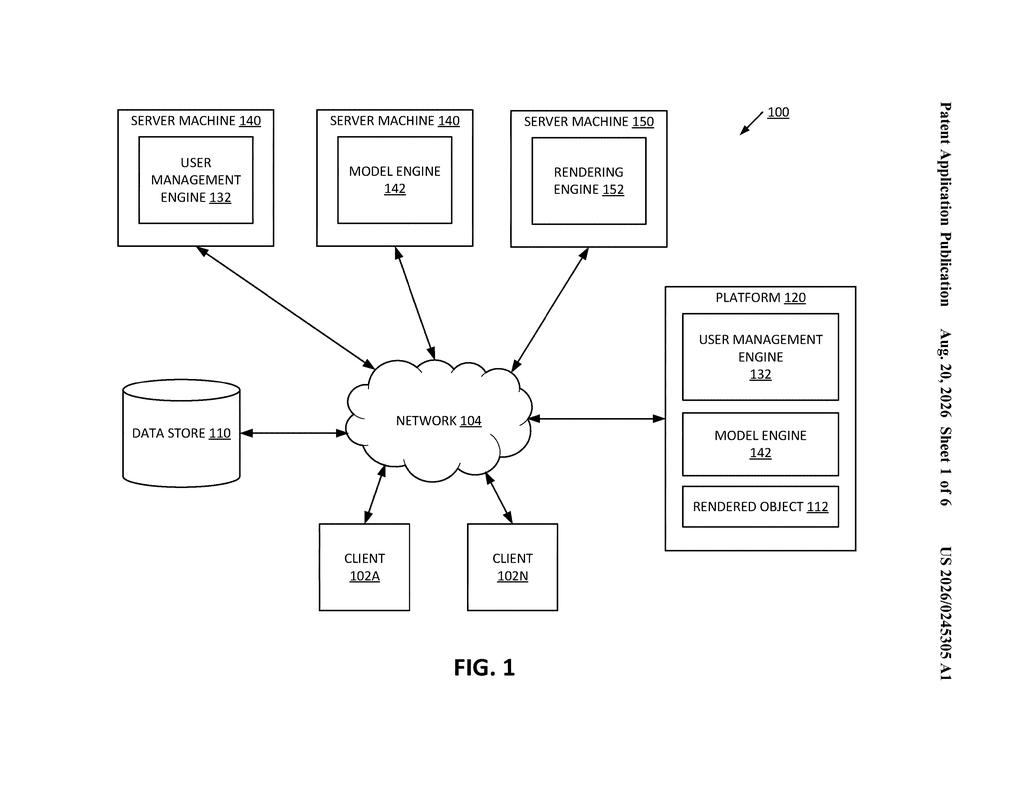
The patent describes a software pipeline that sits between a 3D scene's data and the rendering engine (the software that converts math into pixels on screen).
Here is how the steps flow:
- The system reads the mesh data for a 3D object, specifically the list of bones assigned to each vertex and the weight (a number from 0 to 1 saying how much influence each bone has).
- It checks whether a given vertex has more bones assigned to it than the hardware or rendering path can handle in one pass, which is the first bone number criterion.
- It then sorts the bone list for that vertex into two groups. The first subset contains the bones with the highest weights (most influence on that point of the skin) up to a safe count. The second subset contains the remaining, lower-influence bones.
- The first subset travels to the renderer as standard skinning data (the normal bone-deformation path). The second subset is sent as a different data type, meaning the renderer handles it through an alternate technique such as a secondary deformation or blend-shape pass.
The key insight is that by prioritizing the bones that matter most and routing the rest through a different channel, the system can represent complex, high-bone-count rigs on hardware that would normally truncate or ignore the overflow.
Data associated with the first subset of bones is transmitted to a rendering engine as skinning data for rendering 3D objects. Data associated with the second subset of bones is transmitted to the rendering engine as one or more other types of data for rendering the 3D objects.
Translation: The software splits the character data so the graphics engine can process it without overloading the device.
What this means for games and real-time 3D on Google platforms
For game developers and 3D application builders, bone limits have long been a ceiling that forces a painful tradeoff: either reduce character complexity or lock out lower-end devices. This patent describes a way to split that tradeoff so high-detail characters can scale across a wider range of hardware without requiring the developer to maintain separate, stripped-down versions of every asset.
Google's interest here almost certainly connects to its graphics infrastructure across Android, Chrome, and cloud gaming services like those built on its platform stack. A rendering pipeline that automatically routes overflow bone data is a software-only change, which means it could, in principle, be deployed to existing devices through a driver or middleware update rather than requiring new chips. For readers tracking where Big Tech is betting in real-time 3D and rendering, this filing sits alongside other graphics-layer work covered in this week's Big Tech patents focused on closing the gap between console-quality characters and the hardware most people actually own.
Google's 594th filing we've tracked since May in our Google coverage joins work like their quantum error correction application and pulling health data from photos.
Because this technique lives entirely in software, no new chips or special hardware deals are needed. The bone-sorting logic described in the patent fits into the existing tools that studios already use to build moving 3D characters, so the work to add it is small.
For developers shipping 3D characters across the huge spread of Android phones, from cheap to premium, that low barrier combined with a real everyday slowdown problem makes this patent matter quite a lot.
Get our take in your Top Stories
Liked this breakdown? Add Patentlyze as a preferred source on Google, and our plain-English take shows up more often in your Top Stories the next time Google patent news breaks.
There are more where this came from
We read every patent application Big Tech publishes and send you the ones worth knowing. Plain English, free, every week.
The drawings
6 drawing sheets from US 2026/0245305 A1 · click any drawing to enlarge


Want this weekly breakdown for a company we don't cover? Patentlyze Pro →
Be the first to weigh in