Adobe
Adobe · Software · Filed Feb 26, 2025 · USPTO published Aug 27, 2026 · Aug 27 release
Adobe Patents a System for Generating Realistic Sparkle Effects on 3D Surfaces
Anyone who has tried to render the sparkle in glittery fabric or metallic car paint knows it can be painfully slow to get right. Adobe's new patent describes a system that automates that sparkle, building it directly into the surface model rather than faking it afterward.
- Publication number
- US 2026/0253321 A1(US20260253321A1)
- Applicant
- Adobe Inc.
- Filed · Published
- Feb 26, 2025 · Aug 27, 2026
- Inventors
- Tamy Boubekeur, Theo Thonat, Lois Paulin, Jean Marc Christian Marie Thiery, Pauli Kemppinen
- Status when we published
- Waiting for an examiner
- Document
- 20 claims
- US classification
- 345/426
- Examiner
- WU, CHONG (Art Unit 2613)
What Adobe's glint particle system actually does
A 3D artist drops a glittery dress onto a digital character. The fabric should catch the light and send tiny flashes of reflection in every direction, the way real sequins or metal flakes do. Getting that effect to look convincing, and to update live as the camera moves, has always been one of the harder parts of the job.
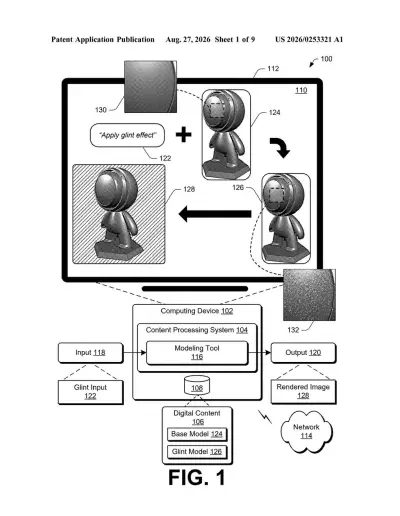
Adobe's patent describes a way to build those tiny sparkling reflections, called glints, directly into the surface description of a 3D object. Instead of painting sparkles on top after the fact, the system places thousands of microscopic virtual particles inside the surface itself, each one capable of catching and bouncing light. You feed it a few controls, like how dense the sparkles should be or how sharp each reflection looks, and it generates the full glint model for you.
The result is a rendered image where only the particles actually visible to the camera contribute to what you see, which keeps things efficient. For designers working on glossy packaging, metallic fabrics, or car paint in tools like Adobe Substance 3D, this kind of automation could cut a lot of manual tweaking.
… conveying visual phenomena that simulate localized reflections or sparkles resulting from embedded particles within the material surface …
Translation: The system mimics how light bounces off tiny bits of glitter or reflective material trapped inside a surface.
How Adobe integrates glint particles into a surface model
The patent describes a three-step pipeline running on a processing device, most likely a GPU or a CPU-GPU combination.
- Base model: The system starts with an existing surface description of a 3D object, things like its shape, color, and basic reflectivity. This is the foundation every 3D renderer already uses.
- Glint parameters: The artist (or an automated tool) passes in a set of controls that describe what kind of glint effect is wanted: particle density, size distribution, the sharpness of each sparkle, and similar properties.
- Glint model generation: The core step. The system integrates a large number of virtual glint particles directly into the surface using those parameters. Integration here means mathematically embedding particle positions and optical properties into the surface data structure, not just overlaying a texture image.
At render time, the system checks which particles are actually visible from the current camera angle and light position. Only those particles contribute reflected light to the final image. This visibility-culling step is what makes the approach practical: a surface might contain millions of virtual particles, but only a fraction matter for any given frame.
The patent is a software-side method. It does not require new chip architecture, though faster GPUs would naturally speed up the particle integration step.
The processing device is operable to generate the glint model by integrating a plurality of glint particles within the material surface based on the glint parameters.
Translation: The computer creates a digital map of sparkle points by placing virtual particles into the object based on user settings.
What this means for 3D artists and rendering pipelines
For 3D artists, glint effects sit in an awkward middle ground: physically accurate renderers can compute them correctly but take a long time, while real-time game engines often fake them with texture tricks that fall apart under close inspection. A procedural system that generates a proper glint model from a handful of parameters could make high-quality sparkle effects accessible in interactive workflows, not just offline film rendering.
Adobe's Substance 3D suite is already the main bridge between material design and production rendering, so a glint tool would slot naturally into that pipeline. This filing sits alongside a steady flow of new Big Tech patents in the 3D rendering and material-simulation space, where the competitive pressure is to close the gap between "looks real" and "renders in time to be useful."
That makes this Adobe's 127th filing we've tracked since May, building on work like spotting customer behavior patterns and routing tricky data to human reviewers, all part of our Adobe coverage.
Source: US 2026/0253321 A1 at the USPTO (PDF). Full patent text and figures are in the official publication.
Get our take in your Top Stories
Liked this breakdown? Add Patentlyze as a preferred source on Google, and our plain-English take shows up more often in your Top Stories the next time Adobe patent news breaks.
Add Patentlyze on Google
One click.
There are more where this came from
We read the new patents from Big Tech, carmakers and more and send you the ones worth knowing. Plain English, free, every week.
The drawings · 9 sheets
9 drawing sheets from US 2026/0253321 A1 · click any drawing to enlarge


Show sheet 9

More from Adobe
All 270 Adobe patents →
More in Software
All 816 Software patents →
Google
Google Patents a Way to Animate 3D Characters Without Hardware Limits
Sony
Sony Patents a Way to Split Game Scene Rendering Between a Server and Your Console
Nvidia
Nvidia Patents a Fix for Terrain Clipping Around High-Detail 3D Objects
Intel