
Google Patents a Search System That Keeps Billion-Item Results Instantly Current
Google has filed a patent for a split storage system that separates freshly added data from older data, letting search engines return up-to-date results without rebuilding their entire index from scratch every time something changes.
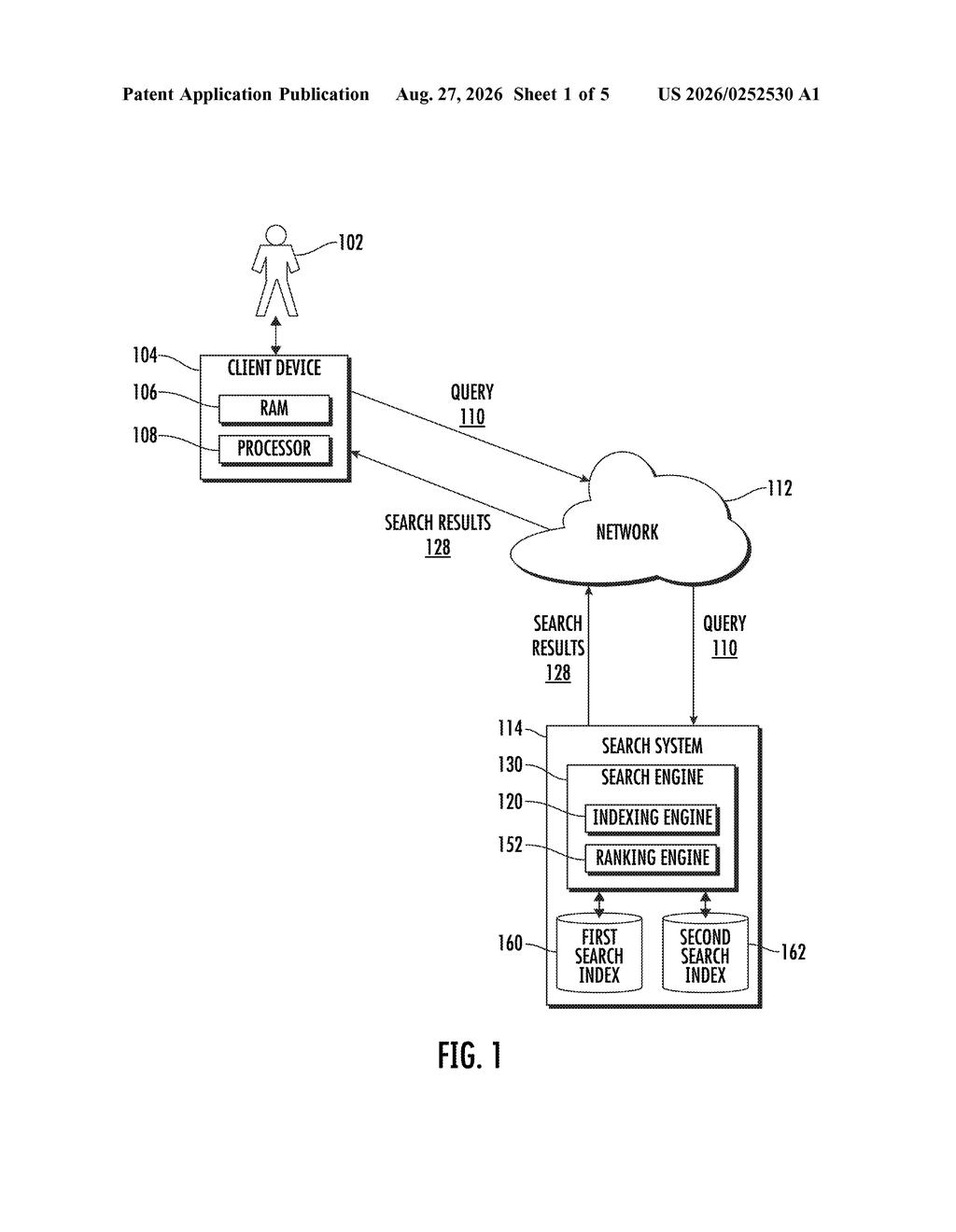
How Google's split index keeps search results current
You're searching for breaking news and the results that pop up are already hours old. That gap exists because search engines store their indexes, the giant lookup tables that connect your query to billions of web pages, in ways that make constant updates expensive.
Google's patent describes splitting that index into two layers. A small, fast layer holds everything added recently. A larger, slower (and cheaper) layer holds the bulk of older data. When you search, the system checks both and merges the answers. Periodically, new items from the fast layer get folded into the slow layer, and the slow layer gets rebuilt with those additions included.
The practical effect: fresher results without the cost of rebuilding the entire index every few minutes. The overlap period, where new items live in both layers at once, means there's no gap in coverage during the handoff.
storing, using a first set of storage media, a first data index that indexes elements of a dataset introduced within a storage period, the first set of storage media having a first latency associated therewith …
Translation: Fast storage keeps track of the newest data items coming in.
Inside the fast-index and slow-index handoff system
The patent describes a bifurcated index architecture, meaning two separate storage systems working in parallel rather than one monolithic index.
- First data index (fast layer): Stored on low-latency media (think RAM or fast SSDs), this index covers only elements added within a recent time window, called the storage period. It's small, quick to query, and updated continuously.
- Second data index (slow layer): Stored on higher-latency, cheaper media (think traditional SSDs or disk), this covers the bulk of the dataset, everything except the most recently added items. It's rebuilt periodically rather than updated in real time.
- Overlap window: During the rebuild cycle, new items exist in both indexes simultaneously. This prevents any query from falling into a coverage gap while the slow index is being recomputed.
The key mechanic is periodic recomputation: at set intervals, the system generates a fresh version of the slow index that incorporates representations of items currently sitting in the fast index. Once the new slow index is ready, the fast index can be trimmed or reset.
This design trades some storage redundancy (items duplicated across both layers during overlap) for a significant reduction in compute cost, because you're only rebuilding the expensive slow index occasionally, not continuously.
… a bifurcated storage architecture that includes a first data index stored by a first set of storage media and a second data index stored by a second set of storage media, where the first set of storage media has a lower latency than the second set of storage media …
Translation: The system splits data across two storage tiers with different speeds.
What this means for the cost of keeping search up to date
For Google, the scale involved is staggering. Rebuilding a search index that covers billions of web pages is one of the most compute-intensive operations in technology. A two-tier system that limits full rebuilds to scheduled intervals, while still serving fresh results from the fast layer between rebuilds, could meaningfully cut the energy and hardware costs behind every Google search, Google Shopping result, or YouTube video recommendation.
Search freshness is also a competitive pressure point: users expect real-time results for breaking news, stock prices, and live events. This architecture directly addresses that without forcing Google to keep the entire index on expensive fast storage. It's the kind of infrastructure filing that sits far from a consumer product announcement but close to the plumbing that determines whether your search results are from five minutes ago or five hours ago, and it fits squarely in the stream of new Big Tech patents focused on making AI-scale data retrieval cheaper to run.
That makes this Google's 612th filing in our Google coverage since May, adding to a body of work that includes radar gesture detection and an AI tool safety gate.
The storage systems this patent describes already exist inside any modern data center: fast drives for quick lookups, slower drives for bulk storage. The patent formalizes a method for coordinating them, which means the heavy hardware investment is already done.
The remaining work is software: teaching the system when to copy data between layers, how long to run both in parallel during a transition, and how to blend results from each without slowing anything down for the person doing the search. If that orchestration logic ships, the everyday result is a search engine that surfaces content published minutes ago at the same speed and cost as content from years ago.
That is a small-sounding change with a very large daily audience.
Get our take in your Top Stories
Liked this breakdown? Add Patentlyze as a preferred source on Google, and our plain-English take shows up more often in your Top Stories the next time Google patent news breaks.
There are more where this came from
We read every patent application Big Tech publishes and send you the ones worth knowing. Plain English, free, every week.
The drawings
5 drawing sheets from US 2026/0252530 A1 · click any drawing to enlarge


Want this weekly breakdown for a company we don't cover? Patentlyze Pro →
Be the first to weigh in