
Samsung Patent Automatically Discards Redundant Video Data to Maintain Wireless Connection Speed
When a wireless network gets congested during an AR or VR session, your device has to make fast decisions about what data to throw away. Samsung's new patent gives phones a structured rulebook for making that call without ruining the experience.
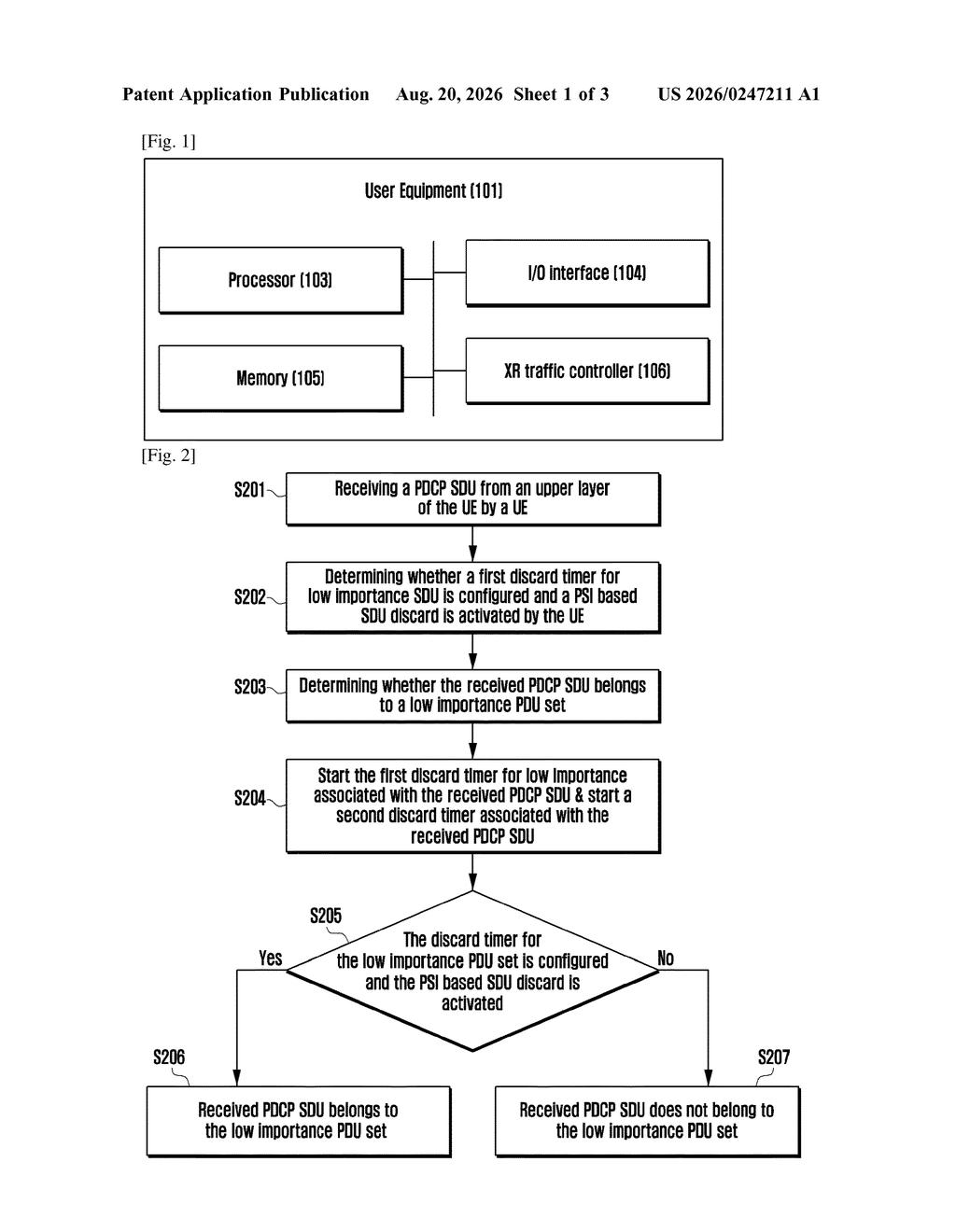
How Samsung's phone decides which AR frames to toss
Imagine you're wearing AR glasses navigating a busy train station, and the network gets congested for a moment. Instead of the whole scene freezing or breaking apart, your device decides which visual pieces matter least and drops only those.
That's the core idea in this Samsung filing. Not all video data in an XR (extended reality, meaning AR and VR) stream is equally important. Some chunks of a frame are labeled as low importance, meaning they add visual detail but aren't critical to understanding the scene. Samsung's system gives the phone a set of countdown timers: if a low-importance data packet hasn't been sent out in time, the phone discards it rather than delaying everything else behind it.
The result is that your AR or VR session stays responsive even when the network hiccups, because the device is tossing out visual garnish instead of the main course.
identifying whether a discard timer for low importance is configured; identifying whether a protocol data unit (PDU) set importance information (PSI) based service data unit (SDU) discard is activated; …
Translation: The system first checks if the rules for dropping unimportant data are currently turned on.
Inside the two-timer discard system for XR data packets
The patent describes a component inside the phone called an XR traffic controller. It sits in the data-processing stack and watches packets called PDCP SDUs (think of these as labeled envelopes of video data moving through the phone's radio layer).
When a packet arrives, the controller checks two things:
- Is this packet part of a low-importance PDU set? (A PDU set is a group of packets that together make up one video frame or frame segment. Low-importance ones carry fine detail, not the base image.)
- Are two specific settings turned on: a discard timer for low-importance data and something called PSI-based SDU discard? PSI stands for PDU Set Importance, a signaling label that tells the phone how much each group of packets matters.
If both settings are active and the packet is low-importance, the controller starts a countdown timer. If that timer expires before the packet can be sent, the controller discards either just that packet or the entire low-importance frame group, depending on how the device is configured.
The two-timer design gives network operators and device makers a dial to tune: aggressive discard (drop whole frame groups early) or conservative discard (drop only the specific expired packet and keep the rest).
… the XR traffic controller ( 106 ) checks if the first discard timer or the second discard timer has expired for the received PDCP SDU. Based on the conditions, it either discards all PDCP SDUs along with corresponding PDCP data PDUs belonging to the low-importance PDU set or selectively discards only the corresponding PDCP data SDUs …
Translation: The software checks time limits to decide whether to delete all or just some of the low priority video data.
What this means for AR and VR headset users on 5G
For anyone wearing an AR headset or using a high-frame-rate VR app on a 5G connection, network wobbles are a real annoyance. The usual result is stuttering or a full stream breakdown because the phone's radio layer doesn't know which data is expendable. A structured discard system means the device can weather brief congestion without the whole experience collapsing, which matters most in crowded venues like stadiums or transit hubs where 5G cells are under pressure.
On the engineering side, this kind of packet-priority logic is exactly what carriers and device makers need to agree on before XR over cellular becomes reliable at scale. Samsung's approach ties into the 3GPP standards work already underway for 5G and the coming 6G era, so this filing is less about one phone feature and more about establishing the rules the whole industry follows. It sits alongside a broader category of interesting tech patents in the 5G XR space that are shaping how wireless standards for immersive media get written.
Samsung's 34th filing we've tracked since May in the AR glasses race builds on earlier applications including one on gaze-based payment scanning and one on skipping redundant sensor calls.
For anyone wearing AR or VR gear on a mobile connection, the moment a bad signal hits is usually the moment the whole experience falls apart at once. Samsung's timer-based discard system gives the phone a configurable hierarchy for which data to drop first under pressure, so the headset can shed low-importance frames in a controlled way before the connection becomes overwhelming. The person wearing the headset gets an experience that degrades gradually and stays usable rather than one that locks up and forces them to pull the device off.
Get our take in your Top Stories
Liked this breakdown? Add Patentlyze as a preferred source on Google, and our plain-English take shows up more often in your Top Stories the next time Samsung patent news breaks.
There are more where this came from
We read every patent application Big Tech publishes and send you the ones worth knowing. Plain English, free, every week.
The drawings
3 drawing sheets from US 2026/0247211 A1 · click any drawing to enlarge


Want this weekly breakdown for a company we don't cover? Patentlyze Pro →
Be the first to weigh in