Samsung
Samsung · AR / VR · Filed Apr 21, 2026 · USPTO published Aug 20, 2026 · Aug 20 release
Samsung Patents AR Glasses That Scan Payment Codes With Your Gaze
Samsung is exploring a way for AR glasses to complete a payment just by tracking where you're looking, no phone or hand gesture required.
- Publication number
- US 2026/0245094 A1(US20260245094A1)
- Applicant
- SAMSUNG ELECTRONICS CO., LTD.
- Filed · Published
- Apr 21, 2026 · Aug 20, 2026
- Inventors
- Wonwoo LEE, Injung LEE, Jeongpyo LEE
- Status when we published
- Waiting for an examiner
- Document
- 20 claims
- US classification
- 705/44
- Parent application
- Continuation of 18/821,488 (filed Aug 30, 2024)(18821488)
How Samsung's eye-tracking payment idea actually works
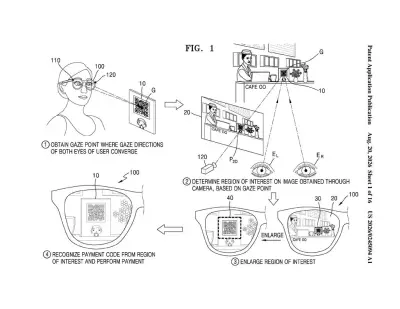
You're standing at a coffee shop counter, AR glasses on, and the barista slides a QR code across the counter. Under this patent, you'd just look at it. The glasses notice where your eyes are pointing, zoom in on that spot, read the payment code, and handle the transaction automatically.
Samsung's system uses sensors inside the headset to track both eyes at once. When your left and right gaze lines meet at a point in the real world, the glasses treat that point as a region of interest. They pull up the camera image, crop and enlarge that zone, then scan it for a payment QR code.
The result is a checkout flow where your hands stay free and you never pull out your phone. That's useful at a busy market stall or anywhere fumbling with a device is awkward. The patent doesn't describe a specific product, but it lays out the core logic for how gaze-driven payments could work on a head-mounted display.
obtain a gaze point at which the user is gazing based on the gaze information obtained by the at least one gaze tracking sensor, enlarge a region corresponding to the gaze point on the image, and recognize a payment code included in the enlarged region on the image.
Translation: The glasses track where you are looking, zoom in on that spot, and automatically identify a payment code.
How the HMD zooms and decodes a code from gaze data
The patent describes a head-mounted display (HMD) that tracks the user's eyes continuously using at least one gaze-tracking sensor. It calculates a gaze point, the spot in space where lines drawn from both eyes converge, which is a standard technique called binocular vergence. That point tells the device roughly where in the scene the user is looking with strong spatial accuracy.
Once the gaze point is established, the processor identifies the corresponding region on the camera's image feed. It then enlarges that region (essentially a digital zoom crop) to make small or distant codes easier to decode. A payment-code recognition step runs on the enlarged patch.
- Gaze tracking: sensors read eye orientation for both eyes simultaneously
- Region-of-interest cropping: the camera frame is sliced to a small window centered on the gaze point
- Code recognition: the enlarged crop is scanned for a QR or similar payment code
- Payment execution: the decoded code triggers a payment, presumably through a connected service
The claim is intentionally broad, covering any HMD that uses gaze data to locate, zoom, and read a payment code. It doesn't specify which payment network, what type of code, or how authentication is handled.
… obtaining, based on gaze information of both eyes of the user, a gaze point where gaze directions of the both eyes of the user converge, wherein the gaze information is obtained using at least one gaze tracking sensor; determine a region of interest corresponding to the gaze point on an image obtained through the camera …
Translation: The device calculates exactly where your eyes are focused by tracking the convergence point of your vision.
What this means for hands-free AR payments
Hands-free payment is a natural fit for AR glasses, which are most useful precisely when your hands are occupied. A construction worker checking a parts invoice, a surgeon reviewing a chart, or a shopper carrying bags would all benefit from a checkout flow that requires nothing more than a glance. This patent stakes out that territory explicitly.
The design does leave open questions worth watching. Eye-tracking at payment moments demands high precision, and a stray glance at the wrong QR code poster could theoretically trigger a purchase. Samsung's filing doesn't detail authentication layers or accidental-activation safeguards, which are the places any real deployment would live or die. AR-payment filings like this one sit alongside other interesting tech patents covering wearable commerce, where the gap between a clever gaze-detection idea and a safe, shippable checkout experience is still significant.
Samsung's 33rd filing we've tracked since May in the AR glasses race adds to a run that includes one on avoiding duplicate sensors and one on floating phone controls into space.
Source: US 2026/0245094 A1 at the USPTO (PDF). Full patent text and figures are in the official publication.
Get our take in your Top Stories
Liked this breakdown? Add Patentlyze as a preferred source on Google, and our plain-English take shows up more often in your Top Stories the next time Samsung patent news breaks.
Add Patentlyze on Google
One click.
There are more where this came from
We read the new patents from Big Tech, carmakers and more and send you the ones worth knowing. Plain English, free, every week.
The drawings · 16 sheets
16 drawing sheets from US 2026/0245094 A1 · click any drawing to enlarge


Show the other 8 sheets


More from Samsung
All 1,662 Samsung patents →
More in AR / VR
All 718 AR / VR patents →
Meta
Meta Patents a Lower-Memory Way to Sharpen AR and VR Display Frames
Sony
Sony Patents Sunglasses That Project Floating Images Into Your Field of Vision
Qualcomm
Qualcomm Patents Real-Time AI Vision Analysis Technology for Smart Glasses Wearables
Qualcomm