
Samsung Patent Merges Mismatched Camera Views Into a Single AR Display
Mixed-reality headsets often carry two or more cameras that see very different slices of the world, and that mismatch breaks depth perception. Samsung's new patent describes a way to stretch a narrower camera's view to match a wider one, then merge the two into a single image that actually understands space.
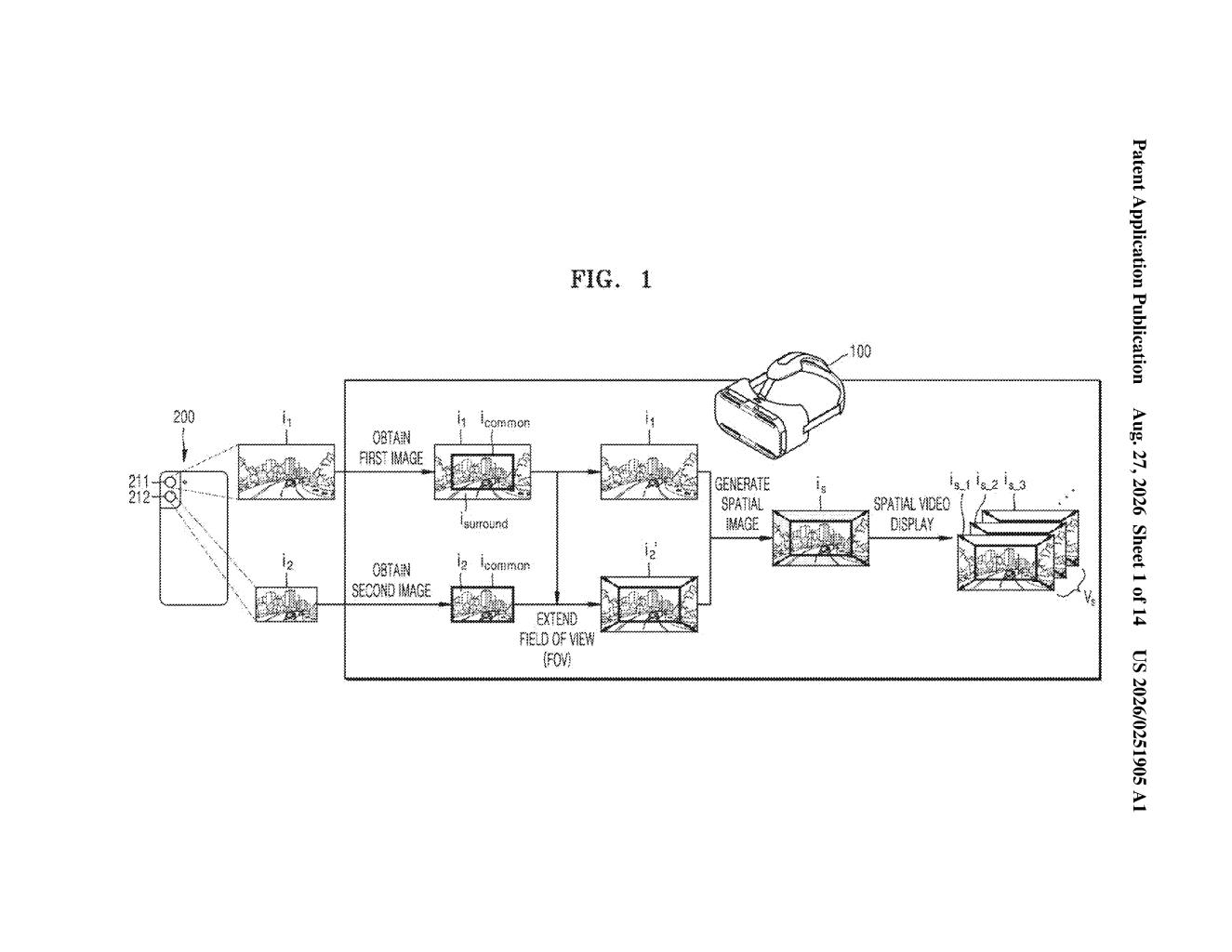
How Samsung stitches together mismatched headset cameras
Most AR and VR headsets today use more than one camera at the same time, and those cameras don't always see the same amount of the world. A wide-angle camera might capture a broad sweep of your living room, while a second camera captures only a narrow slice of the same scene. When a headset tries to combine those two feeds, the mismatch causes problems with depth and distance estimates.
Samsung's patent describes a system that takes the narrower camera's image and stretches its field of view digitally to match the wider camera before the two are combined. Once the views line up, the headset can fuse both images into a single spatial image that includes reliable depth information, so it knows how far away each object in the scene actually is.
The result is that your headset can place virtual objects more accurately in the real world around you, and do so using cameras that weren't designed to match in the first place. That flexibility matters because headset makers often pair very different camera types for cost or performance reasons.
… extend, based on a first FOV of a first image among the plurality of images, an FOV of a second image having a second FOV smaller than the first FOV, obtain a spatial image including depth information by using the first image and the second image with the extended FOV …
Translation: The device digitally stretches a narrow camera view to match a wider one so it can combine them into a single 3D image.
How the FOV extension and depth merge actually work
The patent covers a head-mounted display device that takes in images from two cameras of different types, each capturing a different field of view (FOV) (the angle of the scene a camera can see at once). The first camera has a wider FOV, and the second has a narrower one.
Rather than cropping the wide image down or simply discarding the mismatch, the system extends the narrower image's FOV to match the wider one. The patent does not spell out a single extension technique, but the goal is to produce a second image that covers the same spatial footprint as the first, filling in or inferring what the narrower camera couldn't originally see.
Once both images share the same effective field of view, the device combines them to produce a spatial image with depth information, meaning each pixel carries data about how far away the corresponding real-world surface is. That depth map is what lets the headset correctly anchor virtual content in physical space.
The key claim is broad: any HMD processor that follows this obtain-extend-fuse-display pipeline is covered. That gives Samsung room to apply the approach across different camera hardware combinations without re-filing for each specific sensor pair.
A head-mounted display (HMD) device for processing images obtained from different types of cameras is provided. The HMD device obtains a plurality of images having different fields of view (FOVs) captured by a plurality of cameras of different types …
Translation: This headset uses multiple cameras with different zoom levels to capture a wider view of the world.
What this means for Samsung's AR headset ambitions
For anyone buying or building AR or mixed-reality glasses, accurate depth perception is the difference between virtual objects that look convincingly placed in a room and ones that float or clip awkwardly through surfaces. Getting depth right normally requires cameras that were precisely matched at the factory. Samsung's approach, if it works well in practice, would allow headset designers to pair cheaper or more specialized cameras without sacrificing spatial accuracy.
Samsung is competing in a market where Apple's Vision Pro has set expectations for how well mixed-reality depth should work, and where Meta and others are shipping cheaper alternatives with their own camera trade-offs. A patent like this sits in a broader wave of AR imaging filings tracked across the latest Big Tech patents, where nearly every major player is filing techniques to squeeze better spatial awareness out of imperfect hardware.
That makes this Samsung's 38th filing we've tracked since May in the AR glasses race, following work on avatar emotion reading and hand gesture accuracy.
The problem this patent attacks is real. Headsets routinely carry two or more cameras because no single sensor is ideal for everything: wide-angle lenses see more of the world but distort edges, while narrow high-resolution cameras capture fine detail in a smaller cone. Forcing them to cooperate is genuinely hard, and depth errors are one of the most disorienting things a headset can produce.
The patent's solution is sensible but described at a high level of abstraction. It claims the FOV-extension step without committing to a specific algorithm, which is standard for broad patent filings but means the real technical work may be in unpublished implementation details. Whether Samsung's actual extension method is accurate enough at the edges to produce clean depth maps is the question this document can't answer.
Samsung has shipped AR-adjacent products before but doesn't yet have a publicly announced consumer mixed-reality headset competing directly with the Vision Pro. This filing is a reasonable infrastructure patent for that eventual push, covering a problem any such device would face, without revealing much about how far along the product actually is.
Get our take in your Top Stories
Liked this breakdown? Add Patentlyze as a preferred source on Google, and our plain-English take shows up more often in your Top Stories the next time Samsung patent news breaks.
There are more where this came from
We read every patent application Big Tech publishes and send you the ones worth knowing. Plain English, free, every week.
The drawings
14 drawing sheets from US 2026/0251905 A1 · click any drawing to enlarge


Want this weekly breakdown for a company we don't cover? Patentlyze Pro →
Be the first to weigh in