
Adobe Patents a Text-to-3D System That Lets You Edit Objects by Describing Changes
Adobe is working on a system that takes a plain-text description, builds a 3D object, and then lets you revise it just by typing what you want changed. No mesh editing, no sliders, no manual sculpting.
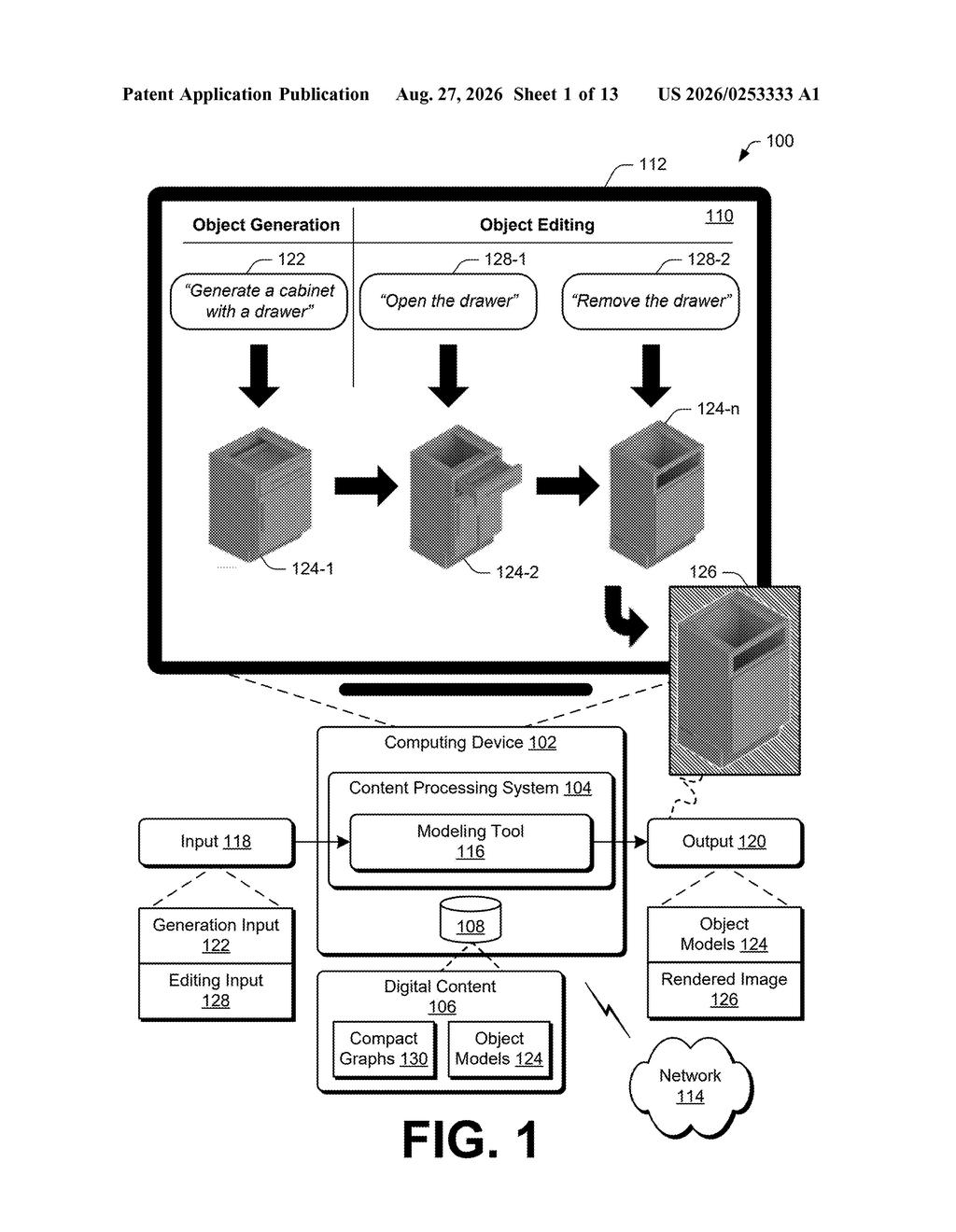
How Adobe's AI turns text descriptions into editable 3D models
Every time a product designer needs a 3D model of, say, a chair, they open a modeling tool and spend hours pushing vertices around. The software has no idea what a chair is supposed to look like. Adobe wants to change that loop entirely.
This patent describes a system where you type a description of an object and an AI generates a 3D model from it automatically. The AI first builds an internal map of the object's properties (shape, parts, how they relate to each other) and then turns that map into actual 3D geometry. If you want to change something, you type the edit and the AI updates the model.
The key idea is that the AI keeps a structured record of what the object is, not just what it looks like. That record gets updated when you make changes, so the whole model stays internally consistent instead of breaking apart the way hand-edited meshes often do.
inputting, by a processing device, an object description into a large language model that creates an initial compact graph representing an initial hierarchy of initial object attributes based on the object description …
Translation: The system turns your text description into a structured blueprint using AI.
How the compact graph maps object traits for 3D generation
The system routes a text description into a large language model (LLM), the same category of AI behind tools like ChatGPT. Instead of producing a written answer, though, the LLM outputs a compact graph, which is essentially a structured data diagram that organizes an object's attributes in a hierarchy (for example: chair has seat, seat has legs, legs are cylindrical, etc.).
A separate generation step reads that graph and produces the actual 3D object model. When the user types an edit, the text goes back into the LLM, which updates the graph to reflect the change, and a new 3D model is generated from the updated graph, replacing the old one.
The hierarchy matters because it preserves relationships between parts. If you change the style of a chair back from modern to Victorian, the system knows that the legs, armrests, and seat are all part of a single object and can update them together rather than treating each piece in isolation.
- Text in: plain-language object description or edit instruction
- Compact graph out: structured map of object parts and their properties
- 3D model out: geometry generated from the graph, replaced cleanly on each edit
… replaces the initial object model with an updated object model generated based on the updated compact graph …
Translation: The software swaps out your old 3D model with a newly revised version based on your latest text instructions.
What this means for designers using Adobe's 3D tools
For designers who use Adobe tools, this patent points toward a workflow where early-stage 3D ideation happens in plain English rather than inside a modeling viewport. That could dramatically lower the barrier for people who understand design but have not mastered tools like Substance 3D Modeler, letting them describe and iterate on objects before handing off to a specialist for finishing.
The graph-based approach is also significant because it gives the AI a stable internal representation to edit against. Most current text-to-3D systems regenerate a model from scratch on each prompt change, which makes iterative editing unpredictable. Adobe's structure here is designed to make changes surgical rather than wholesale. Adobe's 3D generation research sits alongside a wave of similar AI creative-tool filings you can follow through the newest Big Tech patents tracked here.
This is the 16th Adobe filing we've tracked on controllable AI images since May, following earlier applications like one generating themed elements from text and one combining multiple reference photos.
Everything this system needs already exists as software. No new hardware, no specialized sensor, nothing physical has to be invented or manufactured before this could work. The real question is whether a language model can turn a plain text description into a structured enough blueprint to drive a coherent 3D object.
If it can, the edit loop described here is elegant: describe something, get a model, refine it with a follow-up sentence in plain language. The shortest path to a product would be a text-to-3D feature inside an existing creative tool, and how quickly that ships depends almost entirely on whether the output quality holds up, not on anything architecturally missing from what this document describes.
Get our take in your Top Stories
Liked this breakdown? Add Patentlyze as a preferred source on Google, and our plain-English take shows up more often in your Top Stories the next time Adobe patent news breaks.
There are more where this came from
We read every patent application Big Tech publishes and send you the ones worth knowing. Plain English, free, every week.
The drawings
13 drawing sheets from US 2026/0253333 A1 · click any drawing to enlarge


Want this weekly breakdown for a company we don't cover? Patentlyze Pro →
Be the first to weigh in