
Nvidia Patents a Selective Restart System for Autonomous Vehicles
When a piece of software in a self-driving car needs to restart, should the whole vehicle system pause with it? Nvidia's new patent says no, and lays out a method to keep critical functions running while only the affected part resets.
What Nvidia's selective restart system actually does
You're riding in a self-driving vehicle and, somewhere in the background, a software module crashes and needs to restart. Without a plan, that hiccup could ripple outward and pause other systems, including ones responsible for keeping you safe.
Nvidia's patent describes a way to think carefully before allowing any restart to proceed. The system checks what type of function is restarting, looks at which other functions would be affected, and then decides how to handle the restart so the disruption stays as small as possible.
The idea is that not all software is equal inside an autonomous vehicle. A navigation update and a collision-detection module are very different things, and they shouldn't be treated identically when something goes wrong. Nvidia wants the car to know that difference automatically.
identifying a restart of a first functionality for a first type; determining an impact of the restart on a second functionality of a second type different from the first type; and controlling the restart of the first functionality based at least on the impact of the restart …
Translation: The system checks how restarting one car feature will affect other features before deciding if the restart should proceed.
How Nvidia's system weighs restart impact across function types
The patent describes a software management method built specifically for autonomous or semi-autonomous systems, the kind found in self-driving cars or robotic platforms.
At its core, the method has three steps:
- Identify a restart: The system detects that a software function (called a "first functionality") needs to restart, and knows what category or type that function belongs to.
- Measure the impact: Before anything reboots, the system calculates how the restart would affect other software functions of different types. Think of it like checking whether one circuit tripping would cut power to an unrelated room.
- Control the restart: Based on those two factors, the restart is managed, not just allowed to happen freely. It might be delayed, isolated, or sequenced differently depending on what the impact assessment found.
The key technical distinction is the type classification. Functions are sorted into types, and a restart is evaluated across type boundaries. This classification is what lets the system treat a low-stakes process differently from one tied directly to vehicle safety. The patent does not fully enumerate what the types are, leaving that as an implementation detail, but the framework for acting on those distinctions is what Nvidia is claiming here.
The systems and methods may be configured to increase availability of functionalities associated with a system through controlling restarts of functionalities.
Translation: The goal of this technology is to keep a vehicle's various software systems running more reliably by managing how they reboot.
What this means for self-driving software reliability
For anyone who has ever had their phone's GPS app crash while navigating, the frustration of one software failure bleeding into another is familiar. In a self-driving vehicle, that kind of cascade goes beyond annoyance and becomes a safety question. A system that can surgically restart only what is broken, while keeping safety-critical processes intact, is a meaningful engineering goal.
Nvidia already supplies the core chips and software platforms that many autonomous vehicle developers build on, so a patent in this space fits directly into that product line. Automotive reliability standards are strict, and methods that keep systems available during partial failures are exactly the kind of infrastructure work those standards demand. This selective-restart patent for autonomous systems sits comfortably within the latest Big Tech patents covering fault tolerance and safety-critical computing, a segment where filings have grown noticeably denser over the past several quarters.
That makes this Nvidia's 41st filing we've tracked since May in our self-driving sensing race watch, adding to work like mapping road hazards point by point and teaching cars what sensors miss.
Claim 1 is strikingly broad. It covers any method that identifies a restart, measures the impact on a differently-typed function, and then controls that restart based on those inputs. There is no requirement that this happen in a vehicle, on a specific chip, or using any particular detection mechanism. That scope is wide enough to cover a lot of ordinary software watchdog and dependency-management systems that already exist.
The phrase "different from the first type" does at least require that the impact analysis cross type boundaries, which is a small narrowing. But the claim does not define what a "type" is, how impact is measured, or what "controlling" the restart means in practice. That vagueness could make the claim easier to write around than it first appears, or it could make it easier to assert broadly, depending on how examiners read it.
In practice, this reads like a foundational claim that Nvidia would use to anchor a larger family of more specific patents. By itself, it is more of a placeholder for a framework than a description of a finished system.
Get our take in your Top Stories
Liked this breakdown? Add Patentlyze as a preferred source on Google, and our plain-English take shows up more often in your Top Stories the next time Nvidia patent news breaks.
There are more where this came from
We read every patent application Big Tech publishes and send you the ones worth knowing. Plain English, free, every week.
The drawings
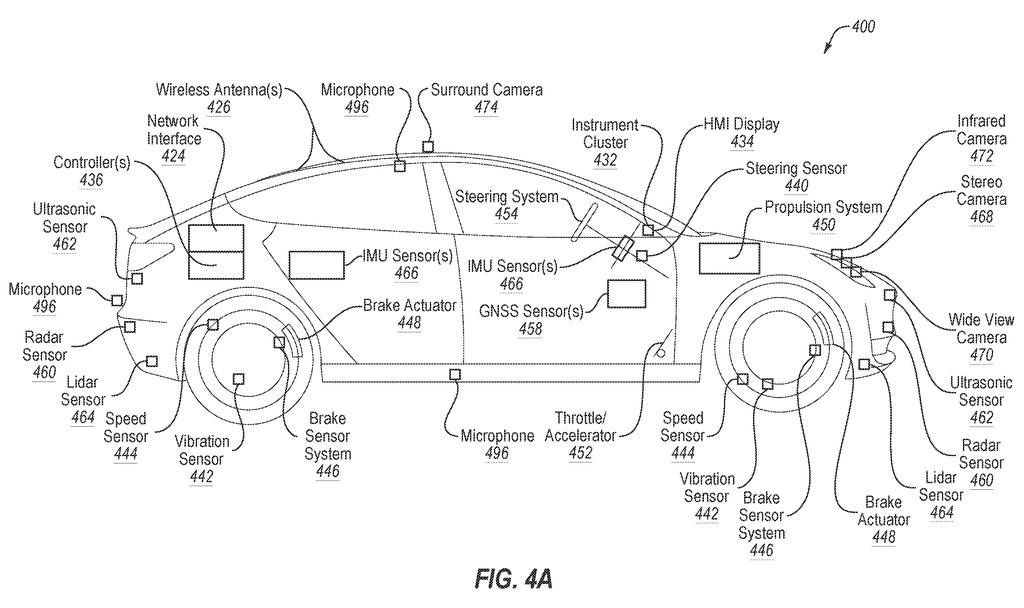
9 drawing sheets from US 2026/0252449 A1 · click any drawing to enlarge


Want this weekly breakdown for a company we don't cover? Patentlyze Pro →
Be the first to weigh in