
Samsung Patents a Way to Send Wireless Audio Over Two Separate Bluetooth Streams at Once
Wireless audio cutting out mid-song is one of those small annoyances that no one has fully solved. Samsung's latest patent filing takes a structural approach: instead of sending all audio packets through one Bluetooth channel, it splits them across two separate streams that can each be tuned independently.
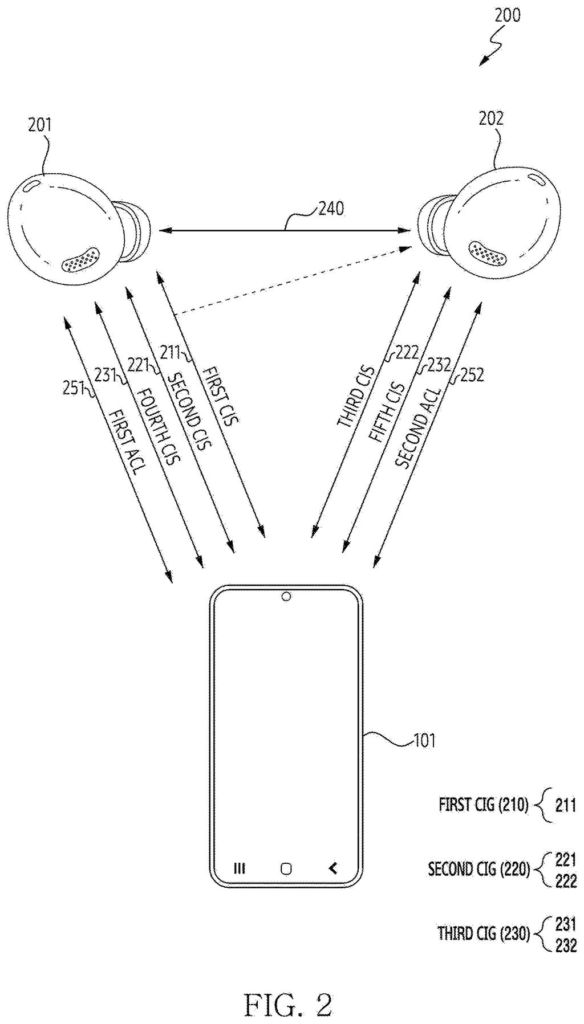
How Samsung's dual-stream Bluetooth audio actually works
A phone sits on a desk, streaming music to a pair of wireless earbuds. The connection looks solid, but the moment you walk near a microwave or a crowded Wi-Fi router, audio packets get dropped and you hear a glitch.
Samsung's idea is to run two separate Bluetooth pipelines to your earbuds at the same time, each with its own settings for things like how often packets are sent and how aggressively errors are corrected. That way, if one pipeline is struggling, the other can be tuned differently to compensate.
Think of it like sending an important document both by email and by text message, with each delivery method configured for the conditions it's working in. The patent covers the logic that decides what settings each pipeline gets and how packets flow through both of them.
generate a first connected isochronous group (CIG) event and a second CIG event to be used to output audio using an external electronic device …
Translation: The device sets up two separate wireless audio connection groups for an external speaker or headphones.
How the two CIG events carry packets differently
The patent centers on a Bluetooth feature called Connected Isochronous Groups (CIGs), which is part of the Bluetooth Low Energy (BLE) audio spec. A CIG is essentially a scheduled time slot during which audio data gets transmitted; the word "isochronous" just means the data has to arrive at regular, time-sensitive intervals, the way audio must.
Normally, a device sets up one CIG with a fixed set of parameters and pushes all audio packets through it. Samsung's approach creates two CIG events, each carrying audio packets under a different transmission parameter set. Parameters can include things like the packet interval (how often data is sent), the number of retry attempts if a packet is lost, and the maximum size of each packet.
Each CIG contains one or more Connected Isochronous Streams (CIS), which are the actual per-device channels. So the phone might send one stream to the left earbud and another to the right, or it could send both streams to the same device under different reliability settings.
- First CIG: uses transmission parameter set A (for example, faster interval, fewer retries)
- Second CIG: uses transmission parameter set B (for example, slower interval, more retries)
- The phone manages both simultaneously, giving it more flexibility than a single fixed channel allows
… transmit a first packet according to a first transmission parameter, set for the first CIG event using the communication circuitry, to the external electronic device through a connected isochronous stream (CIS) event in the first CIG event …
Translation: It sends the first audio stream using one set of connection settings.
What this means for Galaxy Buds users and audio reliability
For anyone who has ever had one earbud drop out while the other kept playing, this kind of architecture is directly aimed at that failure. By decoupling the two audio pipelines, Samsung's approach lets the device respond to interference or link-quality differences on each side independently, rather than forcing both channels to share the same settings regardless of conditions.
Bluetooth audio reliability has been a persistent weak spot for wireless earbuds from every major manufacturer, and new Big Tech patents in the wireless audio space are increasingly focused on squeezing more dependability out of the same radio spectrum. Whether Samsung builds this exact mechanism into Galaxy Buds hardware is an open question, but the filing shows the company is thinking at the protocol level about a problem that most people experience as a simple, annoying glitch.
That makes this Samsung's 21st filing in the Audio patents we've tracked since May, a group that includes one on filtering casual speech and one on distance-aware speakers.
The moment wireless earbuds skip or cut out, it usually happens in exactly the environment where it matters most: a crowded commute, a loud coffee shop, a call you cannot afford to fumble. Samsung's patent tackles that specific failure by sending audio through two separate delivery schedules at once, each tuned differently, so the sound arrives even when one path gets disrupted.
For the person wearing the earbuds, success looks like nothing at all. No dropout, no robotic voice artifact, no reaching to adjust anything. That invisible non-event is the actual improvement.
How much this matters in practice depends on how carefully it gets dialed in during real product development. The wireless foundation it relies on is already built into current hardware, which shortens the distance between a patent filing and something a person can actually put in their ears.
Get our take in your Top Stories
Liked this breakdown? Add Patentlyze as a preferred source on Google, and our plain-English take shows up more often in your Top Stories the next time Samsung patent news breaks.
There are more where this came from
We read every patent application Big Tech publishes and send you the ones worth knowing. Plain English, free, every week.
The drawings
29 drawing sheets from US 2026/0255140 A1 · click any drawing to enlarge


Want this weekly breakdown for a company we don't cover? Patentlyze Pro →
Be the first to weigh in