
Samsung Patents a Projector That Corrects Its Own Faulty Touch Detection Zones
Touch-sensitive projectors sound great in theory, but they fall apart when stray reflections trick the sensor into thinking you're touching something you're not. Samsung's new patent addresses exactly that failure mode automatically.
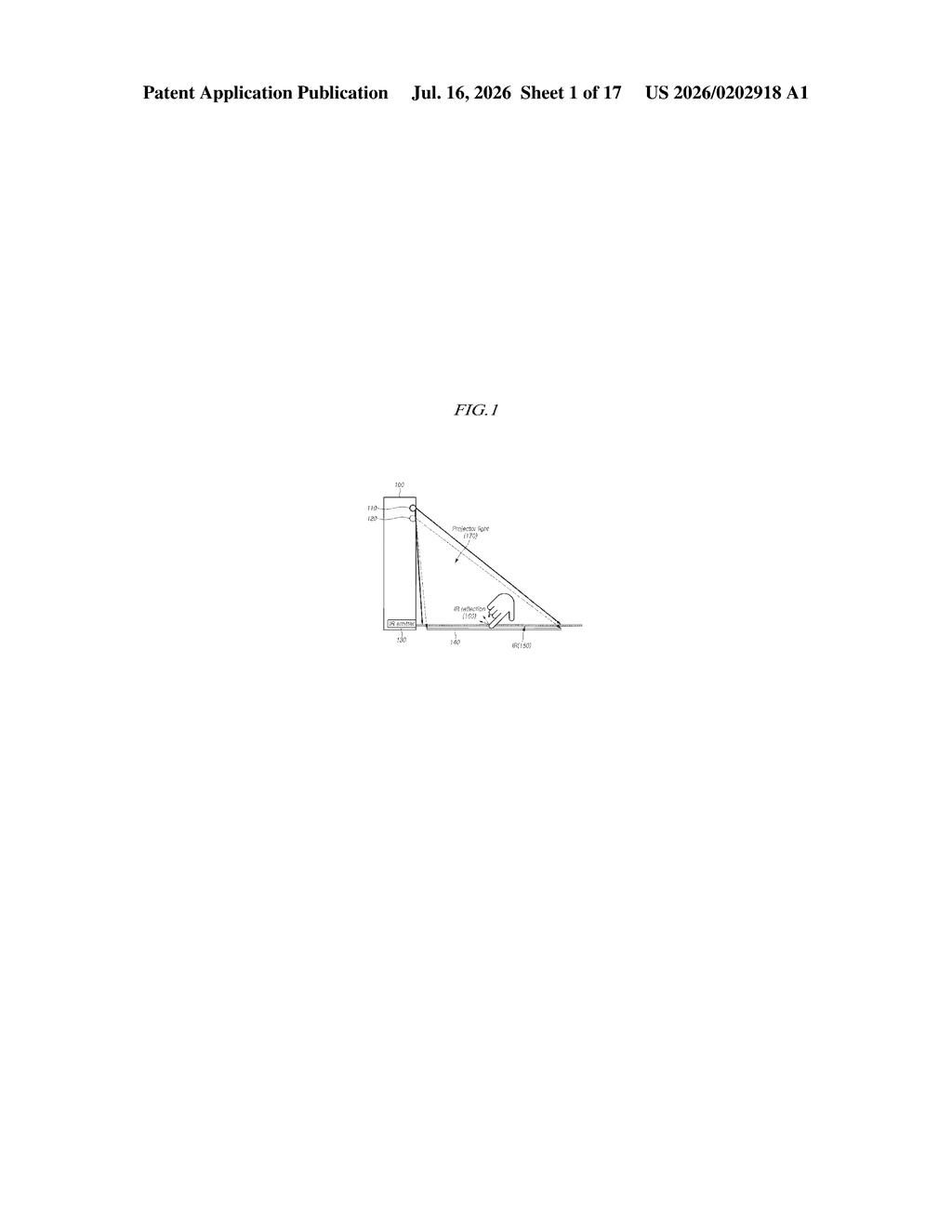
How Samsung's projector keeps its touch zone accurate
Imagine a projector that throws an image onto a wall and also lets you "touch" that image like a screen. To do that, it shoots out an invisible beam of infrared light across the surface. When your finger breaks that beam, the projector registers a touch. The problem: glossy surfaces, mirrors, or nearby objects can bounce that infrared light back even when nobody is touching anything, causing phantom inputs.
Samsung's patent describes a projector that notices when it's getting those false reflections and physically corrects itself. It monitors the infrared zone it creates, and if it detects an unexpected reflection, it automatically tilts or raises the infrared emitter until the problem goes away.
The result is a touch-sensitive projection system that can recalibrate on its own instead of requiring you to manually fiddle with settings every time the environment changes.
How the IR angle-adjustment system works
The patent covers a projector with a built-in infrared (IR) emitter that creates a thin horizontal sheet of IR light across whatever surface the projector is aimed at. That invisible layer acts like a trip wire: break it with your finger, and the projector treats it as a touch input.
The core problem this solves is spurious IR reflection (stray light bouncing back from surfaces that aren't a human finger). The system works like this:
- The projector continuously monitors its IR irradiation area using at least one sensor.
- In a specific operating mode, it checks whether any reflection is coming back when it shouldn't be.
- If a false reflection is detected, the processor instructs the IR emitter to tilt its angle or change its physical height until the reflection disappears.
That adjustment loop means the projector can adapt to different room surfaces, furniture arrangements, or lighting conditions without manual intervention. The claim also covers adjusting the height of the emitter, suggesting the hardware may include a motorized mount rather than just a software tweak.
What this means for wall and floor projectors
Interactive projectors have been a niche product for years partly because their touch detection is unreliable in real homes and offices. A glossy floor, a glass coffee table, or even a shiny whiteboard can fool the IR sensor constantly. Samsung's auto-correction loop could make the technology genuinely usable without a calibration ritual every time you rearrange the room.
For you as a consumer, this matters most if you've ever been frustrated by a smart projector that registers phantom taps or stops responding to real ones. It also signals that Samsung is still investing in the category of projectors that double as interactive displays, which puts them in competition with products like Samsung's own The Freestyle and similar short-throw units already on the market.
This is a sensible engineering fix for a real and well-documented problem with IR-based touch projectors. It's not flashy, but false-touch detection has been a persistent complaint in the interactive projector category for over a decade. An automatic correction system is exactly the kind of unglamorous improvement that separates a product people actually use from one that gets returned after a week.
There are more where this came from
We read every patent application Big Tech publishes and send you the ones worth knowing. Plain English, free, every week.
Want this weekly breakdown for a company we don't cover? Patentlyze Pro →
Be the first to weigh in