
Samsung Patents a Phone That Adjusts Nearby Speakers Based on How Far Away You Are
Samsung is working on a phone that doesn't just connect to a wireless speaker, it measures how far away that speaker is and adjusts its output accordingly, all without you touching a volume knob.
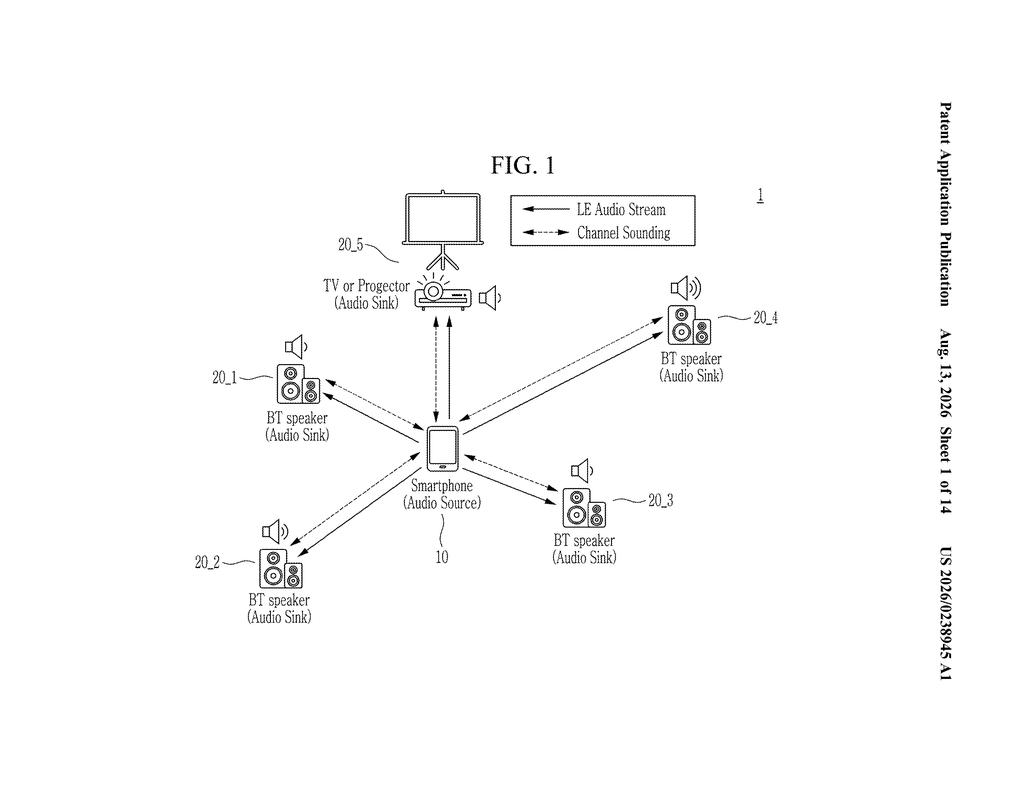
How Samsung's distance-aware speaker control works
A speaker sits across the room, blasting music meant for someone standing right in front of it. For everyone else in the room, it's either too loud or weirdly unbalanced.
Samsung's patent describes a phone that solves this by doing a little geometry before it starts playing audio. When your phone connects to an external speaker wirelessly, it asks that speaker for its technical profile (basically its specs and capabilities), then figures out how far away it is. Using both pieces of information, it generates a control signal to tell the speaker how to adjust its output before a single note plays.
The phone also pulls the audio file from its own storage and converts it into the right format for that specific speaker. The whole handshake happens automatically, so the volume and output are tuned to your distance from the speaker without you doing anything manually.
… calculate a distance to the external device, generate a control signal for controlling an output of the external device based on the profile information and the distance …
Translation: The phone figures out how far away a speaker is and decides how to adjust the sound output.
How the device measures distance and shapes the audio signal
The patent describes a user device (most likely a phone) with processing circuitry that runs a structured sequence when connecting to an external speaker or audio device over a wireless link.
- Connection request: The device initiates a wireless pairing with the external speaker.
- Profile request: It asks the speaker for its profile information, essentially a description of the speaker's capabilities, power output, and supported audio formats.
- Distance calculation: The device computes how far away the speaker is. The patent does not specify the exact method, but wireless signal strength (RSSI) or time-of-flight measurements are common approaches for this kind of calculation.
- Control signal generation: Using both the speaker's profile and the calculated distance, the device generates a control signal that tells the speaker how to modulate its output, volume, equalization, or both.
- Audio conversion and transmission: The device loads the audio from memory, converts it into the format the speaker expects, and sends it over.
The key insight is that the control signal is generated before or alongside audio transmission, meaning the output is pre-tuned to the listener's position rather than adjusted after the fact.
… generate a second request for receiving profile information of the external device, calculate a distance to the external device …
Translation: The device asks nearby speakers for their details and measures the physical gap between them.
What this means for wireless speaker setups at home
For most people, getting a wireless speaker to sound right involves a lot of manual fiddling: adjusting volume by ear, repositioning the speaker, or using a separate app. A system that reads the gap between device and speaker and compensates automatically removes a genuinely annoying friction point, particularly in living rooms or open spaces where people move around.
The broader question is what the design trades away to get there. Distance estimation over wireless signals is notoriously imprecise in cluttered indoor environments, so a system that acts on that estimate could over-correct just as easily as it gets things right. Still, as audio and phone hardware keep getting tighter together, this kind of automatic spatial calibration is a reasonable direction to pursue, and it fits alongside the new Big Tech patents in the wireless audio space that are redrawing what a phone is expected to do on its own.
The design trades accuracy for convenience, and that trade has a visible weak point: indoor distance measurement using wireless signals is unreliable enough that the control signal could just as easily mis-tune a speaker as it calibrates one correctly. The value of the patent depends almost entirely on how Samsung solves the distance-sensing step, which the filing leaves vague. If the sensing is coarse, you get a system that confidently makes the wrong adjustment, which is worse than leaving volume control manual.
There are more where this came from
We read every patent application Big Tech publishes and send you the ones worth knowing. Plain English, free, every week.
The drawings
14 drawing sheets from US 2026/0238945 A1 · click any drawing to enlarge


Want this weekly breakdown for a company we don't cover? Patentlyze Pro →
Be the first to weigh in