
Sony Patents Sunglasses That Project Floating Images Into Your Field of Vision
Sony is working on AR glasses that look like regular sunglasses, using invisible ultraviolet light and microscopic phosphor dots to paint images directly onto a curved lens. It's a genuinely different approach to one of AR's oldest problems: making the display hardware disappear.
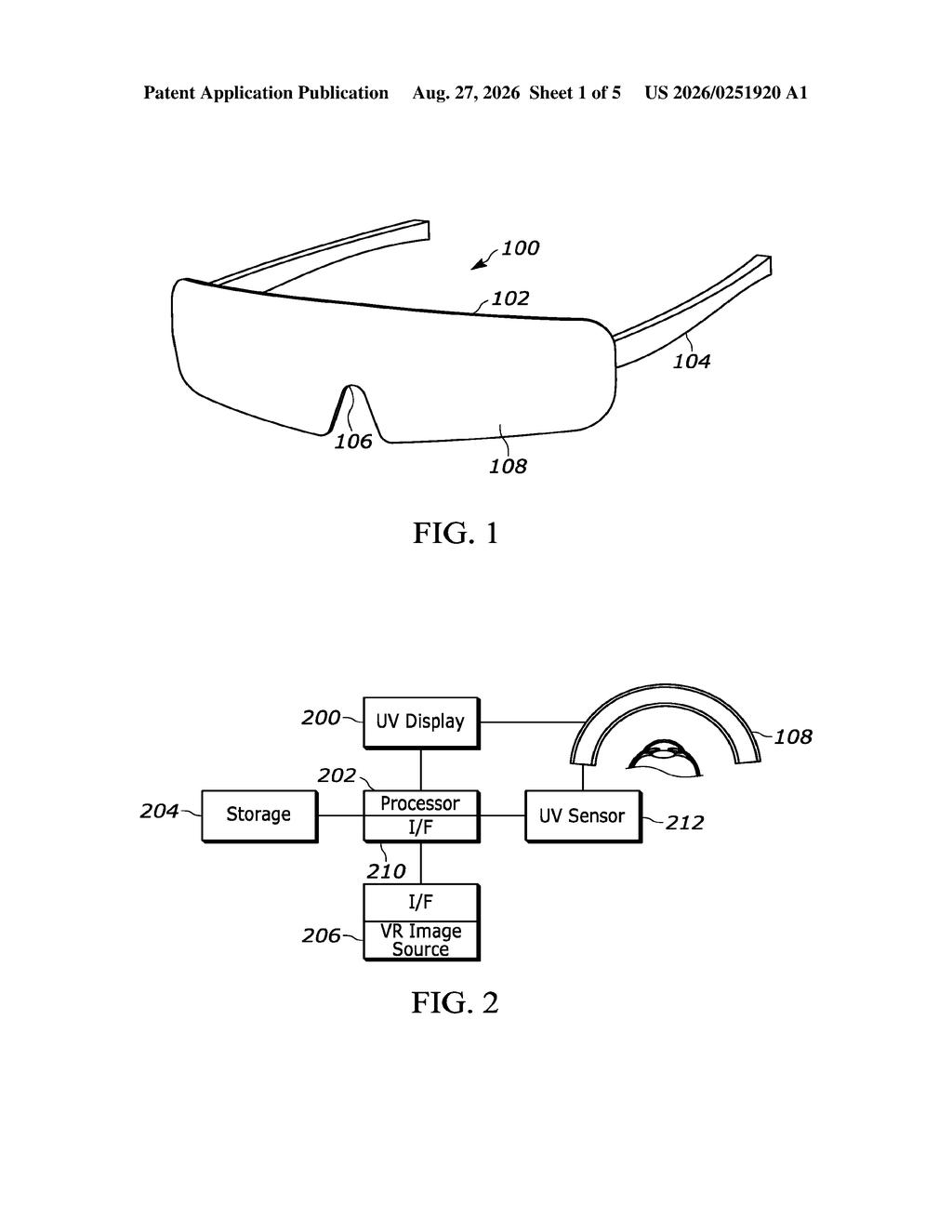
What Sony's UV-powered AR sunglasses actually do
You're walking down the street wearing what looks like a normal pair of sunglasses, but directions, messages, and other digital information float in front of you. That's the scenario Sony is trying to make real with this patent.
The system works by shining invisible ultraviolet light inside the curved lens of the glasses. Tiny phosphor dots (the same kind of material that makes old TV screens glow) are embedded in the lens and convert that invisible UV light into the visible colors that form an image. Because the UV emitters and the image-making dots are all hidden inside the lens itself, you don't need a bulky projector clipped to the side of the frame.
The result, at least on paper, is a pair of AR glasses that could be thin and light enough to actually wear all day, with a wide field of view. Sony hasn't announced a product, but the patent lays out a complete optical design for how such a device could work.
… at least one conversion element in the waveguide and disposed to receive UV light from the UV emitter, the conversion element being configured to convert UV light into visible light that propagates through one or both UV light-reflecting coatings and/or films and that impinges on the eye of a wearer of the waveguide.
Translation: Invisible ultraviolet light is turned into visible images that shine directly into the user's eyes.
How UV light and phosphor dots build the AR image
The patent describes a curved waveguide (a lens that also acts as a light pipe, bouncing light around inside it) shaped like a standard pair of sunglasses. Inside this waveguide, two layers of special coatings reflect UV light but let visible light pass straight through.
A small UV emitter fires invisible ultraviolet light into the waveguide. That light bounces between the two UV-reflecting coatings and travels across the lens until it hits an array of micro phosphor discs. These are pinhole-sized dots of phosphor material, each paired with a tiny micro lens the same size. The phosphor converts the UV light into a specific color of visible light, and the micro lens focuses it toward the wearer's eye.
Because UV light does not pass through the reflective coatings but visible light does, the system keeps the image-forming process contained inside the waveguide while still letting the outside world through. This means the glasses are see-through for real-world light while still projecting a virtual image.
Key components in the design:
- Curved waveguide shaped like sunglasses
- Two UV-reflective coating layers to contain the light signal
- UV emitter (the light source, kept small)
- Array of phosphor micro-discs to convert UV to visible color
- Matching micro-lens array to direct light to the eye
A sunglasses-style head worn display includes a curved waveguide with double reflective coatings/films and containing an array of light wavelength converting phosphor pinhole-size discs covered with pinhole-sized micro lenses, presenting a wide FOV virtual image for AR/VR.
Translation: The glasses use tiny phosphors and lenses hidden inside the curved lenses to project digital displays.
What this means for the future of AR glasses design
The hardest part of building AR glasses has always been the optics. Most current approaches require a projector or a separate screen that bounces light toward the eye through a combiner, which is why AR glasses today tend to be thick, heavy, or have a tiny field of view. Sony's design tries to sidestep that by making the lens itself the display, eliminating the need for a separate projector module.
This patent is still squarely in the research-and-design phase. UV emitters powerful enough to drive an array of phosphor dots at display brightness, at sunglasses scale, don't exist yet as commercial components. The micro-lens and phosphor array would also require precise manufacturing that isn't standard today. But the optical logic in the filing is sound, and it fits into the broader push across the latest Big Tech patents in AR optics, where companies are racing to find a waveguide design thin enough to actually wear.
That makes this Sony's 17th filing we've tracked since July in the AR glasses race, a run that includes work on keeping holograms sharp and fixing gaze detection.
Sony is describing glasses where the lenses themselves generate the image, using tiny light-converting dots embedded directly in curved glass. That requires a light source small enough to hide inside a glasses frame yet powerful enough to drive those dots at screen quality, and that physical component does not exist at consumer scale today.
Everything downstream of that missing piece, the dot arrays, the curved glass, the optics, stays theoretical until someone solves the miniature light source problem first. That is a materials and physics challenge, not a coding project, and this document leaves it explicitly unsolved.
The gap between this design and a pair of glasses on a store shelf is measured in years and open questions, most of them outside Sony's direct control. The patent stakes out a promising direction, but the shortest path to a real product runs straight through hardware that has not been invented yet.
Get our take in your Top Stories
Liked this breakdown? Add Patentlyze as a preferred source on Google, and our plain-English take shows up more often in your Top Stories the next time Sony patent news breaks.
There are more where this came from
We read every patent application Big Tech publishes and send you the ones worth knowing. Plain English, free, every week.
The drawings
5 drawing sheets from US 2026/0251920 A1 · click any drawing to enlarge


Want this weekly breakdown for a company we don't cover? Patentlyze Pro →
Be the first to weigh in