
Qualcomm Patents Real-Time AI Vision Analysis Technology for Smart Glasses Wearables
Qualcomm has filed a patent for smart glasses that can watch the world around you, compress what they see into compact data packets, and run AI analysis on that footage without sending it to the cloud.
What Qualcomm's smart glasses vision encoding actually does
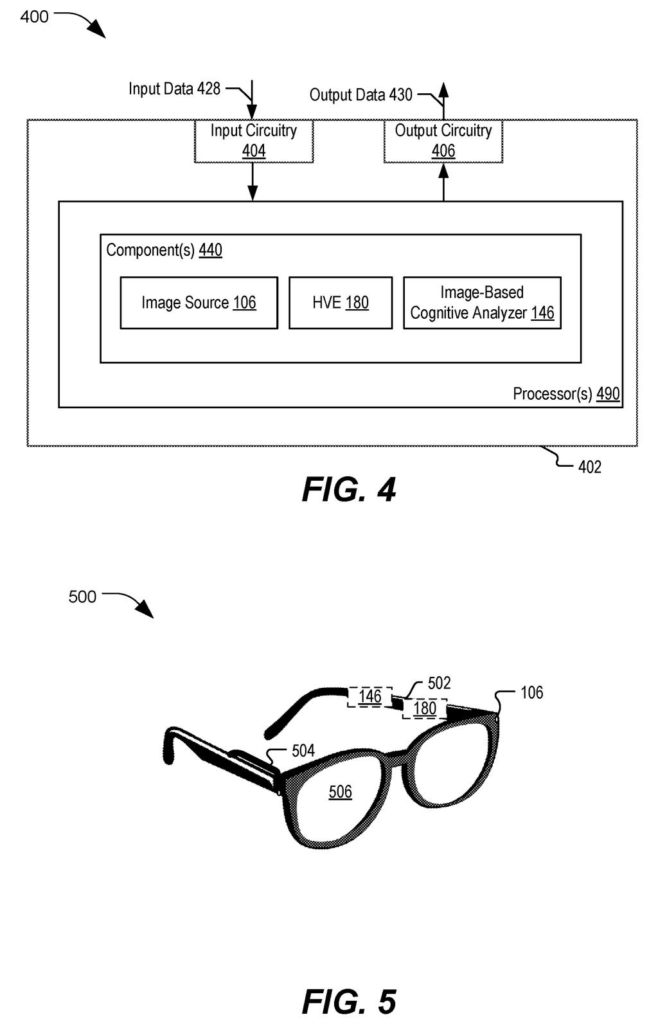
Ever tried to describe a busy street scene to someone over the phone? You quickly realize that raw detail is too much to transmit, so you summarize. Qualcomm's patent does something similar for smart glasses: instead of processing full-resolution video frames, the glasses squeeze each frame down into a compact representation before running AI analysis on it.
The core idea is that your glasses are continuously looking at the world through a camera, and a specialized chip inside compresses each video frame into a smaller data package called image latent data. Those compressed snapshots are stacked up over time to give the AI a running picture of what you've been looking at, without overwhelming the tiny battery and processor inside the glasses.
The goal is cognitive analysis, which is a technical way of saying the glasses can understand scenes, recognize objects, track context, or answer questions about what they see, all on the device itself, without an internet connection required.
process, at a hierarchical vision encoder (HVE), a first image frame of a sequence of image frames to generate first image latent data, wherein the first image latent data corresponds to a downscaled representation of the first image frame …
Translation: The glasses use a specialized encoder to turn video frames into smaller, simplified data files for easier processing.
How the hierarchical encoder compresses frames for on-device AI
The patent describes a hierarchical vision encoder (HVE), a type of image-processing system that breaks a video frame down in stages, extracting increasingly abstract features at each level. Think of it like summarizing a book: first you summarize paragraphs, then chapters, then the whole narrative. The result is a compact mathematical description of the image, not the image itself.
Each compressed frame becomes a set of image latent data (essentially a dense numerical fingerprint of what the camera saw). The device stores these fingerprints in memory across a sequence of frames, building up a running log of visual context over time.
That accumulated log, called image analysis data in the patent, is what gets fed into the cognitive analysis system. Instead of processing raw video, the AI model works from this compressed history. That keeps computational load low and makes it feasible to run on a wearable device with limited battery and processing power.
The claim is deliberately hardware-specific: it is tied to a glasses device with memory and one or more processors. The patent covers the pipeline from raw frame capture, through hierarchical compression, to accumulation of that compressed data for downstream AI tasks.
… add the first image latent data to image analysis data used to represent the sequence of image frames for image-based cognitive analysis.
Translation: The device combines these simplified images into a data stream that allows the glasses to understand what the user is seeing.
What this means for AI-powered wearable glasses
For anyone watching the smart glasses market, this patent signals that Qualcomm is working on the core AI processing architecture that would power always-on vision features in a wearable form factor. Running vision AI on a device as small as a pair of glasses is an engineering problem with no easy answers: the battery is tiny, the chip has to stay cool, and privacy concerns make cloud-streaming every frame politically and commercially difficult. A compression-first approach directly addresses all three of those constraints.
Qualcomm supplies chips to a wide range of device makers, so a patented vision-encoding architecture like this could show up across multiple glasses products rather than just one brand's hardware. The AR glasses space is attracting heavy investment and patent activity right now, and this filing joins a growing body of new Big Tech patents focused on making AI wearables work without a constant cloud connection.
This is the 30th Qualcomm filing we've tracked since July in the AR glasses race, building on earlier applications like keeping two spots sharp in VR and smooth uninterrupted glasses video.
Claim 1 covers any glasses device that compresses incoming video frames through a specific type of encoder and then feeds those compressed frames into an AI analysis system. The claim does not specify what the AI must analyze, how much compression must occur, or what counts as enough "levels" to make an encoder hierarchical, which means the claim is deliberately wide.
That width has real consequences. Any glasses maker building a pipeline where images are shrunk before being analyzed by AI would fall inside this claim if it were granted, because the claim text requires only those two steps and a glasses form factor.
The filing is essentially a boundary marker around a broad category of wearable AI vision, drawn early enough that the specific products do not need to exist yet to make the claim meaningful.
Get our take in your Top Stories
Liked this breakdown? Add Patentlyze as a preferred source on Google, and our plain-English take shows up more often in your Top Stories the next time Qualcomm patent news breaks.
There are more where this came from
We read every patent application Big Tech publishes and send you the ones worth knowing. Plain English, free, every week.
The drawings
10 drawing sheets from US 2026/0253390 A1 · click any drawing to enlarge


Want this weekly breakdown for a company we don't cover? Patentlyze Pro →
Be the first to weigh in