Sony
Sony · Display · Filed Dec 19, 2024 · USPTO published Aug 20, 2026 · Aug 20 release
Sony Patents a Way to Keep Holograms Sharp at Any Depth
Holograms look amazing in movies, but real ones fall apart the moment you try to project them at different depths. Sony's new patent targets exactly that problem.
- Publication number
- US 2026/0246910 A1(US20260246910A1)
- Applicant
- SONY GROUP CORPORATION
- Filed · Published
- Dec 19, 2024 · Aug 20, 2026
- Inventors
- MASATO AKAO, SHIHHAO WEN
- Status when we published
- Examiner raised objections; the company can respond
- Document
- 15 claims
- US classification
- 348/51
- Examiner
- KURIEN, CHRISTEN A (Art Unit 2421)
- Parent application
- National Stage Entry of PCT/JP2023/022635 (filed Jun 19, 2023)(PCTJP2023022635)
How Sony fixes blurry holograms at different distances
Every time a holographic display tries to show you something floating far away or up close, it risks turning a sharp 3D image into a blurry mess. That is because the light-bending components that build the image have one narrow sweet spot, and anything outside it looks terrible.
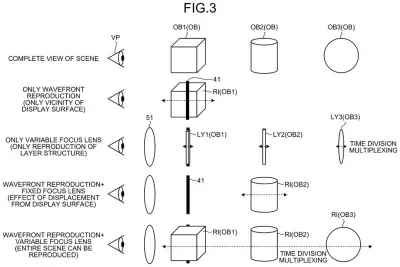
Sony's patent tackles this in two steps. First, a control system works out that narrow zone where the image will look sharp enough to pass a quality threshold. It builds the hologram inside that zone, even if that is not where the object is supposed to appear. Then a separate set of lenses physically moves the image to the correct floating position, so it looks like it belongs exactly there.
The result: a sharp hologram at the right apparent distance, without the display needing to do something that is currently very hard, which is rebuild a perfect image across every possible depth at once.
… reproduces an object area to be reproduced in an appropriate range in a depth direction in which range reproduction image quality equal to or higher than an image quality allowable level is acquired; …
Translation: The system generates the holographic image within a specific depth zone where the visual quality meets acceptable standards.
How wavefront control and lens movement work together
Holographic displays work by manipulating light waves, called wavefronts, so they interfere with each other and form a 3D image in space. The catch is that wavefront reconstruction quality degrades quickly as you move away from the system's optical sweet spot in the depth direction.
Sony's patent splits the job between two subsystems:
- Wavefront reproduction control unit: Instead of trying to reconstruct the hologram at the exact target depth (which may be out of range), this unit finds the nearest depth zone where image quality meets or exceeds a defined minimum threshold. It reproduces the image there.
- Lens control unit: Once the image exists in that high-quality zone, this unit moves the reproduced image to the actual target depth position the scene requires. It acts like a precision optical relay, shifting apparent depth without re-doing the wavefront math.
The key insight is that decoupling reconstruction quality from depth placement lets the system stay inside its reliable operating range while still appearing to cover a wide depth field. The lens stage compensates for the positional offset introduced by confining reconstruction to the quality zone.
This is meaningful because current holographic systems often trade image sharpness for depth range or vice versa. Sony's approach tries to avoid that tradeoff by handling each concern with a dedicated, specialized stage.
The lens control unit moves a reproduced image reproduced in the appropriate range to a depth position of the object area.
Translation: A mechanical lens adjusts the final image so it appears at the correct depth.
What this means for holographic display products
Holographic displays are one of the harder engineering problems in immersive technology, and depth-dependent blur is one of the main reasons they haven't made it into consumer products. A system that can maintain acceptable image quality across a practical depth range while placing objects where they're supposed to appear would remove a significant barrier.
This filing sits in the same broader push toward real holographic imaging that's showing up across new Big Tech patents in display and AR optics, a space where Sony, with its long history in professional imaging and display hardware, has clear commercial reasons to stake out intellectual ground. Whether or not this specific approach reaches a product, it signals that Sony's engineering teams are working on the depth-quality tradeoff at a fundamental optics level, not just a software correction layer.
Sony's 16th filing we've tracked since July in the AR glasses race builds on work like one fixing gaze direction and one on avatar elbow bending.
Source: US 2026/0246910 A1 at the USPTO (PDF). Full patent text and figures are in the official publication.
Get our take in your Top Stories
Liked this breakdown? Add Patentlyze as a preferred source on Google, and our plain-English take shows up more often in your Top Stories the next time Sony patent news breaks.
Add Patentlyze on Google
One click.
There are more where this came from
We read the new patents from Big Tech, carmakers and more and send you the ones worth knowing. Plain English, free, every week.
The drawings · 20 sheets
20 drawing sheets from US 2026/0246910 A1 · click any drawing to enlarge


Show the other 12 sheets


More from Sony
All 722 Sony patents →
More in Display
All 746 Display patents →
Meta
Meta Patents a Method for Sealing Flexible Circuits Through Smart Glasses Hinges
Samsung
Samsung Patents a Display That Renders Only Where Your Eyes Are Looking

Samsung
Samsung Patents Smart Glasses With Two Displays That Slide to Fit Your Eyes
Samsung