
Apple Patents a Lock Screen for Private Browsing and a One-Tap Privacy Fix
Apple is filing patents that treat your private browsing window more like a locked vault, requiring authentication to get back in, while also giving you an easy escape hatch when privacy settings break a website.
What Apple's private browsing lock actually does
Private browsing already exists in Safari, but it has two annoying gaps. First, if you step away from your phone or laptop, anyone who picks it up can see your private tabs without any extra barrier. Second, some websites simply refuse to load properly when Safari's privacy protections are active, and until now your only real option was to open a normal window instead.
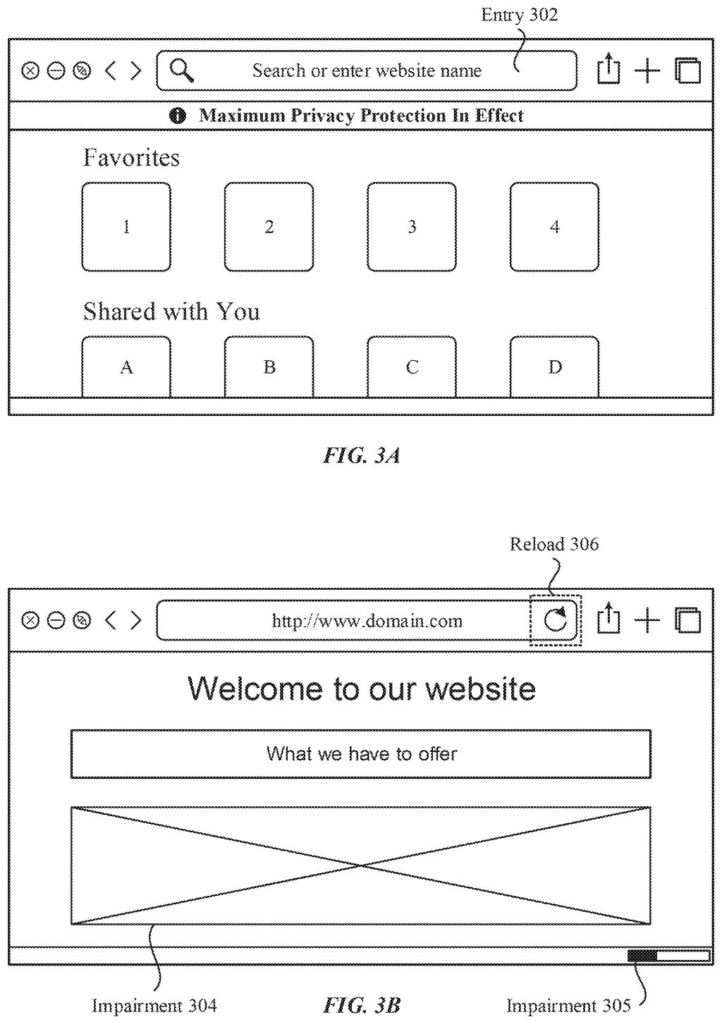
This patent describes two fixes Apple is working on. The first is a lock screen for private browsing windows: Safari would automatically hide your private tabs behind an authentication prompt (Face ID, Touch ID, or a passcode) when certain conditions are met, like when you leave the app or when your screen locks. The second fix is a smarter error message. When a site fails to load because of privacy protections, Safari would show you a clear prompt offering to reload just that page with slightly relaxed settings, without turning off your privacy protections everywhere else.
Both features keep you in control. You decide whether to authenticate to see your private tabs, and you decide whether that one broken site is worth a temporary privacy trade-off.
… displaying, via the one or more displays, an option for unlocking the private web browser window; and in accordance with a determination that the set of one or more criteria is not satisfied, forgoing display of, via the one or more displays, the option for unlocking the private web browser window.
Translation: It decides whether to show a lock screen based on specific rules.
How Safari detects broken pages and locks private tabs
The patent covers two distinct browser features bundled under a single privacy-management system.
Private window locking: When Safari detects that a private browsing window should be hidden, it checks a set of criteria before deciding what to show. If those criteria are satisfied (for example, a screen-lock event happened, or you switched apps), Safari presents an unlock option requiring biometric or passcode authentication. If the criteria are not satisfied, it skips the prompt entirely. This conditional logic prevents unnecessary interruptions while still protecting private tabs when there is a genuine risk someone else could see them.
Page-reload with reduced privacy: When Safari's privacy protections (things like tracker blocking or content filtering) cause a page to fail to load, the browser detects the loading error and displays a targeted prompt. That prompt offers to reload only the current page with temporarily reduced protection measures. The user gets a specific fix for a specific page rather than a blanket setting change.
- Detects the type of loading failure and links it to active privacy settings
- Surfaces a contextual prompt rather than a generic error message
- Reloads just that page with adjusted settings, leaving everything else unchanged
- Locks private windows based on conditional criteria, not a fixed timer
The underlying method is implemented at the operating system level, meaning it would apply across devices that share the same browser engine.
… displaying a prompt that enables the webpage to be reloaded with reduced privacy protection measures, and reloading the webpage with the reduced privacy protection measures.
Translation: It lets you temporarily lower privacy settings to fix a broken webpage.
What this means for everyday Safari privacy
If you use private browsing to keep searches, purchases, or health research away from shared-device eyes, a locked private window is a real upgrade. Right now, stepping away from your Mac or handing your phone to a friend briefly is enough for someone to scroll through your private tabs. A biometric lock closes that gap without requiring you to close and reopen everything.
Apple's steady run of Safari privacy filings The page-reload prompt addresses a quieter but equally frustrating problem. Privacy-conscious users currently face a hard choice: turn off protections entirely or give up on a broken site. A per-page reload option lowers that cost considerably, making it easier to stay in private mode by default rather than toggling it on and off depending on what a site demands.
This is the 374th Apple filing in our Apple coverage since May, adding to work like the bad photo alert patent and the video repair patent.
Private browsing fails people in two very specific moments: when someone else picks up their phone and sees open tabs they were never meant to see, and when a website breaks mid-session and the only fix feels like giving up on privacy entirely. Those failures are not rare. They happen on shared family devices, borrowed laptops, and phones left unlocked on a table every single day.
The locking feature addresses something with real social stakes. Being able to hide private tabs behind a fingerprint or a face scan means the browser protects you even when you forget to protect yourself.
The per-page reload option is a smaller fix, but a meaningful one. Right now, most people abandon private mode the moment a site stops working. Giving them a middle path, reload just this one page with fewer restrictions, removes the choice between privacy and a functioning browser.
Get our take in your Top Stories
Liked this breakdown? Add Patentlyze as a preferred source on Google, and our plain-English take shows up more often in your Top Stories the next time Apple patent news breaks.
There are more where this came from
We read every patent application Big Tech publishes and send you the ones worth knowing. Plain English, free, every week.
The drawings
12 drawing sheets from US 2026/0260018 A1 · click any drawing to enlarge


Show the other 4 sheets


Want this weekly breakdown for a company we don't cover? Patentlyze Pro →
Be the first to weigh in