
Apple Patents a Chip Lid That Corrals Liquid Metal Thermal Paste
Liquid metal is one of the best materials for pulling heat off a chip — but it has a habit of wandering. Apple's latest patent is basically a tiny fence designed to keep it exactly where it belongs.
What Apple's liquid-metal containment lid actually does
Imagine spreading peanut butter on a cracker, except the peanut butter is electrically conductive, costs a fortune, and if it drips onto the wrong component it causes a short circuit. That's roughly the problem with liquid metal thermal paste — the ultra-efficient heat-transfer goo used in some high-performance chips.
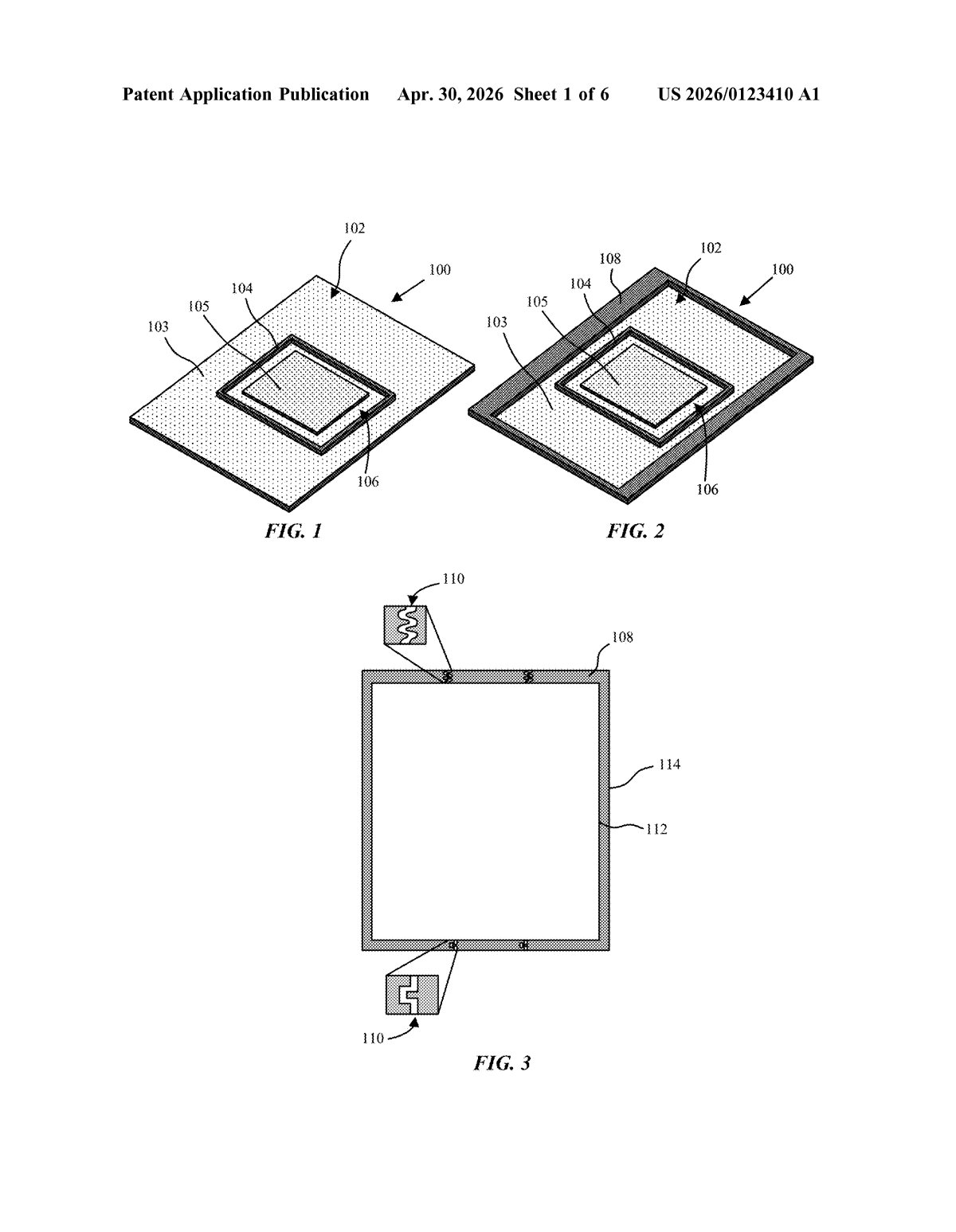
Apple's patent describes a redesigned chip lid — the metal cap that sits on top of a processor — that has built-in walls forming a small pocket around the chip. Those walls act as a physical barrier, keeping the liquid metal from spreading out sideways where it could cause damage or degrade heat transfer over time.
The result is a more reliable, self-contained cooling assembly. You probably wouldn't see this directly, but it's the kind of infrastructure engineering that lets Apple push chip performance harder without thermal failures becoming a concern.
How the pocket sidewalls trap liquid metal in place
The patent describes a multilayer sandwich that sits on top of a routing substrate (the circuit board the chip is soldered onto). Here's how the stack works:
- The electronic component (the chip die) is bonded to the substrate.
- An underfill material wraps around the chip's sides — this is a protective resin that prevents solder joint cracking.
- A thermal interface material (TIM) layer — specifically a liquid metal film — sits on top of the chip and laps over the edges of the underfill, maximizing thermal contact area.
- A lid — with a flat roof and downward-protruding sidewalls — is bonded onto the TIM layer. The sidewalls form a closed pocket around the chip.
The critical innovation is those pocket sidewalls. Liquid metal (typically a gallium-based alloy) is a superb thermal conductor — far better than standard silicone-based thermal paste — but it flows under heat and pressure. Without physical containment, it can migrate laterally over time, thinning out where you need it most or contaminating neighboring circuitry.
By making the lid itself the containment structure, Apple eliminates the need for separate dams or adhesive borders, which simplifies assembly and reduces failure points. The underfill also plays a secondary role here: the TIM layer extending over the underfill gives the lid's sidewalls a continuous surface to seal against.
What this means for Apple's next high-power chips
Liquid metal thermal interface materials have been used in high-end gaming laptops and consoles for years precisely because they transfer heat so much more efficiently than conventional paste — we're talking conductivity roughly 50–100× higher. The tradeoff has always been containment risk. Apple filing a patent around a structural lid solution suggests the company is serious about bringing liquid metal TIMs into its own chip packaging — likely for high-power Mac processors where thermal headroom is the main constraint on sustained performance.
For you as a user, the practical upside would be chips that run faster for longer without throttling. For Apple as a manufacturer, it's also a reliability story: a chip lid that physically prevents thermal paste migration means fewer field failures and tighter quality control at scale.
This is genuinely interesting packaging engineering — not flashy AI stuff, but the kind of detail that determines whether a chip hits its thermal envelope or not. Apple's vertical integration means they're designing packaging at a level most PC makers outsource entirely, and solving the liquid-metal containment problem in-house is consistent with that strategy. Worth watching if you follow Apple Silicon performance trajectories.
There are more where this came from
We read every patent application Big Tech publishes and send you the ones worth knowing. Plain English, free, every week.
Want this weekly breakdown for a company we don't cover? Patentlyze Pro →