
Sony
Sony · Software · Filed Mar 4, 2026 · USPTO published Oct 1, 2026 · Oct 1 release
Sony Patents a Fix That Brings Integrity Checks to Compressed 3D Video
When compressed 3D video moves between devices or studios, there's currently no reliable built-in way to confirm the data arrived intact. Sony's patent patches that gap for a newer class of video called dynamic meshes.
- Publication number
- US 2026/0303872 A1(US20260303872A1)
- Applicant
- SONY CORPORATION OF AMERICA
- Filed · Published
- Mar 4, 2026 · Oct 1, 2026
- Inventors
- Danillo Graziosi, Ali Tabatabai
- Status when we published
- Waiting for an examiner
- Document
- 15 claims
- US classification
- 375/240.26
- Parent application
- Claims priority from a provisional application 63781217 (filed Mar 31, 2025)
What Sony's 3D video checksum fix actually does
A broadcast engineer sends a high-fidelity 3D video asset across a network to a post-production studio. Until now, a key safety check built into the video coding standard simply didn't work for that format.
Video files can pick up invisible errors in transit: a flipped bit here, a corrupted frame there. To catch these, engineers use hash checks, a kind of digital fingerprint taken before and after transmission. If the fingerprint changes, something went wrong. The problem is that the fingerprint tool Sony's industry standard included was designed for an older 3D format and couldn't read the newer dynamic mesh format at all.
Sony's patent describes a way to extend that fingerprinting tool so it works with dynamic mesh video, the format used for detailed, moving 3D objects. Your takeaway: if this approach gets adopted, studios and streaming platforms get a reliable, standardized way to confirm their 3D video files arrived exactly as sent.
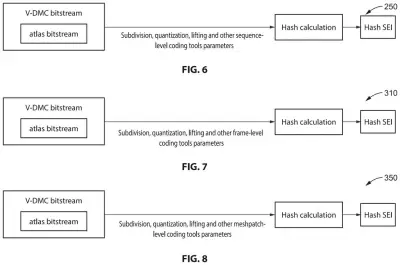
modifying existing decoded atlas hash supplemental enhancement information (SEI) to use syntax elements and variables defined in the V3C extension used by the video-based dynamic mesh coding (V-DMC) specification …
Translation: Sony alters existing data verification tools so they can understand compressed 3D mesh video formats.
How Sony extends the V3C hash message for mesh data
The patent targets a specific gap inside V3C (Visual Volumetric Video-based Coding), the international standard that covers how immersive and volumetric 3D video is compressed and transmitted.
Inside V3C, there is already an SEI message (Supplemental Enhancement Information, basically a metadata packet that travels alongside the video) called the Decoded Atlas Information Hash. Think of it as a checksum receipt: the encoder calculates a fingerprint of the compressed data, tucks that fingerprint into the stream, and the decoder checks on arrival. If the fingerprints match, the data is clean. The catch is that this message was only built to understand V-PCC (the point-cloud variant of V3C, which represents 3D scenes as clouds of dots) and doesn't know how to read V-DMC (the dynamic mesh variant, which uses connected polygon surfaces instead).
Sony's method does three things:
- Modifies the existing SEI message so it can read syntax elements specific to V-DMC, including mesh patch definitions and mesh-specific parameter sets.
- Creates new byte strings (structured data packets) that define how a decoder should process dynamic mesh data, covering fields in the Atlas Frame Parameter Set extension, the Atlas Sequence Parameter Set extension, and newly defined mesh patch structures.
- Uses those new inputs to calculate a hash value that accurately fingerprints a V-DMC bitstream, enabling conformance testing (checking that an encoder or decoder correctly follows the standard).
The net effect is that the standard gains a single, consistent integrity-check mechanism that spans both its point-cloud and dynamic mesh variants.
This disclosure describes a modification of the V-DMC specification to reuse the SEI message but create hash values according to decoded syntax elements from the VDMC bitstream.
Translation: The filing explains how to adapt current video integrity checks to work with 3D dynamic mesh data streams.
What this means for streaming and storing 3D video
For anyone building or using tools that work with high-fidelity 3D video, such as game studios, virtual production pipelines, or immersive media platforms, this kind of standards plumbing is load-bearing. Without a checksum mechanism, errors in a dynamic mesh file can go undetected until they surface as visual glitches or decoding failures, which are expensive to diagnose.
The broader point is that dynamic mesh video is increasingly the format of choice for detailed 3D objects in volumetric capture and AR applications. several Sony filings on volumetric video coding this year suggest the company is actively shaping how this standard evolves. A working conformance-testing mechanism also matters for interoperability: hardware and software from different vendors need a shared way to confirm they're all reading the same standard correctly, and this patch gives them one.
Sony's 551st filing we've tracked since May in our Sony coverage joins the AI game recommender and the Moiré camera fix as another step in its software and imaging work.
Source: US 2026/0303872 A1 at the USPTO (PDF). Full patent text and figures are in the official publication.
Get our take in your Top Stories
Liked this breakdown? Add Patentlyze as a preferred source on Google, and our plain-English take shows up more often in your Top Stories the next time Sony patent news breaks.
Add Patentlyze on Google
One click.
There are more where this came from
We read the new patents from Big Tech, carmakers and more and send you the ones worth knowing. Plain English, free, every week.
The drawings · 9 sheets
9 drawing sheets from US 2026/0303872 A1 · click any drawing to enlarge


Show sheet 9

More from Sony
All 722 Sony patents →
More in Software
All 816 Software patents →
Microsoft
Microsoft Patents a Fix for Video Quality Rules That Break When Splitting Work Across Processors
Google
Google Patents a Video Filter That Uses Color Data to Fix Compression Blur
Google
Google Patents a Three-Way Accuracy Check Before Serving You a Video Ad

Apple
No comments yet