
Sony Patents a Way to Clone Your Co-op Teammate as an AI Bot
When your co-op partner drops out, you're usually stuck with a generic AI that plays nothing like them. Sony's new patent describes a system that builds a replacement bot from the real player's own data.
What Sony's player-profile NPC system actually does
You're mid-session in a co-op game when your friend has to quit unexpectedly. Instead of a dumb filler bot that ignores your strategy, the game swaps in an AI that actually plays like your friend: same tendencies, same role, same habits.
That's the core idea in this Sony patent. The system pulls a player profile built from how a real human actually plays, and uses that data to shape an NPC (a computer-controlled character). The resulting bot reflects that person's real behavior rather than a one-size-fits-all script.
You could also use someone else's profile on purpose, essentially recruiting a digital version of a player you admire. The profile is the key ingredient, and whoever controls the user input decides which one gets loaded in.
accessing, based on a user input of a user, a dataset representing a player profile of a human player of the cooperative video game, the player profile including a set of attribute values indicating a playing behavior of the human player; and creating the NPC based on the set of attribute values.
Translation: The system reads a player profile based on how a human teammate plays and builds a bot using those exact habits.
How the system reads and copies a player's behavior
The patent describes a two-step process: first, building a player profile from recorded gameplay data; second, using that profile to instantiate an NPC.
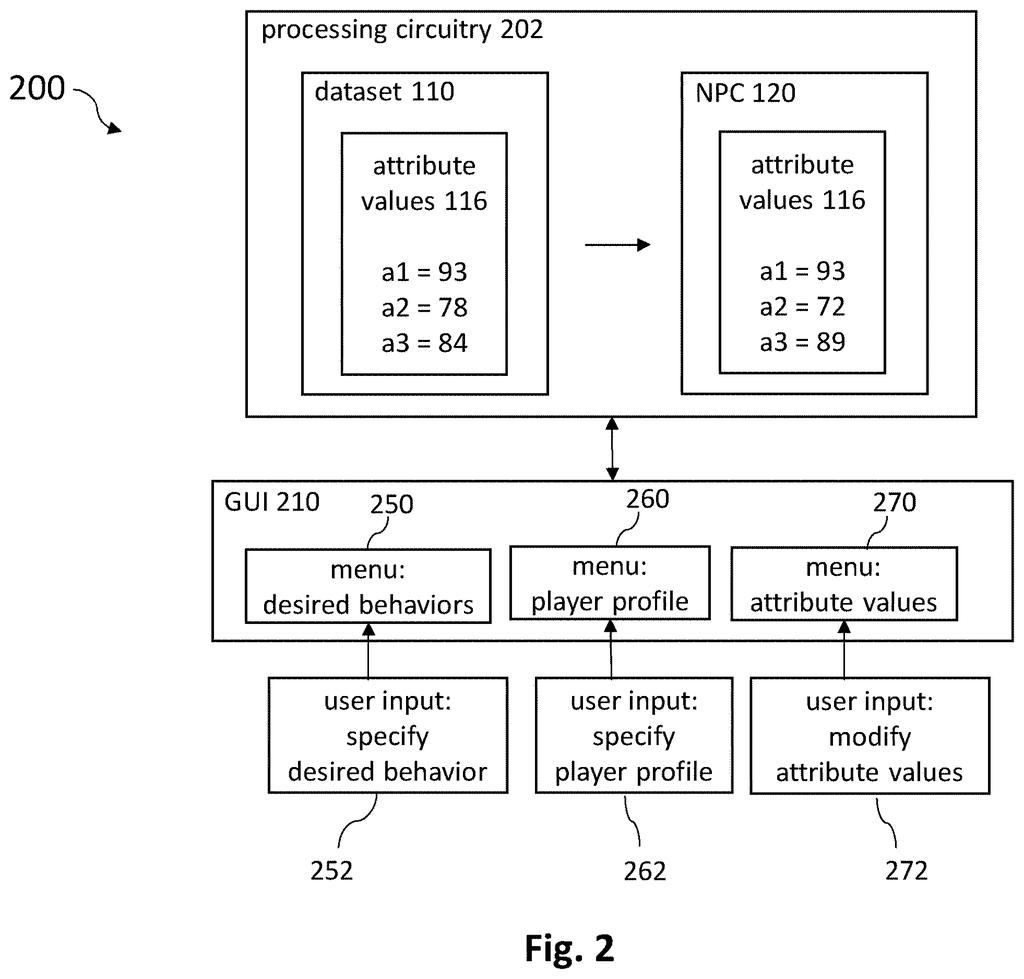
The player profile is a dataset of attribute values, meaning a structured collection of numbers or categories that represent how a specific human plays. This could include things like aggression level, preferred tactics, response times, or role tendencies (healer vs. Attacker, for example). The patent doesn't lock down exactly which attributes are tracked, leaving that flexible.
A user input then selects which profile to use. That could be the absent player's own profile, a friend's, or potentially any player in the system. The NPC is then created or configured based on the chosen attribute set.
- Access a player profile tied to a specific human player
- Read the set of behavioral attribute values in that profile
- Create or configure an NPC using those values as its behavioral blueprint
The patent also covers a companion method for generating those player profiles in the first place, meaning Sony is claiming both the profiling pipeline and the NPC creation step as part of the same system.
What this means for co-op gaming and player absence
Co-op games live or die on the quality of your teammates. When a human player drops out, the experience usually falls apart because AI substitutes play in a generic, predictable way that doesn't match the session's established rhythm. Sony's ongoing push into AI-driven game systems makes this a logical extension of that direction.
If this system works as described, it could make drop-in/drop-out co-op far less disruptive, especially for games that require tight coordination. It also opens a more interesting possibility: players choosing to bring in a profile of a skilled player they respect, essentially borrowing that person's playstyle as a tool. That shifts NPC design from static scripting toward something more personal and data-driven.
Sony's fourth filing we've tracked since July in our agents that act for you watchlist follows one on custom game rules and one built from player data.
When a friend drops out of a cooperative game mid-session, the experience often collapses. Either everyone quits, or a generic AI fills the slot so badly that the remaining players feel it. That friction is common enough to kill the genre's best quality: the feeling that you and specific people built something together.
Sony's approach here, building a stand-in character from a real player's recorded habits and tendencies rather than scripting generic behaviors from scratch, is proportionate to how personal that loss actually feels. A replacement that echoes how your friend actually plays is a meaningfully different thing than a replacement that merely functions.
The patent covers the structure of that idea, not the proof that it works. Whether the data collected about any given player is deep enough to capture what makes them recognizable in practice is an open question. But the problem being targeted is the right one.
Get our take in your Top Stories
Liked this breakdown? Add Patentlyze as a preferred source on Google, and our plain-English take shows up more often in your Top Stories the next time Sony patent news breaks.
There are more where this came from
We read every patent application Big Tech publishes and send you the ones worth knowing. Plain English, free, every week.
The drawings
7 drawing sheets from US 2026/0257137 A1 · click any drawing to enlarge


Want this weekly breakdown for a company we don't cover? Patentlyze Pro →
Be the first to weigh in