
Google Patents On-Device AI That Runs Meeting Tasks Across Participants' Devices
What if your laptop could run an AI assistant during a video call — not by pinging Google's servers, but by using the AI model sitting right on your device? That's the core idea in this Google patent.
What Google's cross-device meeting AI actually does
Imagine you're on a video call and you ask an AI assistant to summarize what someone just said, or pull out action items from the last five minutes. Today, that kind of request almost always gets routed to a cloud server somewhere. Google's patent describes a different approach: your device does the work locally.
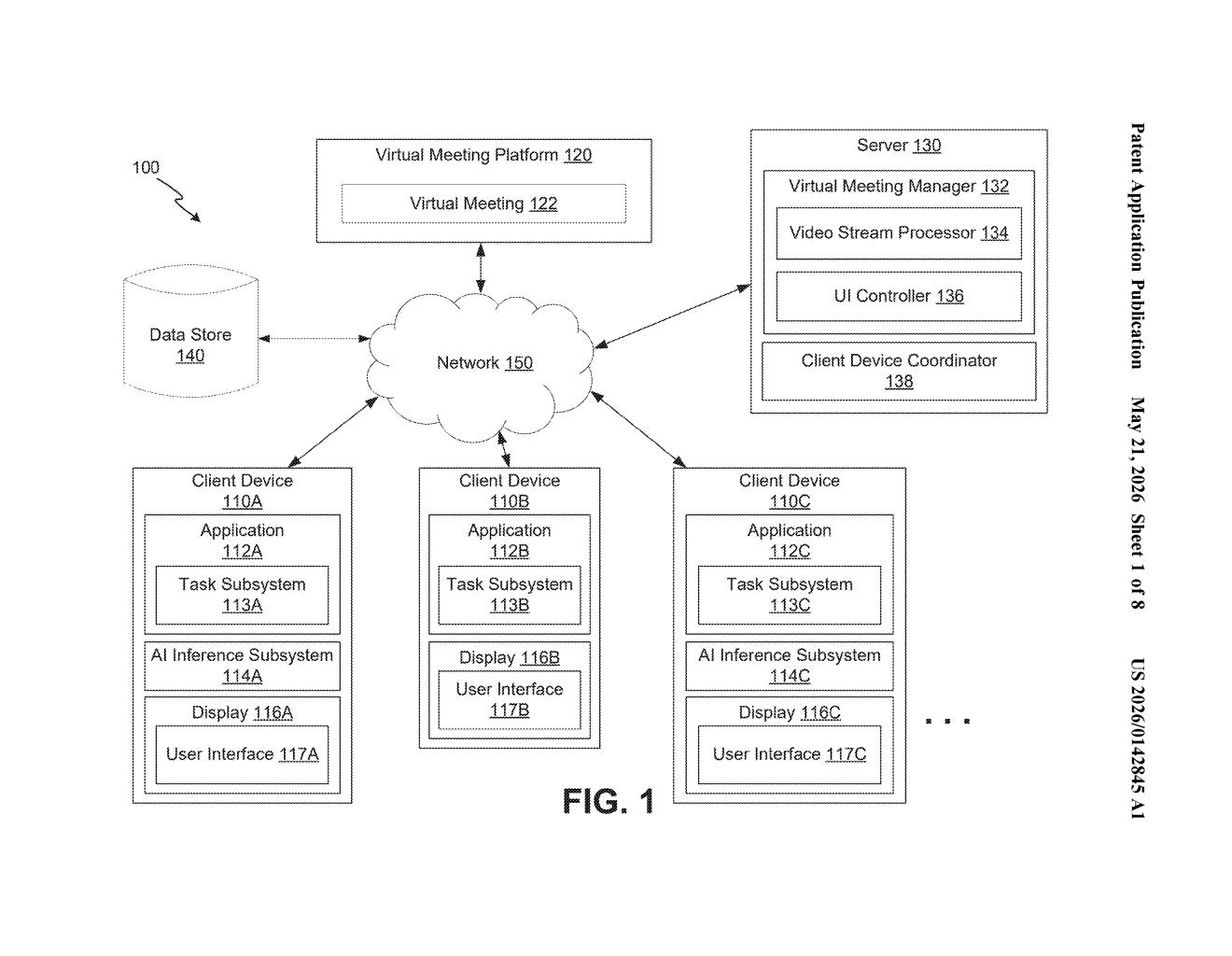
Here's how it plays out: one participant on the call sends a request — say, 'summarize the last few minutes' — and instead of that going to a remote server, another participant's device picks up the audio from the call, converts it to text, and feeds it into an on-device AI model to complete the task. The result is sent back to whoever asked.
The appeal here is privacy and speed. Running AI locally means your conversation audio doesn't have to leave the room (figuratively speaking). It also reduces latency and server costs. Think of it as turning your meeting participants' collective devices into a mini distributed AI cluster.
How one device processes another participant's audio with AI
The patent describes a system where on-device AI models — the kind that run entirely on a phone, laptop, or tablet without a cloud connection — handle tasks triggered during a live virtual meeting.
The flow works like this:
- A second participant (or their device) sends a task request to a first participant's device during an active meeting.
- The first device grabs audio stream data from the second participant, transcribes it into text locally.
- That text is fed into the device's own AI model, which executes the requested task (summarization, Q&A, translation, etc.).
- The result is returned to the requesting participant's device.
Notably, the AI processing happens on the receiving device, not a centralized server. The patent doesn't prescribe which AI model is used, just that it lives on-device. This architecture is sometimes called federated or distributed edge inference — meaning compute is spread across endpoints rather than centralized.
The patent also implies that participants can delegate AI tasks to other devices in the call, which opens the door to scenarios where a more capable device (say, a desktop with a powerful local model) handles requests on behalf of participants on weaker hardware.
What this means for Google Meet and privacy in video calls
For Google Meet users, this kind of architecture could mean AI meeting features that work even with spotty internet, since the heavy lifting happens locally. It also addresses a growing concern: nobody loves the idea of their private work conversations being processed on remote servers. On-device processing keeps audio data closer to home.
Strategically, this filing fits Google's broader push to deploy capable on-device AI through its Gemini Nano model family, which already runs locally on Pixel phones and some Android devices. A patent like this suggests Google is thinking seriously about how on-device AI slots into collaborative, multi-user contexts — not just single-user tasks like autocomplete or photo editing.
This is a genuinely interesting architectural idea: instead of routing meeting AI through the cloud, offload it to whoever in the call has a capable device. It's a logical next step for on-device AI, and it lines up cleanly with where Google's Gemini Nano strategy is heading. The distributed-compute angle — where a stronger device in the call picks up slack for weaker ones — is the most novel wrinkle here and worth watching.
Get our take in your Top Stories
Liked this breakdown? Add Patentlyze as a preferred source on Google, and our plain-English take shows up more often in your Top Stories the next time Google patent news breaks.
There are more where this came from
We read every patent application Big Tech publishes and send you the ones worth knowing. Plain English, free, every week.
Want this weekly breakdown for a company we don't cover? Patentlyze Pro →