
OpenAI Patents Technology That Stops AI From Re-Reading the Same Instructions Twice
Every time you send a long prompt to an AI, the model re-processes every word from scratch, even if most of it hasn't changed. OpenAI's new patent describes a caching layer that fingerprints prompt segments so the AI can skip work it's already done.
What OpenAI's prompt caching actually does for API users
Right now, every call you make to an AI service gets processed from zero, even if 90% of the text is identical to the last request. That is slow and expensive, especially when your prompt contains a large document, a lengthy instruction block, or a chunk of binary data like an image.
OpenAI's patent describes a system that takes a snapshot (called a hash, a short fingerprint) of each portion of your prompt before sending it to the AI engine. If the AI has already processed that exact chunk in a recent prior request, it can skip re-reading it and jump straight to the new part you actually changed.
For developers who build apps on top of AI APIs, this could mean noticeably faster responses and lower costs on calls where most of the prompt stays the same between turns. Think of a legal tool that always opens with a 10-page contract before adding a new question each time.
… generating a hash associated with a portion of the first prompt; identifying a generative response engine for generating a response to the natural language task based on the hash; transmitting the first prompt to the generative response engine …
Translation: It creates a digital fingerprint of the instructions to quickly route them to the right AI engine.
How the hash identifies reusable prompt chunks
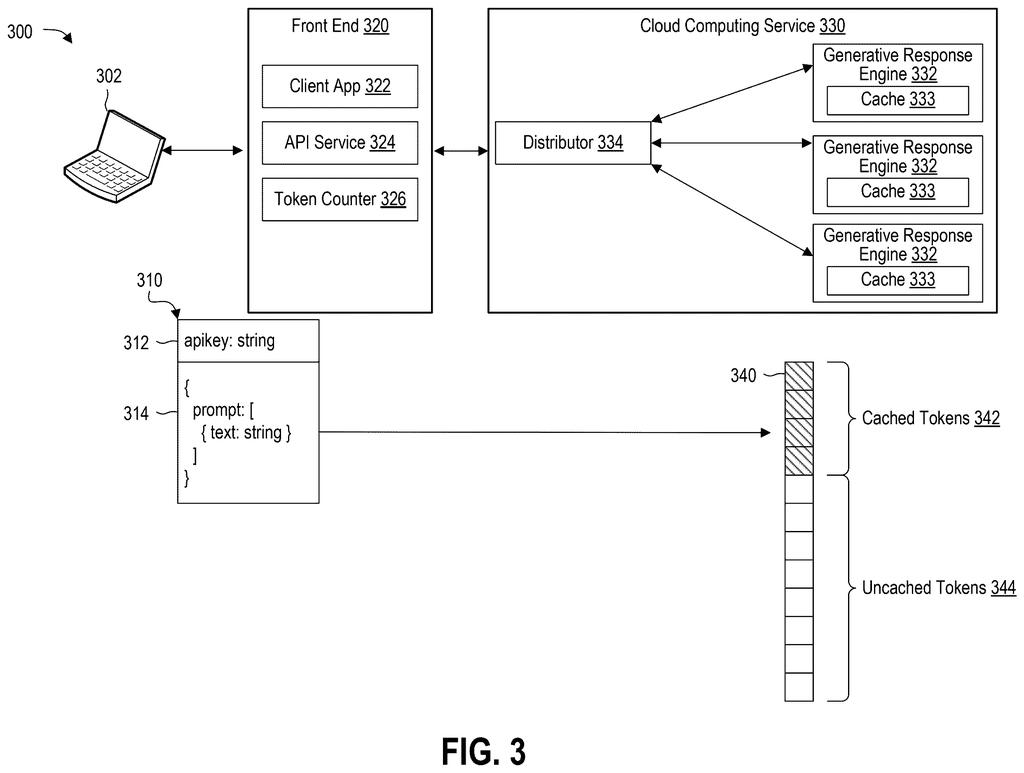
The patent describes a cloud computing service that sits between the user's application and the underlying AI model (what the patent calls a "generative response engine").
When a request comes in, the system generates a hash (a compact numeric fingerprint derived from the contents) for one or more portions of the incoming prompt. Crucially, the prompt can contain not just plain text but also binary data, such as images or audio encoded as tokens. The hash is forwarded along with the prompt to the AI engine.
The key mechanic is in how the response is structured: the AI engine returns a count of binary tokens from the current prompt that were already "activated" by a previous prompt. Those activated tokens represent work the model has already done and doesn't need to repeat in full.
The cloud layer uses the hash to route the request to the right engine instance, presumably one that already holds the relevant cached state in memory. The access key included in each request ties the caching to a specific caller, so one customer's cached prompts don't bleed into another's.
Disclosed are systems, apparatuses, processes, and computer-readable media for caching prompts for a generative response engine.
Translation: The patent describes methods for saving and reusing previous AI prompt data to save time.
What cheaper API calls mean for developers and products
For developers paying per token to call an AI API, sending the same large context window on every request is a real cost driver. A caching layer that recognizes repeated prompt segments and charges less (or processes faster) for them directly affects the economics of building AI-powered products.
This also matters for response latency. If the model can skip re-processing a 50,000-token system prompt that hasn't changed, your app feels faster without any code changes on your end. OpenAI's interest in API infrastructure efficiency shows up here as the kind of plumbing work that makes the platform stickier for enterprise developers who embed AI into existing products.
That makes this OpenAI's sixth filing we've tracked in the AI chip wars since July, building on one on skipping zero calculations and one on searching AI memory.
From a shipping standpoint, this is about as close to ready as a patent gets. Nothing here requires new chips, new models, or new physical infrastructure. It is a bookkeeping layer built on top of systems OpenAI already runs.
The core idea is simple: save a fingerprint of a repeated request, recognize it next time, and skip the expensive work of processing it from scratch. The document extends this to prompts that include images or audio, not just text, which matters as more apps send mixed content to these services.
The practical result for most people is lower costs and faster responses, felt but never seen. That is quiet, careful work, and it is exactly what keeps a service reliable and affordable as it scales.
There are more where this came from
We read every patent application Big Tech publishes and send you the ones worth knowing. Plain English, free, every week.
The drawings
11 drawing sheets from US 2026/0278026 A1 · click any drawing to enlarge


Want this weekly breakdown for a company we don't cover? Patentlyze Pro →
Be the first to weigh in