
Qualcomm Patents a Self-Correcting Fix for Compressed On-Device AI Models
When AI models are squeezed down to fit on a phone chip, they lose accuracy in ways that are hard to predict. Qualcomm has a plan to detect exactly where things go wrong and apply a targeted fix, automatically.
How Qualcomm's AI error patches work on your phone
Every time you ask an AI feature on your phone to summarize a message or describe a photo, the model powering it has been heavily compressed to fit into a chip that sips battery power instead of gulping it. That compression, called quantization, is a bit like saving a photo at low resolution: you save space, but some detail gets lost.
Qualcomm's patent describes a system that checks which parts of the compressed model are producing the most errors and then attaches small corrective modules, called adapters, to those specific parts. The worse a layer performs, the larger and more capable the adapter it gets.
The result: your phone's AI output stays close to what a full, uncompressed model would produce, without needing to store the full model. You probably wouldn't think about any of this, but you'd notice the difference when an on-device AI actually gives you a useful answer instead of a garbled one.
… determine a sensitivity of a first layer of the machine learning model based on an error associated with the output values; determine, based on the sensitivity of the first layer, a first adapter rank of a first adapter to attach to the first layer …
Translation: The system calculates how much a specific layer contributed to an error and decides how large a fix to apply.
How the adapter rank is chosen layer by layer
The patent describes a two-stage process that runs on a device's processor and memory.
Stage 1, Error measurement: The device runs the quantized (compressed) AI model on input data and compares the outputs against a reference, measuring how far off each layer's results are. The metric is called sensitivity: a layer that produces large errors is highly sensitive to quantization damage.
Stage 2, Adapter assignment: Based on each layer's sensitivity score, the system picks an adapter rank for that layer. Rank is a technical term for how expressive the adapter is: a higher rank means more corrective capacity but also more memory and compute. Layers that barely deviate get a low-rank (small) adapter or none at all; layers that deviate a lot get a high-rank (large) adapter.
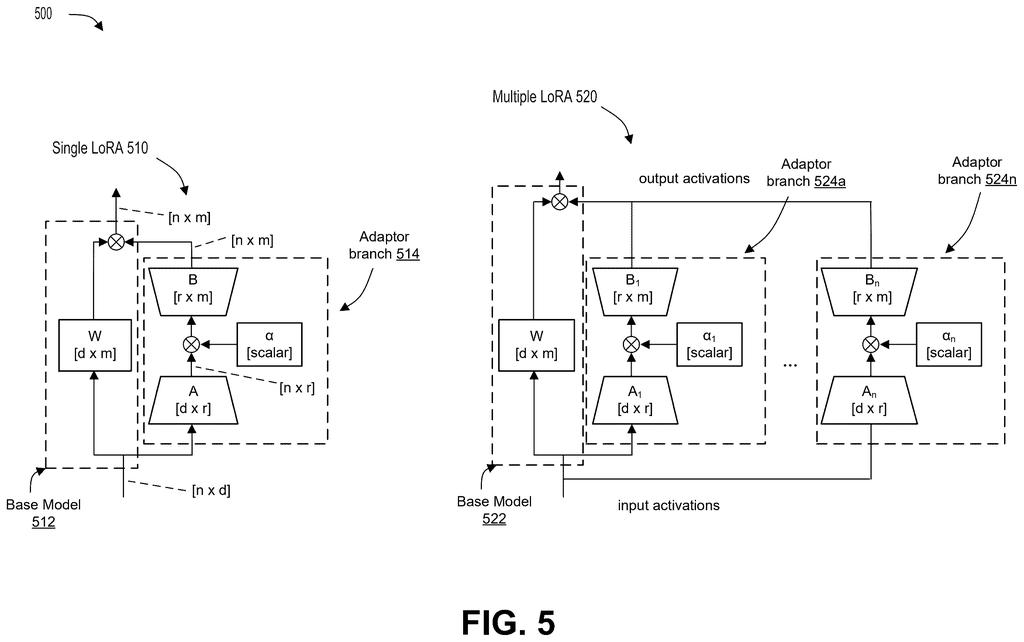
These adapters follow the LoRA (Low-Rank Adaptation) pattern, a well-known technique where a pair of small matrices is added alongside the original weight matrix to adjust its behavior without replacing it entirely.
The system then runs inference again using both the base compressed model and the attached adapters together, producing output that recovers much of the accuracy the compression stripped away. Importantly, the adapter selection is automatic and proportional to actual measured error, not a one-size-fits-all correction.
… process, using quantized base model weights of a machine learning model, input data to generate output values.
Translation: The compressed AI model runs initial calculations on the input data to produce preliminary results.
What this means for AI quality on mobile chips
On-device AI is only useful if it's actually accurate. Qualcomm makes the chips inside a huge share of Android phones, and those chips are increasingly expected to run AI workloads locally, without sending data to a cloud server. The problem is that fitting a capable AI model onto a mobile chip almost always requires quantization, and quantization degrades quality in ways that vary unpredictably from model to model and layer to layer.
This patent's approach of measuring error per layer and sizing the correction to match means phone makers could ship compressed models that behave much closer to their full-size counterparts, with less manual tuning. For you, that could mean on-device AI features like live translation, photo editing, or text generation that actually work reliably rather than occasionally producing nonsense, and Qualcomm's work here fits into the broader pattern of new Big Tech patents aimed at squeezing accurate AI onto the mobile chips that power everyday devices.
The concrete win is specific and visible: AI features on Snapdragon-powered phones that degrade less after the model compression that shipping on real hardware always demands. Qualcomm is doing the unsexy work of raising the quality floor, which matters most when you're relying on on-device AI to get something right the first time rather than retrying with a cloud query. The adaptive sizing of adapters by layer is the strongest detail, because blanket corrections waste resources, and wasted resources on a phone mean shorter battery life.
There are more where this came from
We read every patent application Big Tech publishes and send you the ones worth knowing. Plain English, free, every week.
The drawings
8 drawing sheets from US 2026/0236755 A1 · click any drawing to enlarge


Want this weekly breakdown for a company we don't cover? Patentlyze Pro →
Be the first to weigh in