
Nvidia Patents a Way to Merge Overlapping Sensor Readings in Self-Driving Cars
When an autonomous car uses a dozen sensors at once, the same nearby object can trigger dozens of separate alerts. Nvidia's new patent describes a method for stitching those overlapping readings together so the car sees one clear obstacle, not a confusing cloud of signals.
What Nvidia's sensor-grouping system actually does for cars
A self-driving car rolls slowly through a parking garage. Its sensors ping off the walls, pillars, and a shopping cart someone left in the lane, and every surface bounces back its own little blip of data. The car's computer is now staring at hundreds of individual readings that all need to be sorted out, fast.
Nvidia's patent tackles exactly that problem. It describes a system that collects those individual sensor hits, checks whether any of them are close enough together to be the same physical object, and then bundles matching hits into a single group. Instead of the car's brain wrestling with a flood of raw sensor noise, it gets a tidy list: pillar at two o'clock, cart at six o'clock, wall dead ahead.
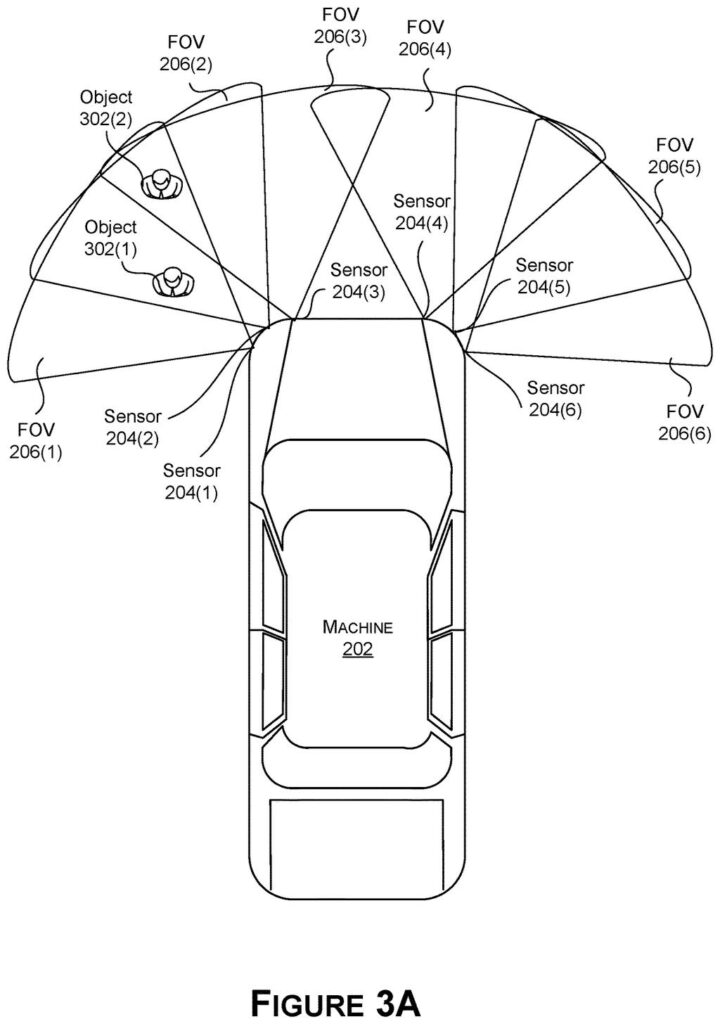
The system can use multiple sensors at the same time (ultrasonic sensors, the kind that make that beeping sound when you reverse, are specifically mentioned) and can map out the positions of several objects all at once. The goal is giving an autonomous vehicle a clear, low-confusion picture of everything around it so it can decide what to do next.
determine that object detections represented by sensor data obtained using the external sensors are within a threshold distance; determine, based at least on the object detections being within the threshold distance, a location of an object using the object detections …
Translation: The car figures out if close readings from different sensors are actually pointing to the exact same physical obstacle.
How the system clusters sensor echoes into one object location
The patent describes an object detection association system built for autonomous and semi-autonomous machines, primarily vehicles. The core job: take raw readings from multiple external sensors and figure out which readings belong to the same physical object.
Here is how the pieces fit together:
- Sensor data collection: The vehicle gathers data from several sensors simultaneously. Ultrasonic sensors, which work by sending out sound pulses and listening for the echo, are the main example. Each bounce back is called a detection (or echo).
- Threshold-distance comparison: The system checks whether two detections are within a set distance of each other. If they are, it treats them as likely belonging to the same object. That cutoff distance (the threshold) can be configured.
- Grouping: Detections that pass the closeness test get bundled into a group. Each real-world object gets its own group. The system can process these groups in a specific order, which affects how detections get sorted when things are ambiguous.
- Location output: Once grouped, the detections in each cluster are used to calculate a single estimated position for that object, giving the vehicle's driving systems a clean location to act on.
The claim covers the full machine: CPUs, GPUs, and dedicated hardware accelerators all working together, with the sensor fields of view pointing outward around the vehicle.
… group object detections (e.g., echoes, etc.) that are detected using multiple sensors (e.g., ultrasonic sensors, sonar sensors, etc.) and then use the groupings to process the object detections to perform one or more tasks …
Translation: It bundles up overlapping sound waves or pings from multiple sensors to help the vehicle understand its surroundings.
What this means for self-driving reliability around obstacles
Sensor fusion (getting multiple sensors to agree on what they're seeing) is one of the unglamorous hard problems in autonomous driving. A car that misreads a sensor echo as two separate objects, or that misses a real obstacle because two sensors canceled each other out, is a car that can make dangerous decisions. The stakes are not abstract.
Ultrasonic sensors are common on today's cars for parking assist, and they are relatively cheap compared to lidar or cameras, which makes them attractive for cost-sensitive autonomous systems. Nvidia's track record in autonomous-vehicle patents suggests this kind of low-level perception work is part of a broad effort to make its DRIVE platform handle the messy physics of the real world. Better grouping logic means fewer false alarms and fewer missed objects, which matters both for safety and for ride comfort.
This is the 58th Nvidia filing we've tracked in the self-driving sensing race since May, adding to earlier work like a lane-keeping check system and a self-fixing simulation tester.
The problem this patent addresses is real and genuinely difficult. Sensor echoes are noisy by nature, and the closer a vehicle gets to a complex environment (a crowded lot, a narrow street), the more those echoes pile up. A bad grouping algorithm can turn a single shopping cart into a phantom obstacle field, or worse, miss a real object entirely because its echoes got split across two categories.
The solution described here is conceptually straightforward: compare detections pairwise against a distance threshold, bundle the close ones, output a location. That is a proven class of approach in robotics. The filing's value is likely in the specifics (the ordering of sensor data analysis, the configuration of thresholds, the handling of multi-sensor overlap) rather than in a conceptual leap.
For everyday drivers, this kind of patent represents the unglamorous engineering that separates a self-driving system that works in a parking garage from one that only works on a clear highway. It is not a moonshot. It is the kind of careful, specific work that makes a safety-critical system trustworthy.
There are more where this came from
We read every patent application Big Tech publishes and send you the ones worth knowing. Plain English, free, every week.
The drawings
14 drawing sheets from US 2026/0279073 A1 · click any drawing to enlarge


Want this weekly breakdown for a company we don't cover? Patentlyze Pro →