
Google Patents a Faster AI Image Compression System That Drops a Key Architectural Layer
Google has patented an AI-powered image compression system that deliberately throws out a piece of architecture most engineers consider standard, and ends up running faster because of it.
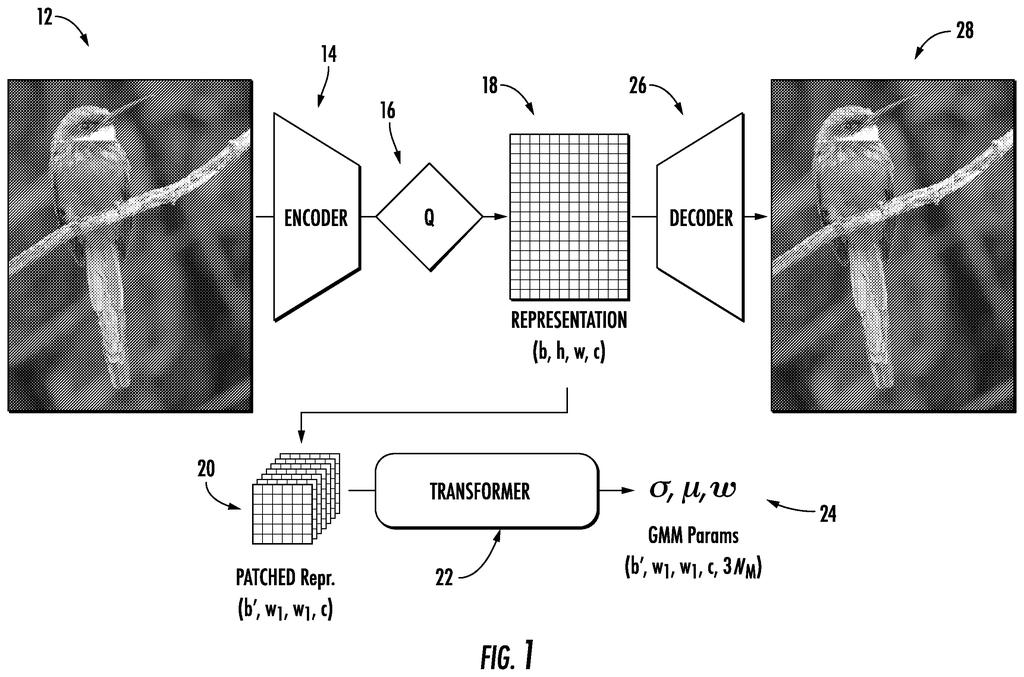
What Google's leaner image compression actually does
You're scrolling through a photo gallery on a slow connection and images take forever to load. What's happening behind the scenes is that the server is compressing those photos, and your phone is unpacking them. That process is slower and more complex than it needs to be, and Google thinks it has found a way to fix it.
The patent describes a compression system powered by a type of AI called a transformer (the same family of models behind ChatGPT, though applied here to images rather than text). Most AI compression systems use a two-part setup where one model helps the other handle uncertainty. Google's approach cuts that second part out entirely, using a single, simpler model instead.
The result is a system that compresses and decompresses images more quickly without meaningfully sacrificing quality. For you, that could mean faster page loads, smoother video calls, or tighter storage on devices, all without any visible change to the images themselves.
… training, by the computing system, a masked transformer model on the plurality of feature tokens to learn a distribution associated with the plurality of feature tokens, wherein the masked transformer model comprises a single-scale transformer model that does not use a hyperprior; …
Translation: The system trains a simplified AI model that completely skips the traditional auxiliary layer.
How the masked transformer predicts and encodes each image chunk
Most neural image compression systems use a two-level architecture. The primary model compresses the image, but it also has to describe its own uncertainty about what it compressed, and a second model called a hyperprior handles that uncertainty description. This double-model setup adds complexity and slows things down.
Google's patent describes a single-scale masked transformer model that skips the hyperprior entirely. A transformer, in this context, is an AI model that looks at all parts of an image simultaneously and learns relationships between them. The word "masked" means that during training, parts of the image data are deliberately hidden from the model, forcing it to predict what those hidden parts should look like based on context (similar to how a language model predicts the next word in a sentence).
Instead of letting the model decide on the fly which parts are uncertain and need extra attention, Google uses a fixed, predetermined schedule for which parts get masked during training. This is called a deterministic schedule, meaning the order of operations is locked in advance rather than adaptive. That predictability is what makes faster "masked attention" possible during training.
Finally, the system uses entropy coding, a well-established compression technique that encodes frequent patterns with fewer bits. The transformer's predictions about the data inform how that encoding is done, making the compression tighter.
… instead of relying upon a complex multi-scale model that uses a hyperprior, example implementations of the present disclosure can use a single-scale transformer model that does not use a hyperprior, such as, for example, a standard transformer or similar variants.
Translation: Dropping the complicated extra layer speeds up image processing while keeping the core AI architecture straightforward.
What this means for loading images and video on slow connections
For anyone who uses the internet on a phone or a slow Wi-Fi connection, compression is invisible but constant. Every photo you view, every video that loads without buffering, every attachment that downloads in seconds rather than minutes depends on compression working efficiently. A faster and simpler compression model, if it holds up at scale, could mean real speed improvements at the network edge, in cloud storage, and in on-device media apps.
Google's interest in AI-driven compression shows up across several product lines where bandwidth and storage costs matter enormously, from Google Photos to YouTube to Search. A compression method that runs faster without requiring extra models is the kind of engineering gain that compounds across billions of images served every day.
Google's 54th filing we've tracked in the AI photo editing race since May follows work like its tap-to-cut depth tool and its two-frame video predictor.
For most people, this shows up as an image that loads cleanly on a slow connection instead of sitting as a gray box, or a photo that arrives sharp instead of blocky. Those moments happen dozens of times a day across Google products, and the friction of waiting is real even when you stop noticing it.
The failure this prevents is the one you already know: the photo that never quite resolves, the page that stalls mid-scroll. A more efficient compression system means that failure becomes less common without any announcement you would ever see.
The honest caveat is that Google's infrastructure teams will feel this before users do. Whether it translates into a meaningfully better experience for someone on a slow phone or a crowded network depends on how the system holds up outside a lab, and this document describes the method without fully proving that outcome.
There are more where this came from
We read every patent application Big Tech publishes and send you the ones worth knowing. Plain English, free, every week.
The drawings
7 drawing sheets from US 2026/0279036 A1 · click any drawing to enlarge


Want this weekly breakdown for a company we don't cover? Patentlyze Pro →