
Samsung Patents AI That Turns Blurry Photos Into Sharp, High-Resolution Images
Samsung has filed a patent for a system that doesn't just blindly enlarge a low-resolution photo. It first diagnoses the specific ways the photo is degraded, then lets users tune the result to their own taste before producing a sharper version.
What Samsung's photo sharpening system actually does
Ever tried to zoom in on an old photo and watched it turn into a blurry mess of pixels? That's the core problem this Samsung patent is trying to fix.
The system takes a low-quality image and, before doing anything else, builds a map of what's wrong with it: is it blurry? Noisy? Compressed too aggressively? It then runs two separate AI processes in parallel to reconstruct a sharper version, while also factoring in your personal preferences about how the final image should look.
The result is a high-resolution image that isn't just mathematically enlarged. It's rebuilt with an awareness of the original photo's specific problems and adjusted to what you actually want the output to look like.
… determining, by the electronic device, a degradation representation map of the input low-resolution image based on at least one of the input low-resolution image and the one or more feature vectors of the one or more image attributes; …
Translation: The system figures out exactly how and why the original picture got blurry.
How the two-path pipeline reads flaws and rebuilds pixels
The patent describes a pipeline with several distinct stages working together.
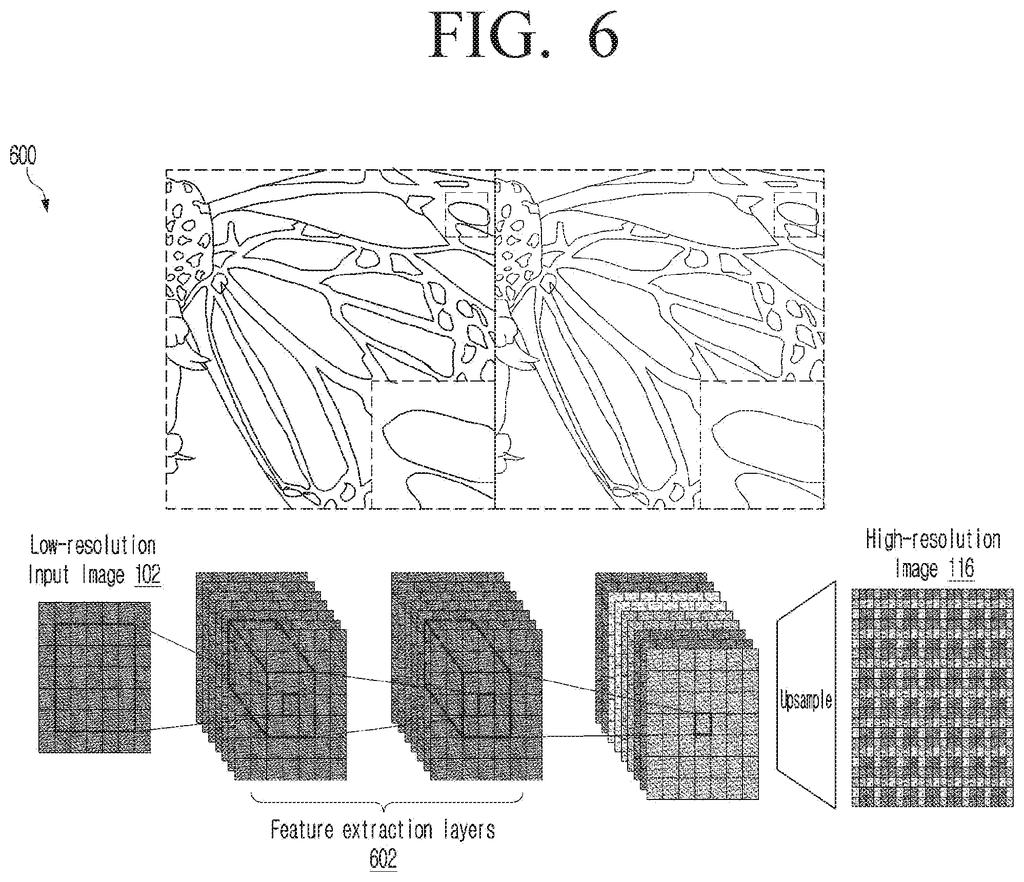
First, the system analyzes the input photo and produces feature vectors (numerical descriptions) for image attributes like sharpness, noise level, and compression artifacts. From those vectors, it builds a degradation representation map (think of it as a heat map showing which parts of the image are damaged and how).
Next, the system generates personalization parameters based on the image itself and on user input. This means the same low-res photo could be upscaled differently depending on whether a user prefers, for example, a softer look versus a highly sharpened one.
Then two separate output images are generated in parallel:
- A first output image produced by one processing method, shaped by the degradation information and personalization parameters.
- A second output image produced by a different processing method, using the same inputs.
Finally, at least one of those two outputs is upsampled (enlarged at high quality) to produce the final high-resolution image. The dual-path approach suggests the system may blend or select between the two results depending on quality.
… generating one or more personalization parameters based on at least one of the input low-resolution image and a user input, …
Translation: It creates custom settings using the blurry photo and your personal preferences.
What this means for Galaxy camera quality and AI photo tools
For Samsung's Galaxy lineup, better on-device photo upscaling means older or compressed images could be meaningfully improved without sending data to the cloud. It also points toward a future where AI photo tools don't just apply a one-size-fits-all sharpening filter but actually adapt to the specific flaws in each image and to the individual user's taste.
The personalization angle is the part worth watching closely. Most AI upscaling tools today treat every photo the same way. A system that remembers or responds to user preferences could become a meaningful differentiator in Samsung's camera software, and it fits neatly into the ongoing wave of Big Tech patent news around AI-driven image processing that is reshaping how phone manufacturers compete on camera quality.
This is the 101st Samsung filing we've tracked since May in our camera sensor push watchlist, following work on a cleaner charge chip and a dual-view camera.
Claim 1 is written at a high level of abstraction. It covers the combination of building a degradation map, generating personalization parameters, running two separate output processes, and upsampling. That's a broad sweep: it doesn't lock down any specific AI architecture or upscaling algorithm, which means the claim could theoretically apply to a wide range of implementations.
In practice, that breadth is a double-edged thing. A broad claim is harder to design around, which gives Samsung more room to enforce it. But broad claims also face more scrutiny from patent examiners, especially in a crowded field like image super-resolution where prior art (earlier work) from Adobe, Google, and academic AI research is dense.
The personalization piece is the most distinctive element here. Most prior art in AI upscaling focuses on the reconstruction quality alone. A claim that explicitly covers user-preference inputs as part of the upscaling decision could carve out real space, assuming that specific combination hasn't been done before.
Get our take in your Top Stories
Liked this breakdown? Add Patentlyze as a preferred source on Google, and our plain-English take shows up more often in your Top Stories the next time Samsung patent news breaks.
There are more where this came from
We read every patent application Big Tech publishes and send you the ones worth knowing. Plain English, free, every week.
The drawings
10 drawing sheets from US 2026/0253183 A1 · click any drawing to enlarge


Want this weekly breakdown for a company we don't cover? Patentlyze Pro →
Be the first to weigh in