
Samsung Patents a Single Motor That Both Slides Open a Phone Screen and Vibrates It
Sliding phones that expand their screen need a motor to do the sliding, and phones need a motor to buzz in your pocket. Samsung's patent asks: what if one motor did both?
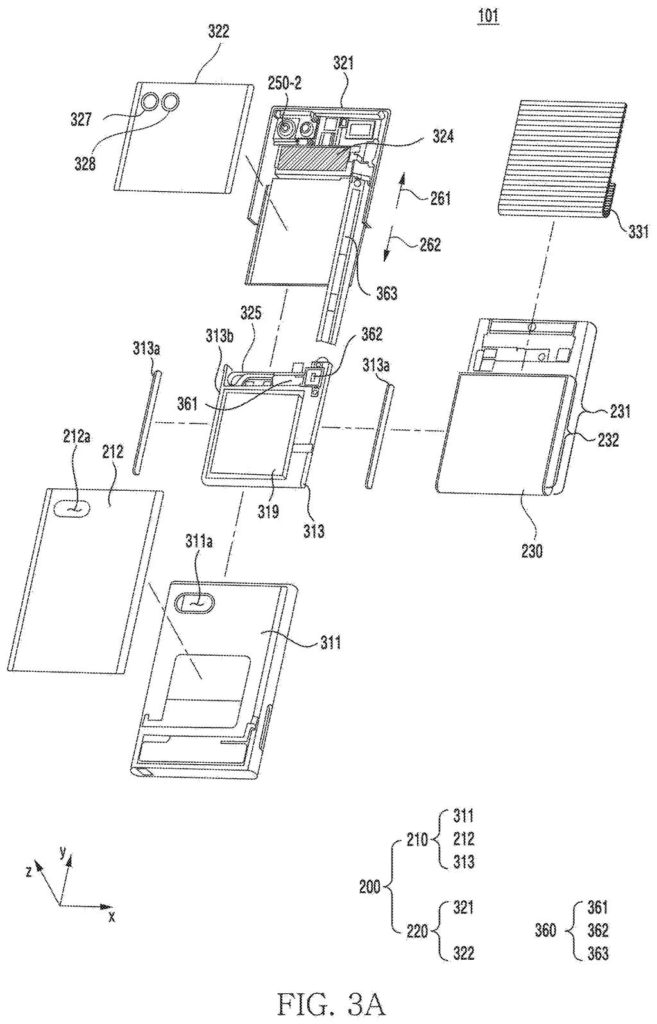
How Samsung's sliding phone shares one motor for two jobs
You're watching a video and your phone buzzes with a notification. In a normal phone, the vibration motor and any screen-movement hardware are completely separate parts, each taking up space and drawing power. In a phone where the screen physically slides out to get bigger, that space problem gets real fast.
Samsung's patent describes a mechanical setup where a single motor handles both jobs. A small piece called a rotating member can latch onto one of two shafts inside the device. When it locks onto the first shaft, the motor drives a gear system that slides the second half of the phone outward, expanding the display. When it locks onto the second shaft, the motor powers a vibrator instead, sending a buzz through the phone's body.
The phone's software decides which mode is needed and switches the connection accordingly. The result, on paper, is a phone that can grow its screen and give you tactile feedback without carrying two separate motors inside.
control the rotating member to be fastened to the first shaft such that the second housing part is movable with respect to the first housing part through the rotating member …
Translation: The motor shifts gears to physically push and slide the phone screen open.
How the rotating member switches between two shafts
The patent covers an electronic device with two housing parts: a fixed section and a second section that slides in and out to change how much display is visible. Inside is a motor assembly with two shafts and a single rotating member, a coupling piece that can engage either shaft depending on which task is needed.
- First shaft mode: The rotating member locks onto the first shaft, which connects through a gear assembly to physically push or pull the second housing outward, expanding the screen area.
- Second shaft mode: The rotating member instead latches onto the second shaft, which has a vibrator attached to one end. The motor then drives that vibrator to produce haptic feedback, the buzz you feel for notifications or touch responses.
The processors (the phone's computing core) communicate with the motor assembly and switch the rotating member between shafts as needed. When you get a call, the software routes power to the vibration shaft. When you tap a button to expand the screen, it routes to the gear shaft instead.
Critically, the two shafts are physically separated, so the motor cannot accidentally drive both functions at once. The design is essentially a software-controlled mechanical clutch inside a consumer phone.
… control the rotating member to be fastened to the second shaft such that the vibrator is configured to provide vibration through the rotating member …
Translation: The same motor then switches over to shake the device for haptic alerts.
What this means for thin, sliding-screen phones
Sliding or rollable phones are one of the more credible bets in the mobile industry right now, but they face a genuine engineering constraint: every extra motor, hinge, and actuator eats into the slim profile that makes a phone feel premium. A design that folds haptic feedback and screen-expansion mechanics into one motor assembly directly attacks that problem.
For you as a buyer, the payoff would be a sliding phone that is thinner, potentially lighter, and has one fewer component that could fail over time. That said, a single shared motor also means the phone cannot vibrate while the screen is sliding, a constraint worth watching as these devices mature and multitask more aggressively.
Samsung's 74th filing we've tracked in our foldable phone watchlist since May builds on ideas like a battery-switching design and a tri-fold layout system.
The core idea here is a single motor doing two jobs: physically sliding a screen larger and buzzing your hand when a notification arrives. That requires entirely new hardware, not a software update to something that already exists, which means Samsung has to design, test, and manufacture parts that do not yet exist in shipping phones.
Before this reaches a real product, that shared motor needs to switch between its two jobs quickly enough that a person never notices the handoff. A motor that hesitates or locks up while the screen is moving would make the whole device feel broken, and a flexible sliding screen is already a more fragile starting point than a standard phone.
The design logic is sound: one motor instead of two saves space and weight inside a device where every millimeter matters. Getting from sound logic to a product someone buys is a long road, and this document describes the beginning of it.
There are more where this came from
We read every patent application Big Tech publishes and send you the ones worth knowing. Plain English, free, every week.
The drawings
30 drawing sheets from US 2026/0281218 A1 · click any drawing to enlarge


Want this weekly breakdown for a company we don't cover? Patentlyze Pro →