
Samsung Patents a Battery-Switching System Built for Folding Displays
Folding phones need a burst of power every time the screen moves, and Samsung is patenting a clever way to rewire the batteries on the fly to deliver it without killing battery life the rest of the time.
What Samsung's battery-switching trick does for foldable phones
You're using your foldable phone all day, opening and closing it dozens of times. Each time that screen unfurls, a tiny motor has to physically push the display, and that motor is hungry for power.
Samsung's new patent describes a phone with multiple batteries that can be wired together in different ways depending on what the phone is doing. When the motor needs a high-voltage push to move the display, the batteries connect in series (think of it like stacking AAA batteries end-to-end to double the voltage). The rest of the time, they connect in parallel (side by side), which keeps the phone running longer on everyday tasks.
A processor watches for "events" like the screen starting to unfold, then flips the wiring configuration automatically. You never touch a setting. The phone just handles it.
… switch circuitry including a plurality of switches, configured to switch between a first state connecting the plurality of batteries in series and a second state connecting the plurality of batteries in parallel …
Translation: Internal switches change how the multiple batteries wire together depending on device needs.
How the series-to-parallel switch responds to folding events
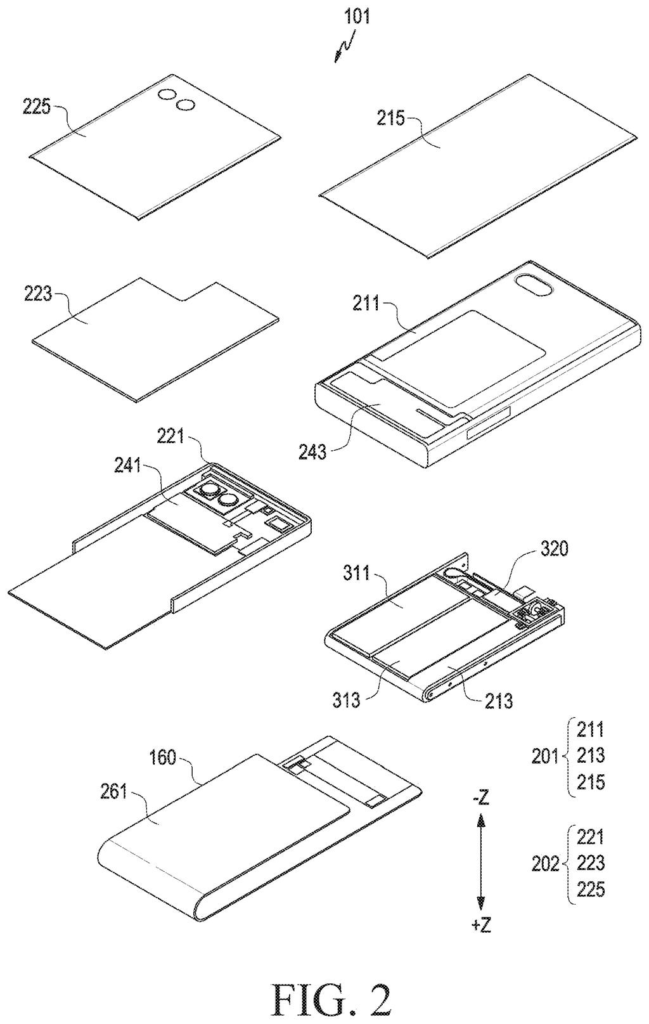
The patent covers an electronic device, almost certainly a foldable or rollable phone, that contains several key components working together:
- Multiple batteries that can be rewired on demand
- A motor that physically drives the flexible display open or closed
- Motor driving circuitry that translates electrical power into mechanical movement
- Switch circuitry, a set of electronically controlled switches that change how the batteries connect to each other
The two battery states are the core of the invention. In the series state, the batteries are chained together, which adds their voltages (a motor driving a physical display needs higher voltage to operate efficiently). In the parallel state, the batteries combine their capacity instead, which is better for sustained, lower-draw tasks like browsing or video playback.
The processor monitors for a triggering event, such as the user initiating a fold or unfold gesture, then instructs the switch circuitry to flip between states. The transition happens in software, so there is no manual intervention and presumably no noticeable interruption to the user.
The patent does not specify exactly which events trigger a switch, which leaves room for Samsung to tune the logic around screen-open detection, motor current draw, or other sensor signals.
… a motor configured to drive at least a portion of the flexible display to move, motor driving circuitry connected to the motor …
Translation: A tiny motor actively moves parts of the bendable screen when the device changes shape.
What this means for foldable phone battery life and reliability
Foldable phones have a real engineering problem: the motor that moves the display is one of the most power-hungry components in the device, but it only runs for a fraction of a second at a time. Designing a battery around those short spikes means either over-building the battery (heavier, thicker phone) or accepting voltage sag that could damage the motor or cause stuttering folds.
This approach lets the same hardware serve two jobs: high-voltage delivery when the motor fires, and extended capacity the rest of the time. If it works as described, you'd notice it as a foldable that opens and closes more crisply and one whose battery holds up better through a full day of real use, especially if you fold and unfold frequently.
Samsung's 73rd filing we've tracked since May in our foldable phone work, following tri-fold screen layout idea and vibration by open angle, adds yet another application to the set.
The part of a foldable phone that wears out fastest is the hinge, and the reason it wears out is that the small motor moving the screen doesn't always get the right amount of power at the right moment. This patent addresses that directly, letting the phone automatically shift how its batteries connect together depending on what the motor needs.
For the person using it, the benefit is a hinge that keeps feeling tight and responsive years into ownership, not just in the first few months. The phone would also stop draining battery faster than expected every time you open or close it.
Most people don't return a foldable because the screen cracked. They return it because it stopped feeling premium. Solving the motor's power supply in the background is exactly the fix that keeps a phone feeling worth what you paid for it.
There are more where this came from
We read every patent application Big Tech publishes and send you the ones worth knowing. Plain English, free, every week.
The drawings
16 drawing sheets from US 2026/0281222 A1 · click any drawing to enlarge


Want this weekly breakdown for a company we don't cover? Patentlyze Pro →