
Google Patents a Method to Diagnose the Hardware Running Its Quantum Computers
Quantum computers are notoriously hard to test because the act of measuring them can disturb what you're trying to measure. Google is now patenting a way to diagnose a quantum processor by modeling it mathematically rather than just poking it directly.
What Google's quantum diagnosis method actually does
You're trying to tune a car engine, but every time you open the hood to look, the vibrations from lifting the hood throw off the engine's behavior. That's roughly the problem with quantum computers: testing them tends to disrupt the very thing you're testing.
Google's patent describes a method that sidesteps this by building a detailed mathematical portrait of the quantum chip using a technique borrowed from physics research. Instead of running thousands of test operations on the chip itself, the system finds the chip's natural energy states, called eigenstates, through a computer simulation and then uses that portrait to characterize how the chip actually behaves.
The payoff is that engineers get a cleaner, more complete picture of what's happening inside the processor without needing to bombard it with measurements. That kind of precise characterization is an essential step if quantum hardware is ever going to be reliable enough to run useful calculations.
performing a variational algorithm to determine a set of eigenstates of a Hamiltonian, wherein the Hamiltonian corresponds to a quantum processor; and characterizing the quantum processor based on the set of eigenstates.
Translation: Running a math routine to map out the native energy states of the physical chip to check its health.
How the DMRG algorithm maps and tests a quantum chip
The patent centers on applying a variational algorithm (a method that iteratively adjusts a mathematical model until it best matches real-world data) combined with Density-Matrix Renormalization Group, or DMRG, to quantum processors.
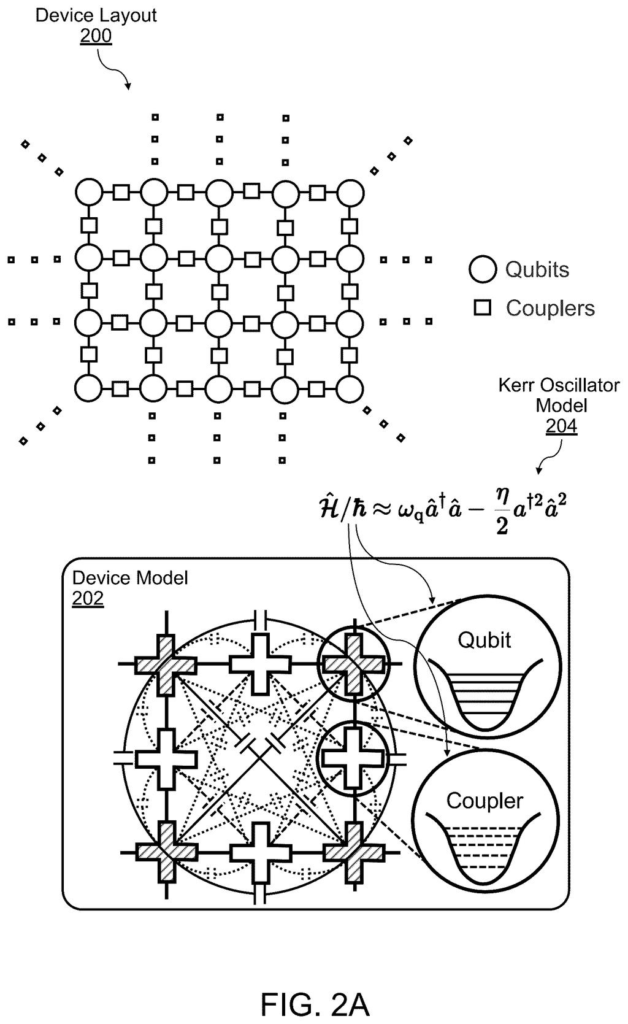
DMRG is a classical physics technique, normally run on ordinary computers, that finds the lowest-energy states of complex quantum systems by compressing information in a mathematically smart way. Google's method treats the quantum processor itself as the quantum system to be studied: the chip's physical layout and qubit interactions are encoded into a mathematical object called a Hamiltonian (essentially a complete description of the system's energy landscape).
The algorithm then computes a set of eigenstates, which are the stable, characteristic energy configurations the processor naturally settles into. Think of them as the processor's fingerprints. By comparing these fingerprints to expected behavior, engineers can identify where the chip deviates, spot sources of noise or error, and calibrate the hardware accordingly.
- Build a Hamiltonian model matching the quantum processor's physical structure
- Run the DMRG-based variational algorithm on classical hardware to find eigenstates
- Use those eigenstates to characterize and diagnose the quantum processor's real behavior
What better quantum benchmarking means in practice
Quantum computers in 2025 are still fragile and error-prone, and one of the biggest barriers to making them useful is simply understanding what they're doing wrong. Better characterization tools let engineers find and fix problems faster, which shortens the cycle between building a chip and trusting it enough to run real workloads.
For you as a potential user of cloud-based quantum services (Google offers access to its quantum hardware through Google Cloud), this kind of diagnostic work is what separates a noisy, unreliable machine from one that can actually return correct answers. Google's track record in quantum computing patents suggests this is part of a long engineering push, not a one-off filing.
Google's latest chip patent is the 13th we've tracked since May in our Chip topic coverage, which already includes reusing CPU vectors for AI and preserving photo detail in weak hardware.
Getting a quantum computer to work reliably requires first understanding exactly how it's misbehaving, and this patent is about building that diagnostic step. Google is describing a way to use a well-understood classical math technique to map out the flaws and quirks of a quantum chip's behavior.
That mapping still has to feed into fixes, which requires better physical hardware, error-correction systems, and engineering infrastructure that this document doesn't address. The shortest path to a product runs through all of that before this diagnostic work becomes something a customer ever touches.
What this filing represents is foundational groundwork, not a feature. The teams building quantum computers are still constructing the basic tools for understanding what they've built, and this is one of those tools.
There are more where this came from
We read every patent application Big Tech publishes and send you the ones worth knowing. Plain English, free, every week.
The drawings
8 drawing sheets from US 2026/0278445 A1 · click any drawing to enlarge


Want this weekly breakdown for a company we don't cover? Patentlyze Pro →