
Nvidia Patents an AI That Routes Your Questions to a Panel of Specialist AIs
Instead of one AI trying to know everything, Nvidia's patent describes a coordinator AI that farms out your question to a group of specialist AIs and then synthesizes their answers into a single response.
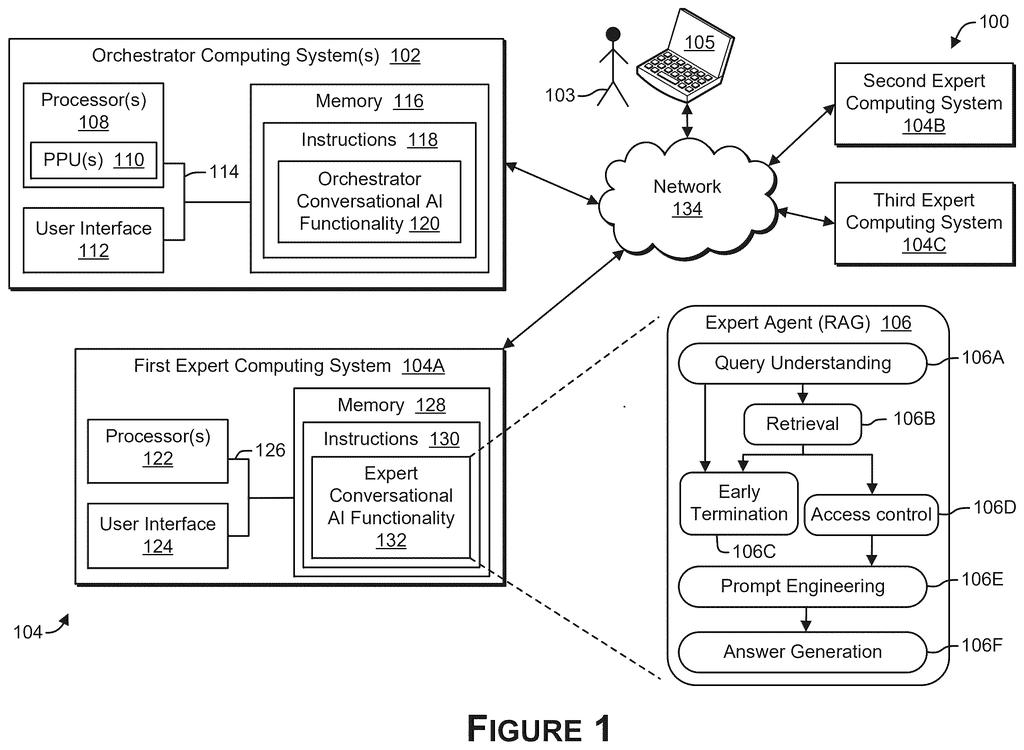
What Nvidia's AI coordinator system actually does
Most AI assistants today are a single model doing its best on every topic, whether that's medical questions, legal details, financial advice, or just helping you write an email. That one-size-fits-all approach means the AI is often mediocre across the board rather than excellent in any particular area.
Nvidia's patent describes a different setup: a "conductor" AI that receives your question, figures out which specialist AIs are best suited to handle it, sends the question (or parts of it) to those specialists, and then combines their answers into one coherent reply that gets read aloud or shown on screen.
Think of it like a doctor who, instead of guessing at every symptom, calls in a cardiologist, a neurologist, and a pharmacist and then summarizes their input for you. The coordinator doesn't need to know everything itself. It just needs to know who to ask.
selecting, by an orchestrator conversational Artificial Intelligence (AI), multiple expert conversational AIs from a plurality of expert conversational AIs, based at least in part, on one or more inputs obtained by the orchestrator conversational AI …
Translation: The main AI picks a team of specialist AIs based on what you ask it.
How the orchestrator picks and combines expert AI responses
At the center of the system is what the patent calls an orchestrator conversational AI. This is a general-purpose AI model whose main job is not to answer questions directly but to decide how to delegate them.
When you ask a question, the orchestrator evaluates the input and selects from a pool of expert conversational AIs, each trained or configured to handle specific domains (think: a billing expert, a technical support expert, a compliance expert). The orchestrator then directs those chosen specialists to retrieve relevant information from data sources, such as internal databases or knowledge bases, and generate their own responses.
The orchestrator then takes those multiple responses and synthesizes them into a single answer. The patent specifies that the final answer can be delivered as audio, as text on screen, or both, making it compatible with voice-based interfaces and chat interfaces alike.
- Orchestrator AI: coordinates the overall conversation and delegates subtasks
- Expert AIs: specialist models that retrieve data and generate domain-specific responses
- Synthesis step: the orchestrator blends expert outputs into one coherent answer
- Output delivery: audible speech, visual text, or both
… an orchestrator conversational AI receives input(s), and uses one or more strategies to obtain one or more results from one or more expert conversational AIs …
Translation: The supervisor AI uses different strategies to gather answers from the specialists.
What this means for AI assistants handling complex tasks
For enterprise AI deployments, this architecture solves a real problem: no single AI model handles every business domain equally well. A customer-service platform, for example, might need to answer questions about billing, technical issues, and compliance all in one conversation. This patent describes a way to wire together specialized models behind a single conversational front end, so users never have to know which system is actually answering them.
For everyday users, the practical effect would be an AI assistant that gives more reliable, domain-specific answers without requiring you to hunt down the right tool yourself. The coordinator handles that routing invisibly. Whether this shows up in Nvidia's own AI products or gets licensed as infrastructure for enterprise chatbot builders, the target is clearly the business market where accuracy across specialized topics carries real stakes.
Nvidia's 11th filing we've tracked since July in our AI models working in teams adds to a pattern that includes one routing queries to engines and one splitting tasks across workers.
The core tradeoff in this design is complexity for quality. A single AI model is easy to update, monitor, and debug. An orchestrated network of specialist AIs introduces a lot of moving parts: the orchestrator can pick the wrong experts, the experts can contradict each other, and the synthesis step can paper over disagreements in ways that are hard to detect. That is a real cost.
The patent doesn't describe in detail how the orchestrator resolves conflicting expert responses, which is precisely where this kind of system gets dangerous in high-stakes settings. If your medical-specialist AI says one thing and your pharmacology AI says another, and the orchestrator smooths it into a confident-sounding single answer, that's worse than just admitting uncertainty.
That said, Nvidia's interest in enterprise conversational AI infrastructure makes this a logical piece of their platform strategy. For well-scoped business use cases where the expert domains don't overlap much, the tradeoff probably reads as worth it. The system's value rises as the question complexity rises and falls as the chance of expert conflict rises.
There are more where this came from
We read every patent application Big Tech publishes and send you the ones worth knowing. Plain English, free, every week.
The drawings
13 drawing sheets from US 2026/0277949 A1 · click any drawing to enlarge


Want this weekly breakdown for a company we don't cover? Patentlyze Pro →
Be the first to weigh in