
Nvidia Patents a System for Steering AI Queries to the Right Processing Engine Automatically
When you have dozens of AI models running at once, getting a question to the right one is harder than it sounds. Nvidia's new patent describes a traffic-cop layer that does exactly that, automatically and in real time.
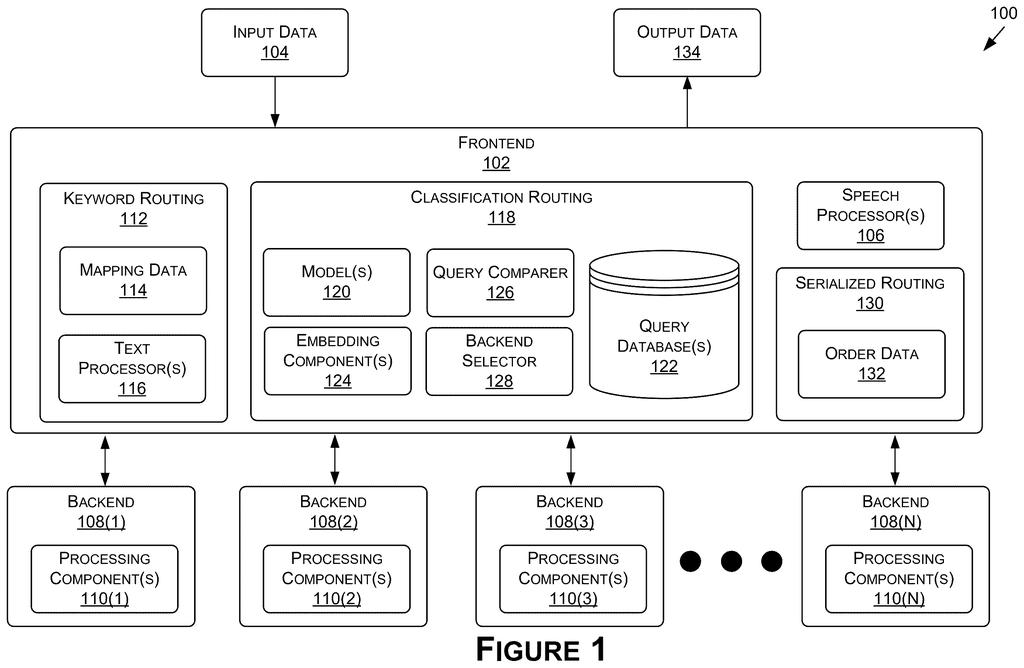
How Nvidia's AI dispatcher picks which model answers your question
You're using a company's AI assistant and you ask a question about billing, then one about a product feature, then one about a legal policy. Behind the scenes, those questions probably need to go to three completely different AI models, each trained for a different job. Right now, many systems make you pick the right one yourself, or they just guess.
Nvidia's patent describes a front-end dispatcher that reads your question and decides which AI backend should handle it. It can do this by spotting keywords in your message, by comparing the overall meaning of your question to past questions it already knows how to route, or by working through a ranked list of backends in a set order.
If a backend is busy or decides it can't handle a particular question, it tells the dispatcher, and the dispatcher sends the question somewhere else automatically. You never see any of that happen.
… compare the second vector to the first vectors to determine scores associated with the first queries; determine, based at least on the scores, that one or more of the first vectors are related to the second vector; select, based at least on the one or more of the first vectors being related to the second vector, a backend from the backends …
Translation: The system matches incoming requests against past queries to find the best processing engine.
How vectors and scoring direct each query to a backend
The core mechanism in claim 1 is a vector comparison system. A vector, in this context, is a list of numbers that represents the meaning of a piece of text (the way "bark" and "howl" would end up numerically close to each other because they're both about dogs). The system pre-stores vectors for example queries already linked to specific backends.
When a new query arrives, the system converts it into its own vector and then scores how similar it is to each stored example vector. If the new query's vector is close enough to examples associated with a particular backend, that backend gets the job.
The patent also describes two other routing methods that can work alongside or instead of vector comparison:
- Keyword routing: If the query contains specific names or code words (like a product name or department code), it gets sent directly to the matching backend.
- Serialized routing: The dispatcher tries backends in a fixed or dynamic order, moving on if one passes or rejects the query.
Backends can actively accept or reject queries sent to them, giving the dispatcher a feedback loop to reroute when needed rather than assuming the first answer is final.
… backends may be configured to initially respond to the frontend to indicate whether the backends accept or reject queries, such that the frontend is able to reroute queries if needed …
Translation: Processing engines can accept or reject tasks so the system can instantly reroute them.
What this means for companies running multiple AI models at once
For companies running AI infrastructure at scale, getting query routing wrong is expensive: you waste compute sending questions to the wrong model, and users get bad answers. A system that can compare meaning (not just keywords) and recover from a backend rejection in one pass is a real operational improvement over simpler rule-based routers.
For everyday users, the visible effect is subtler but real. An AI assistant powered by this kind of dispatcher could handle a wider range of questions without you needing to navigate menus or pick a specific tool. The system absorbs that complexity in the background, which is increasingly what enterprise AI buyers are asking for as they stack up specialized models.
Nvidia's tenth filing we've tracked on our AI teams working together since July builds on earlier applications like splitting tasks across AI workers and AI that writes and voices scripts.
Claim 1 is broad in the way that infrastructure patents tend to be broad. It covers any processor that stores example-query vectors, generates a vector for incoming queries, scores similarity, and routes based on that score. That description fits a large slice of how modern AI orchestration layers already work, which raises the obvious question of how it clears prior art during examination.
The claim doesn't require a specific model architecture, a minimum number of backends, or any particular embedding technique. That breadth means, if granted, it could cast a wide net over commercial AI routing products. But that same breadth is also what patent examiners push back on hardest, and Nvidia's bet on AI infrastructure makes filings like this part of a larger effort to establish IP around the scaffolding that holds multi-model systems together, not just the models themselves.
The practical engineering here is sound and the problem is real. Whether the claim language survives examination without significant narrowing is a different question entirely.
There are more where this came from
We read every patent application Big Tech publishes and send you the ones worth knowing. Plain English, free, every week.
The drawings
18 drawing sheets from US 2026/0277971 A1 · click any drawing to enlarge


Want this weekly breakdown for a company we don't cover? Patentlyze Pro →