
Samsung Patents AI-Powered Video Sharpening for See-Through XR Headsets
Mixed-reality headsets show you the world through cameras, and those cameras often look worse than your own eyes. Samsung is patenting a way to fix that in real time using an AI model that pulls detail from multiple video frames at once.
What Samsung's passthrough sharpening actually does for you
You're wearing a mixed-reality headset and everything looks a little soft or grainy compared to just opening your eyes. That's because the passthrough feed (the live camera footage the headset shows you instead of your actual vision) has to be processed quickly, and speed usually comes at the cost of image quality.
Samsung's patent describes a system that grabs several video frames, lines them up so they all match the same reference point, and then feeds them into an AI model. That model figures out which parts of each frame can be used to fill in and sharpen a single output image, so the final picture you see is cleaner than any one raw frame could produce on its own.
The approach is aimed squarely at devices like see-through XR headsets, where the camera feed IS your window to the world. Better passthrough quality is one of the biggest complaints users have about current headsets, so this kind of enhancement could meaningfully change how natural the experience feels.
… aligning, using the at least one processing device, remaining image frames in the plurality of image frames to the first image frame by tracking changes in the image features in the remaining image frames; …
Translation: The headset lines up sequential video frames by tracking how visual features move over time.
How the multi-frame attention model picks which pixels to fix
The patent describes a pipeline with four main steps.
- Frame capture: The device collects several consecutive video frames over a short window of time.
- Feature detection and alignment: The system identifies recognizable points in the earliest frame, then tracks how those points shift in every later frame. It uses that tracking data to warp the later frames so they all line up with the first one spatially.
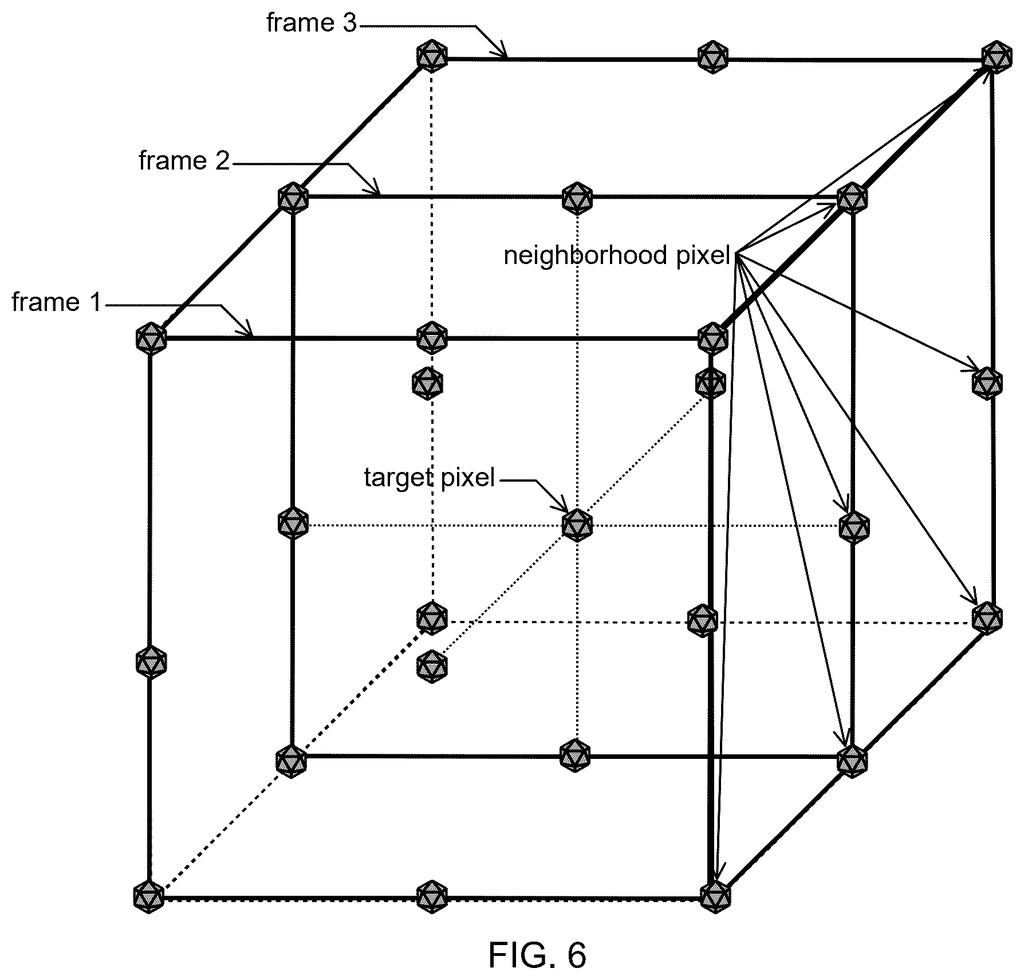
- AI enhancement via multi-headed graph attention: The aligned frames go into a machine learning model. 'Multi-headed graph attention' means the model runs several parallel comparisons at once, each looking at different relationships between pixels across all the frames. For any pixel it wants to improve, it calculates a weighted average drawing on similar pixels from every frame in the set, weighted by how relevant each one seems. The result is a sharper, cleaner estimate of what that pixel should look like.
- Display output: The enhanced frames are sent straight to the headset's display.
The 'graph attention' framing is notable because it treats the pixels across frames as a connected network rather than a simple stack of images, letting the model find useful information from non-obvious spatial relationships. The model is pre-trained, so all of this runs at inference time on the device without sending data to a cloud server.
The machine learning model is trained to employ multi-headed graph attention to modify a target pixel at a specified location in a target image frame based on a weighted sum of other pixels in the image frames.
Translation: An AI algorithm sharpens individual pixels by analyzing and combining data from surrounding video frames.
What this means for mixed-reality headset video quality
Passthrough video quality is one of the central complaints about current mixed-reality headsets. When the camera feed looks noticeably worse than unassisted vision, the whole premise of an XR device that 'blends' digital and physical worlds breaks down. A system that sharpens that feed without adding significant lag could make the experience feel far more natural to everyday users.
Samsung keeps filing on XR display and imaging This particular patent also sits squarely in software and model architecture, meaning it doesn't require new camera hardware to work. If the AI model is efficient enough to run on existing chips inside a headset, Samsung could potentially apply it to devices already in development or even push it as a firmware update.
Samsung's 126th filing we've tracked in our camera sensor push since May adds to work like the color fix for dark photos and the frame-merging shortcut.
Nothing described here requires new hardware. The improvement is a trained software model that runs on whatever processor a headset already contains, which puts this closer to a software update than a product launch.
The real open question is speed. The method collects and lines up several frames before improving them, and even a small delay in a passthrough headset makes the physical world feel slightly out of sync with your own body. The filing does not address how fast this actually runs, which is the one thing that determines whether this ships or stays on a research shelf.
The underlying approach already works in smartphone cameras during burst shooting, so moving it to live video in a headset is a believable next step. If the speed holds up, a wearer would notice the improvement immediately without needing to understand anything about how it works.
There are more where this came from
We read every patent application Big Tech publishes and send you the ones worth knowing. Plain English, free, every week.
The drawings
10 drawing sheets from US 2026/0278742 A1 · click any drawing to enlarge


Want this weekly breakdown for a company we don't cover? Patentlyze Pro →