
Apple Patents a Two-Device System That Sharpens Only What Your Eyes Are Looking At
Your eyes only see fine detail in a small patch at the center of your vision, and Apple wants to exploit that fact by splitting the rendering work across two devices, so one handles the sharp center and the other handles everything else.
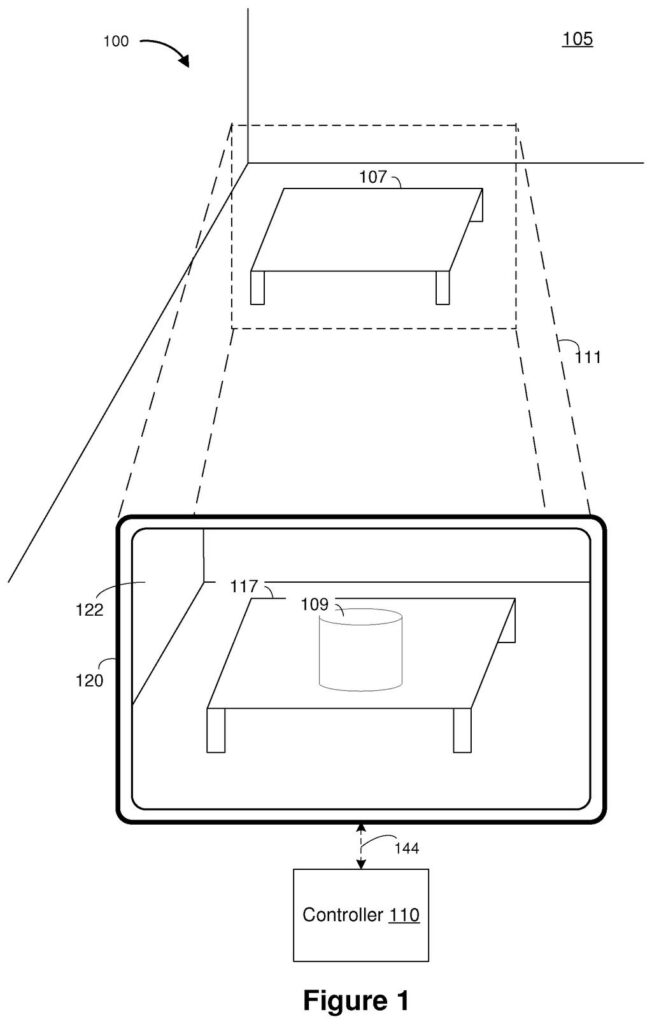
How Apple splits eye-tracking work between two devices
Displays today render every pixel at full quality, whether your eyes are pointed at it or not. That wastes enormous computing power, especially in headsets where you need high frame rates to avoid nausea. Apple's patent describes a way to focus that power exactly where your eyes are aimed.
The system uses two devices working together. One device tracks where you're looking and sends that information, plus a set of instructions called warp parameters, to the other device. The second device then renders a sharp, detailed image only around your gaze point and a lower-detail version everywhere else. The result gets sent back to the first device to display.
The split means neither device has to do all the heavy lifting alone. The device you're wearing handles the eye tracking and the final image; a companion device, perhaps a phone or a processing puck, handles the rendering math. That division of labor could let Apple build lighter, cooler, longer-lasting hardware without sacrificing image quality where it counts.
… determining, based on the gaze data, a portion of the unwarped image data corresponding to the gaze location; generating warped image data by warping the unwarped image data based on the gaze data …
Translation: The system figures out what you are looking at and distorts the image around it.
How the warp parameters flow between the two devices
The patent describes a technique called foveated rendering (named after the fovea, the small central area of your retina responsible for sharp vision). The idea is to render the part of the scene your eyes are actually focused on at full resolution, and render the surrounding area at a reduced resolution, since your peripheral vision can't detect fine detail anyway.
What's distinctive here is the distributed part. The system is split across two devices:
- A first device (the display, likely a headset or glasses) collects gaze data from eye-tracking sensors, determines where in the stored image frame your gaze is landing, and sends warp parameters (a compact set of numbers describing where to focus detail) to the second device.
- A second device (a companion processor, phone, or dock) holds the raw, unwarped image in memory, receives those warp parameters, applies a spatial distortion that concentrates pixels around the gaze point, and ships the resulting warped image data back.
The warped image has two distinct zones: a high-detail region centered on where your eyes are pointed, and a downscaled, compressed version covering the rest of the frame. Only the combined output travels back across the link to the display device.
By dividing the task, neither device bears the full computational load. The display device doesn't need a powerful GPU; the companion device doesn't need to host its own display or eye-tracking hardware. The patent's independent claim also covers the reverse perspective: the companion device generating the warp and pushing it to the display device.
… transmitting, to a second device having a second display, warp parameters based on the gaze data. The method includes receiving, from the second device, display data based on the warp parameters.
Translation: The two devices send eye tracking data back and forth to adjust the display.
What this means for future Apple headsets and glasses
For anyone who has worn a VR or AR headset, weight and heat are the two things that ruin the experience fastest. Rendering every pixel at full quality is one of the biggest contributors to both. A distributed foveated system lets Apple put a lighter chip in the headset itself, offloading the hard rendering work to a device you carry in your pocket or leave on a table nearby. That's a real engineering path toward headsets that don't feel like wearing a brick.
Apple's long bet on spatial computing shows up here in a very practical form. The Vision Pro already offloads some compute to a companion battery pack; this patent hints at taking that further, where gaze-driven rendering is shared across hardware rather than stuffed into one device. If the wireless link between the two devices is fast and reliable enough, the user experience could be indistinguishable from local rendering, but the headset could be meaningfully smaller and lighter.
Apple's 56th filing we've tracked since May in our AR glasses watch builds on one for moving AR groups and one for meeting content permissions.
The core cost here is time. Every eye movement triggers a message to a second device, which then sends back image data fast enough to match where your eyes have already moved. If that loop slows down even slightly, the sharp part of the image will lag behind your gaze in a way you'll feel before you can describe it.
What the design trades away is resilience. A wireless connection between two devices drops and stutters unpredictably, and the patent says nothing about what happens to the image when that signal hiccups.
The underlying logic is sound: keeping heavy image processing off a device that sits on your face is a reasonable goal. But the value of that trade depends entirely on a wireless link staying fast and steady, and that is the part this design leaves unresolved.
There are more where this came from
We read every patent application Big Tech publishes and send you the ones worth knowing. Plain English, free, every week.
The drawings
20 drawing sheets from US 2026/0277320 A1 · click any drawing to enlarge


Want this weekly breakdown for a company we don't cover? Patentlyze Pro →