
Apple Patents a Way to Move Groups of AR Objects With a Single Gesture
Arranging virtual objects in a headset can feel like trying to move furniture one piece at a time. Apple's new patent describes a way to grab several AR objects together and reposition them all at once.
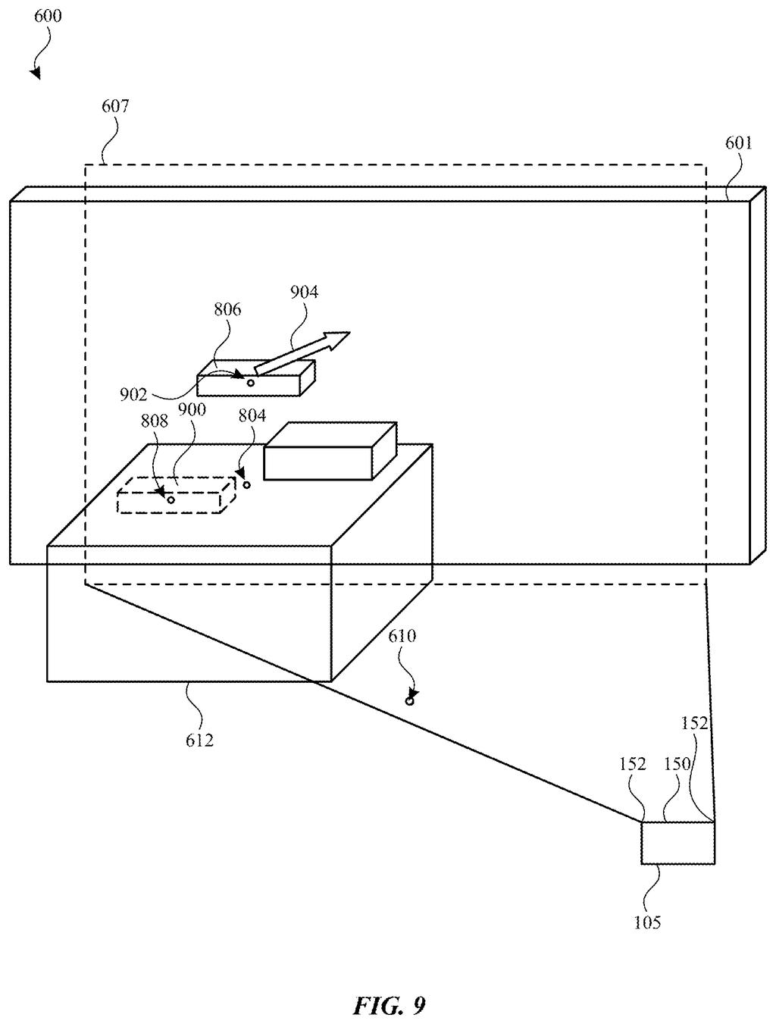
What Apple's grouped AR object placement actually does
Ever tried to rearrange a group of things and keep accidentally scattering them? That frustration is exactly what this patent addresses for augmented and mixed-reality headsets like Apple Vision Pro.
Right now, if you have several virtual objects pinned to spots around your room, such as a calendar on one wall and a to-do list next to it, moving them means adjusting each one individually. Under Apple's patented approach, you could select a point between those objects, and the device would recognize them as a linked group. From then on, moving a physical object in the room (like picking up a small prop or controller) would move the whole group together, keeping the spacing between them exactly as you set it.
Your virtual desktop layout, in other words, travels with you rather than staying stuck to the walls. It's a small workflow change that could make spatial computing feel much more like rearranging real things.
… detecting a user gesture indicating selection of a location between the first virtual object and the second virtual object; generating, responsive to the user gesture, a proxy anchor for joint movement of the first virtual object and the second virtual object …
Translation: Recognizing a hand movement between two items creates a temporary anchor to move them together.
How the proxy anchor tracks physical objects in the room
The system works in three stages.
First, it stores a relationship. When two or more virtual objects are displayed in an extended reality environment, the device records not just where each one is, but the spatial relationship between them, essentially saving the gap, angle, and relative positions as a bundle.
Second, it detects intent. When you gesture toward a point between those objects, the device interprets that as selecting the whole group rather than any individual item. It then creates what the patent calls a proxy anchor, a temporary reference point that corresponds to a specific physical object in the real room.
Third, it moves the group. As the device tracks that physical object's movement (using the headset's cameras and sensors), it translates that tracked movement into repositioning for every virtual object in the linked group simultaneously. The relative spacing between objects is preserved throughout.
- Associations between virtual objects can reflect app preferences or system-level rules.
- The proxy anchor ties the group's movement to something physical, giving the user a tangible handle on abstract content.
- The gesture that triggers grouping happens between the objects, not on any single one.
Aspects of the subject technology provide a real-time system for positioning and/or arranging application content anchored to locations in a physical environment.
Translation: The technology instantly places digital app content so it stays fixed to specific spots in the real world.
What this means for Apple Vision Pro and spatial apps
For anyone using a spatial headset as a real work environment, managing multiple pinned windows or information panels is one of the biggest daily friction points. Having to adjust each object one by one after walking across the room, or after the room's furniture shifts, slows everything down.
This patent points toward a more intuitive spatial computing experience where your layout is something you own and carry, not something you rebuild every session. Apple has been filing around spatial interaction design since 2022, and this filing fits that direction: the closer extended reality gets to matching the casual ease of rearranging real objects, the more useful it becomes as a daily computing environment.
Apple's 55th filing we've tracked since May in our AR glasses work adds to earlier applications on per-person meeting permissions and display depth as you move.
Keeping multiple floating windows in consistent positions inside a headset is one of the most exhausting problems in the medium. Every time you move, adjust, or re-enter a space, you're manually re-sorting an invisible mess.
Tying a group of virtual objects to a physical prop you can actually touch is a sensible match for that frustration. The mental model is simple: move the physical thing, move the group.
Whether this becomes useful depends entirely on how reliably the device recognizes the prop and how smoothly the gestures respond. A good idea with clunky execution would leave the core problem unsolved.
There are more where this came from
We read every patent application Big Tech publishes and send you the ones worth knowing. Plain English, free, every week.
The drawings
14 drawing sheets from US 2026/0277386 A1 · click any drawing to enlarge


Want this weekly breakdown for a company we don't cover? Patentlyze Pro →