
Sony Patents an AI That Rewrites a Game's Video and Audio Mid-Session for Accessibility
Most game accessibility features are bolted on as menus or toggles. Sony is patenting something different: an AI that watches the game as it runs and rewrites the video or audio output, frame by frame, to match a player's specific accessibility needs.
What Sony's real-time game accessibility AI actually does
Every time a player with color-blindness, low vision, or a hearing disability boots up a game, they face the same lottery: did this studio bother to add the accessibility options they need? Usually the answer is partial, outdated, or missing entirely.
Sony's patent describes an AI engine that sits between the game and your screen (or speakers). The game runs exactly as normal, and the AI watches what it's producing. Then, knowing your specific accessibility profile, it generates a replacement version of that content in real time and sends that to your display instead. The original game code doesn't need to change at all.
The key word is real-time. This isn't a filter applied to a recording after the fact. The AI is trained on accessibility information for different conditions and produces adapted content while you're actively playing, so there's no pause, no loading screen, and no break in the experience.
an artificial intelligence engine generates the second media content in real-time relative to the execution of the video game application based at least in part on the artificial intelligence engine receiving at least a portion of the first media content as an input …
Translation: An AI instantly processes normal game footage to create customized versions.
How the AI swaps out game content without pausing play
The system works in three linked steps that run continuously during gameplay.
First, the game produces its normal output, what the patent calls first media content. That might be a rendered frame (the picture on your TV) or an audio stream (dialogue, sound effects). The system intercepts this before it reaches the display.
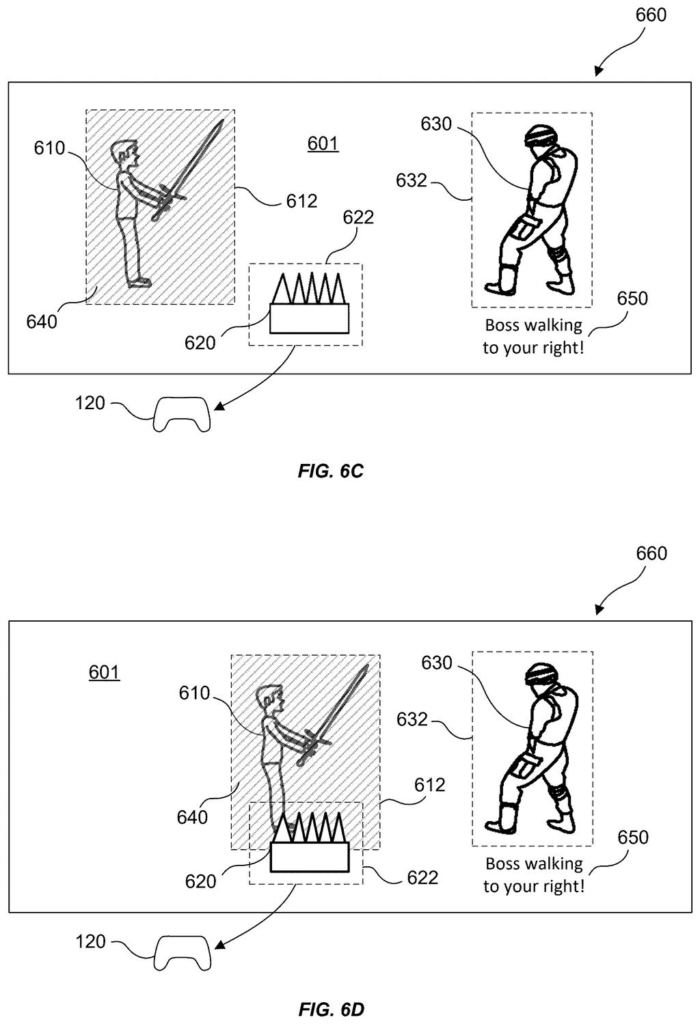
Second, the AI engine receives that raw game output as input. It has already been trained on a library of accessibility information tied to specific user conditions, things like color-vision deficiency profiles, low-contrast sensitivity, or hearing loss patterns. Based on the player's stored accessibility status, the engine generates an alternative version of the content, the second media content.
Third, that AI-generated version is sent to the screen or speakers instead of the original. The original game still runs at full speed in the background.
- The game application is never paused or modified
- The AI operates in real-time, frame by frame or stream by stream
- The adaptation is personalized to the individual player's accessibility profile
- Output can replace visuals, audio, or both
The claim covers the full pipeline: detecting what the game is about to show, generating the adapted alternative, and routing that alternative to the user interface.
… causing, while the execution of the game application continues, a second media content to be generated based on an accessibility status of the user.
Translation: The game modifies its audio and visuals on the fly to match a player's needs.
What this means for disabled players and PlayStation's future
For players who currently depend on developers to individually build and test accessibility modes, this approach could be significant. Right now, if a studio doesn't ship a color-blind mode or audio description track, you simply don't have one. A platform-level AI layer wouldn't depend on each studio doing the work separately.
Sony keeps filing on AI-assisted player experience across its gaming platform, and this one sits at a genuinely difficult intersection: making games accessible without requiring game publishers to rebuild anything. The commercial angle is also real. Expanding the playable audience for every title on a platform is a meaningful business case, not only an ethical one.
Sony's 25th filing we've tracked in Enterprise AI since May follows a robot routing server and a self-rebuilding app interface, showing Sony exploring how AI can manage both physical and digital systems.
The core cost Sony accepts here is the gap between what an AI assumes someone needs and what that person actually needs. Color blindness alone takes several distinct forms, and a system trained on broad categories will sometimes produce an adaptation that confidently misses the mark for a specific user. A wrong adaptation is not neutral; it can feel more disorienting than the original problem.
Speed is the second pressure point. Any noticeable delay between a game moment and its adapted version makes the whole experience feel broken, and the patent makes no concrete claims about how that lag gets controlled.
The trade still has a reasonable case behind it: accessibility support that works at the platform level, automatically, across every game, solves something individual developers have consistently failed to prioritize on their own. Whether that promise holds depends entirely on execution the patent has not yet shown.
There are more where this came from
We read every patent application Big Tech publishes and send you the ones worth knowing. Plain English, free, every week.
The drawings
9 drawing sheets from US 2026/0273417 A1 · click any drawing to enlarge


Want this weekly breakdown for a company we don't cover? Patentlyze Pro →