
Apple Patents a System for Keeping Group Call Participants Together in 3D Environments
When two people are looking at the same 3D object in a virtual call, who gets to move it? Apple has patented a specific answer: a 'local driver' system that grants or blocks control based on each device's current state.
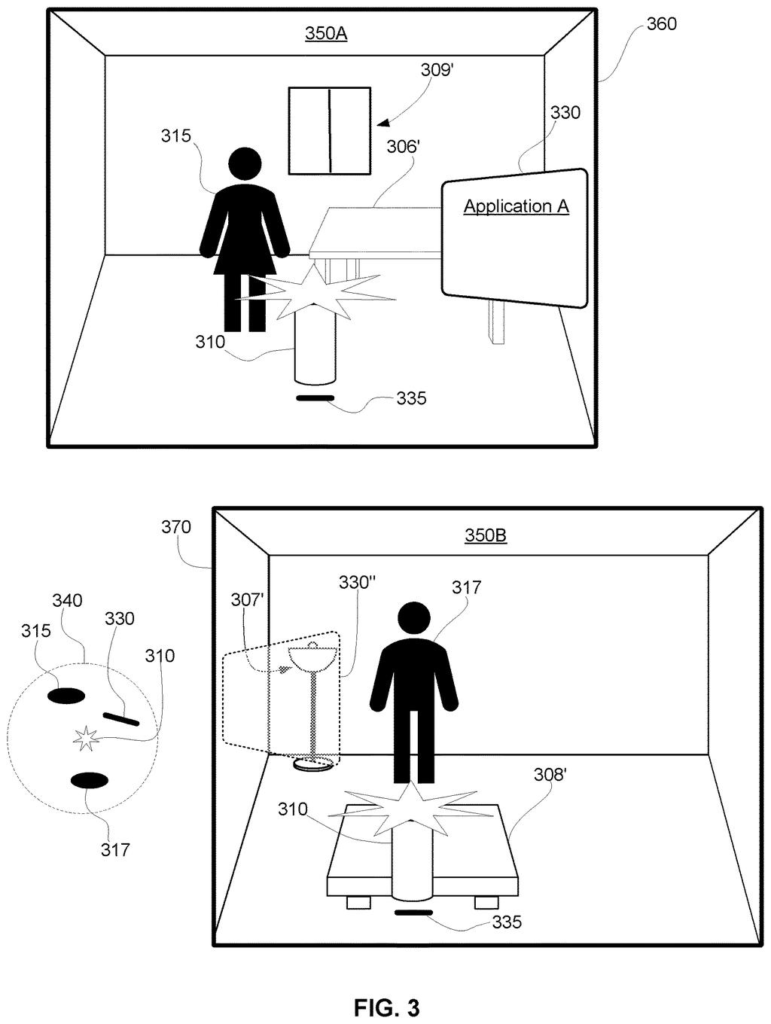
How Apple's spatial group controls work in a shared 3D call
Ever tried to edit a shared document at the same time as a colleague, only for each other's changes to collide? Now picture that same problem in a 3D virtual space, where two people are looking at the same floating object during a video call.
Apple's patent describes a system called spatial groups for multi-user sessions in 3D environments. When you and another person are in the same spatial group, you can both see a shared object. But only one person, the "local driver," can actually interact with and update it at any given moment. If your device's state changes (say, you step away, switch modes, or lose group membership), control rules shift automatically.
This keeps shared virtual spaces from turning into a tug-of-war over who can grab what. Think of it like the "driver" seat in a car: one person steers, and everyone else watches the same road.
… updating, via the one or more displays, display of a visual appearance of the first object in the three-dimensional environment in accordance with the input …
Translation: The group leader can physically interact with and change the shared virtual object.
How the 'local driver' state decides whose input wins
The patent covers a method running on a first electronic device that is paired with a second electronic device in a live communication session. Both devices render the same three-dimensional environment, including a visual stand-in for the other user and a shared 3D object.
When a user tries to interact with that shared object (by tapping, pinching, or using any supported input), the device first checks its own "state". That state flag determines whether the user is the "local driver" of their spatial group.
- If you are the local driver, your interaction updates the object's appearance for both devices in real time.
- If you are not the local driver, the interaction is silently dropped. Nothing changes, even though you tried.
- If either device changes state (for example, a user disengages or a device goes offline), the two users can be removed from the same spatial group entirely, changing who holds driver status.
The design is intentionally asymmetric: one device arbitrates control locally rather than negotiating back and forth over the network. That keeps the experience responsive and avoids conflicts when both users try to manipulate the same object simultaneously.
… the user of the first electronic device and the user of the second electronic device are no longer grouped into the same spatial group within the multi-user communication session …
Translation: Participants are automatically separated into different virtual spaces if their connection states change.
What this means for visionOS and shared virtual workspaces
For anyone using Apple Vision Pro or a future spatial computing device, this is the infrastructure that would make shared virtual workspaces actually usable. Without a rule like this, two people grabbing the same 3D model in a call would produce chaotic, contradictory results on each screen.
The patent is narrow in a practical sense: it specifically covers the local driver logic and the state-change trigger that breaks up a spatial group. several Apple filings on spatial computing collaboration this year suggest the company is building a full framework around multi-user 3D sessions. Whether visionOS ships this exact mechanism or something close to it, the underlying problem, deciding who controls shared virtual objects, is one every spatial computing platform will have to solve.
Apple's 453rd filing in our Apple coverage since May continues a focus on eye-tracking, following applications on a gaze-reactive headset frame and a two-device sharpening system.
Claim 1 covers a precise sequence of steps: when a user interacts with a shared virtual object, the device first checks its own internal readiness before deciding whether to carry out or ignore that action. That sequence, happening locally on the device, is what the claim actually protects.
In practice, any competing system that follows the same check-then-act order on the device itself would fall within the claim's reach. A system that sends the same decision to a remote server first would likely sit outside it, which makes the protected territory real but specific.
That specificity reflects a genuine design priority. On a headset worn on your face, a local check takes milliseconds less than a server round-trip, and when someone reaches for a virtual object, that small delay is the difference between an interaction that feels real and one that feels broken.
There are more where this came from
We read every patent application Big Tech publishes and send you the ones worth knowing. Plain English, free, every week.
The drawings
27 drawing sheets from US 2026/0277312 A1 · click any drawing to enlarge


Want this weekly breakdown for a company we don't cover? Patentlyze Pro →