
Microsoft Patents a Predictive Digital Ink System That Only Reports When It's Wrong
Your stylus is constantly shouting its position to your computer — even when nothing surprising is happening. Microsoft's new patent flips that model: only send a report when the prediction is wrong.
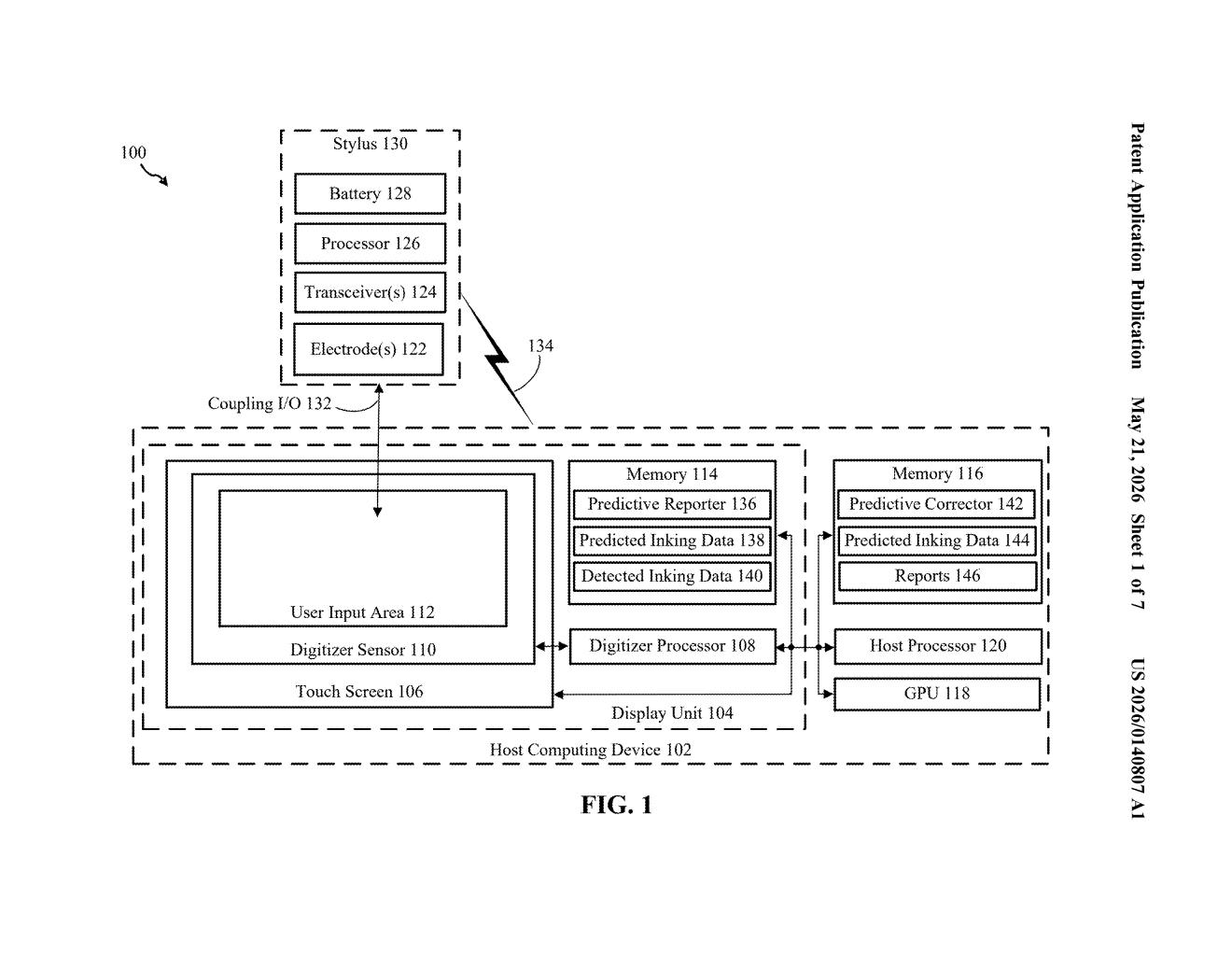
What Microsoft's predictive ink reporting actually does
Imagine you're drawing a slow, steady curve with a stylus. Every tiny movement gets reported to your PC dozens of times per second — even when the line is completely predictable. That's a lot of data for something your computer could have guessed on its own.
Microsoft's patent describes a system where both the stylus digitizer and the host computer run the same prediction model simultaneously. The digitizer forecasts where your pen is going next, and so does the PC. If reality matches the prediction, no report gets sent — the host just uses its own guess. A report only fires off when your actual stroke diverges from the predicted one by more than a set threshold.
The prediction models can be swapped depending on what you're doing — polynomial regression for smooth curves, Fourier series for more rhythmic or repeating strokes, or even custom user-defined models. The result is fewer data packets flying between your stylus hardware and your computer, without your digital ink looking any different.
How the predictor-detector loop filters stylus reports
The system has two synchronized components: a predictive reporter running on the digitizer (the hardware that reads your stylus) and a matching predictor on the host computer.
Here's the core loop:
- The digitizer detects a pen position and simultaneously predicts where the pen should be based on prior movement.
- A detector compares the actual reading to the prediction and calculates the error — how far off the guess was.
- If the error is below a threshold, no report is transmitted. Both sides stay in sync using their shared prediction model.
- If the error exceeds the threshold, a corrective report is sent to the host, which updates its model accordingly.
The prediction algorithms are interchangeable. Polynomial regression (fitting a curve to recent data points) works well for smooth, continuous strokes. Fourier series (decomposing a signal into repeating wave components) suits more periodic motion patterns. The system can select models dynamically based on input conditions.
The net effect is a significant reduction in the volume of data the digitizer needs to transmit — without any visible degradation in ink fidelity, since the host is always running the same model and corrects itself the moment a real deviation arrives.
What this means for stylus latency and battery life
Stylus input is one of the more bandwidth-intensive interactions between hardware and a PC. Reducing unnecessary reports means less CPU overhead processing ink events, potentially lower power draw on both the digitizer and the host, and — in wireless stylus scenarios — less radio traffic eating into battery life. For devices like the Surface Pro or any Windows tablet with an active pen, this kind of efficiency work compounds across long writing or drawing sessions.
There's also a latency angle worth noting: if the host already has a good prediction, it can render ink ahead of confirmed reports, making strokes feel more responsive. This patent formalizes the infrastructure needed to keep both sides of that prediction in lockstep — which is the hard part of making predictive ink rendering reliable rather than glitchy.
This is unglamorous plumbing work, but it's the kind that actually ships and makes products feel better. The dual-predictor architecture — running the same model on both ends so you only sync on divergence — is an elegant solution to a real bottleneck in pen input. Worth watching for anyone building stylus-enabled hardware or drivers on Windows.
There are more where this came from
We read every patent application Big Tech publishes and send you the ones worth knowing. Plain English, free, every week.
Want this weekly breakdown for a company we don't cover? Patentlyze Pro →