
Microsoft Patents a Real-Time Meeting Summarizer That Switches AI Attention Modes on the Fly
Most AI meeting summaries arrive after the call ends. Microsoft is patenting a system that builds the summary while people are still talking — by cleverly toggling between two different ways of reading the conversation.
What Microsoft's live meeting summarizer actually does
Imagine you're 20 minutes into a one-hour Teams call and you want a quick recap of what's been decided so far. Today, most AI tools make you wait until the meeting is over before handing you a summary. Microsoft's new patent describes a system that generates that summary in real time, as the words are still being spoken.
The trick is how it processes the audio. Two different reading modes — one that only looks backward at what's been said, and one that looks both backward and forward — take turns handling the incoming speech. The backward-only mode is fast and works well for live, incomplete sentences. The two-way mode is more thorough but needs a chunk of context to work well, so it kicks in less often.
The result is a rolling summary that stays current without lagging behind the conversation. You could theoretically check in mid-meeting and get a coherent, up-to-date digest of everything discussed so far.
How the attention-switching encoder processes live speech
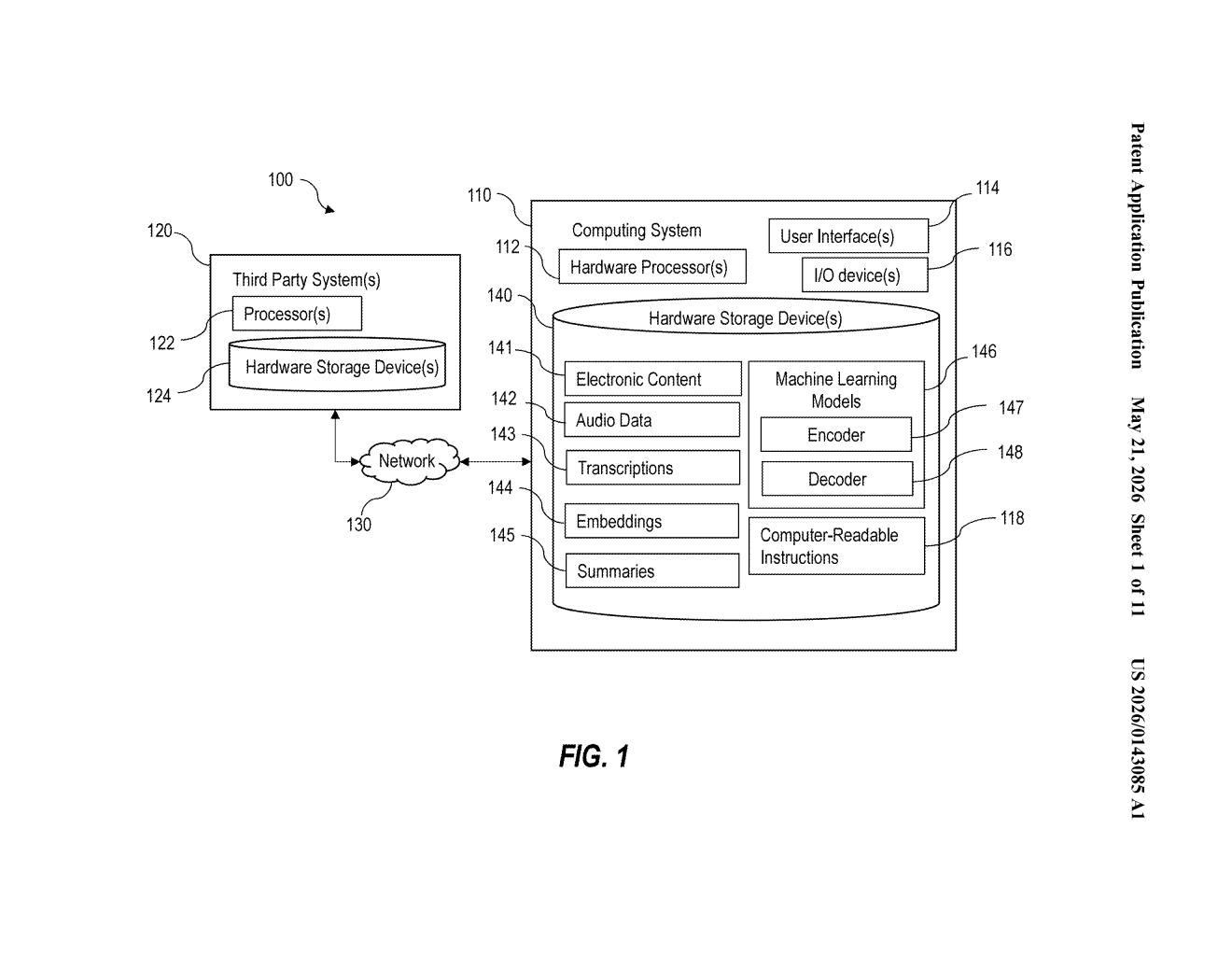
The patent describes an encoder-decoder architecture applied to a live audio stream. Speech is first converted to text (via automatic speech recognition), then fed into a transformer-style encoder — the kind of neural network layer that's at the heart of most modern language models.
The core innovation is the alternating attention mechanism:
- Unidirectional (causal) attention — the model only looks at tokens that came before the current word. This is how GPT-style models work and is well-suited to streaming because you don't need future context to process the present moment.
- Bidirectional attention — the model looks both backward and forward across a window of text, like BERT does. This produces richer representations but requires a complete chunk of text, so it can't run on every token in a live stream.
The patent specifies that these two modes run at different frequencies — unidirectional attention applies more often (essentially token-by-token), while bidirectional attention applies less frequently, periodically re-processing buffered content to refine the summary.
A decoder then takes the encoded representations and generates the actual summary text. The system is designed to keep the summary continuously updated rather than waiting for a defined endpoint like a sentence boundary or meeting end.
What this means for Teams and real-time AI notes
If this lands in Microsoft Teams or Copilot, it closes one of the more annoying gaps in AI meeting tools: the fact that you can't get a useful AI-generated recap mid-meeting. Real-time summaries would be useful not just for latecomers catching up, but for anyone who needs a quick "where are we?" check before making a decision in the room.
The attention-switching design also matters technically. It's a pragmatic middle ground between the latency of pure causal models and the accuracy of full bidirectional models — essentially admitting that live summarization is a different problem than post-hoc summarization, and solving it differently. That architectural honesty is worth noting.
This is a real engineering problem with a thoughtful solution. The hybrid attention approach isn't a marketing gimmick — it reflects a genuine trade-off that anyone who's tried to apply BERT-style models to streaming data has run into. Whether it ships as a polished Teams feature or stays buried in Copilot infrastructure, it's the kind of unglamorous plumbing that actually makes AI assistants more useful day-to-day.
Get our take in your Top Stories
Liked this breakdown? Add Patentlyze as a preferred source on Google, and our plain-English take shows up more often in your Top Stories the next time Microsoft patent news breaks.
There are more where this came from
We read every patent application Big Tech publishes and send you the ones worth knowing. Plain English, free, every week.
Want this weekly breakdown for a company we don't cover? Patentlyze Pro →