
Salesforce Patents an AI Workspace That Builds Its Own Dashboard From a Question
Type a question, get a whole visual workspace back. Salesforce is patenting a system where an AI doesn't just answer your query, it builds a live, multi-panel dashboard around it automatically.
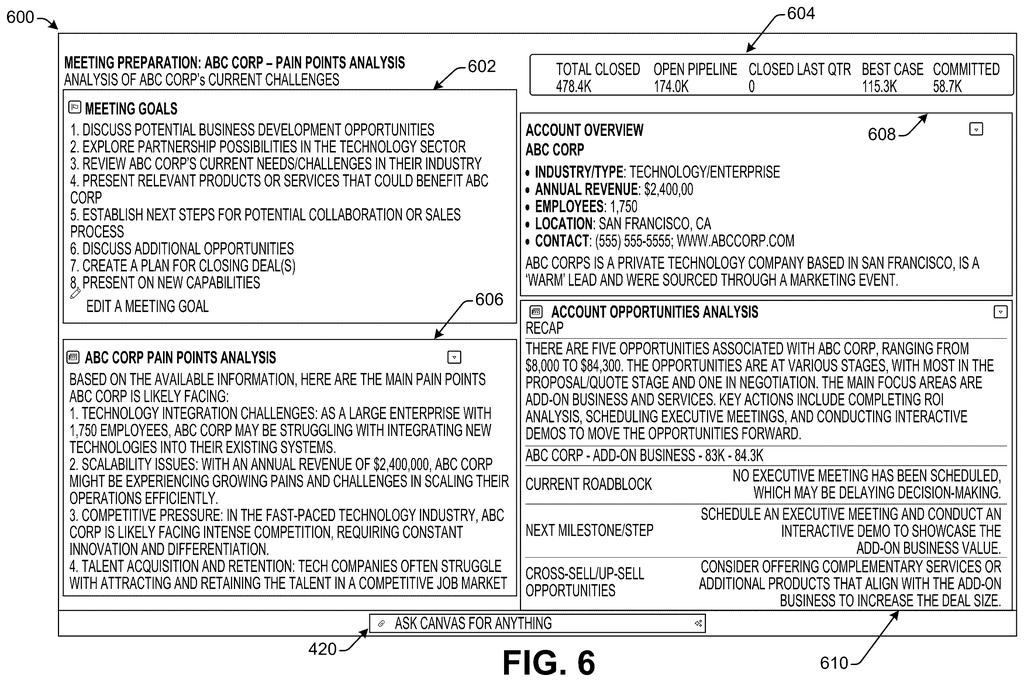
What Salesforce's auto-generated canvas actually does
Imagine you type 'Q3 pipeline health' into your company's CRM and, instead of a single text answer, the screen fills with a structured board: one panel shows deal stages, another shows rep performance, another shows at-risk accounts. You didn't build any of that. The system figured out what mattered and laid it out for you.
That's the core idea in this Salesforce patent. You enter a request, and an AI works out the topic behind it, breaks that topic into distinct sub-areas, and then generates a tiled canvas with content already filled in for each tile. The tiles can be different sizes and arranged in a deliberate layout, not just a uniform grid.
The canvas also stays live. As new relevant data comes in, or as you ask follow-up questions, the workspace updates itself. The goal is to keep you inside one place rather than bouncing between reports, documents, and dashboards to piece together the same picture.
How the AI picks tiles, sizes, and content layout
The patent describes a two-stage AI process. First, a model reads your request and identifies the underlying topic (the actual subject behind what you asked, not just keywords). Second, it determines the distinct aspects or categories of that topic and assigns each one to its own tile.
Each tile then gets populated with content the model considers relevant to that specific aspect. Tiles are not uniform: they vary in size and position to reflect the relative importance or nature of what they contain. Think of it like a responsive magazine layout generated on the fly.
The system is also designed to pull from multiple source types at once, including internal documents, external data, and live records, without requiring the user to navigate to any of those sources directly. Everything surfaces inside the same canvas virtual space.
Dynamic updating is built in. The canvas can refresh when new information becomes available or when the user submits a follow-up request, keeping the workspace current without a manual reload or rebuild. The patent mentions both user-triggered and automatic updates as valid triggers.
What this means for Salesforce's AI assistant strategy
Salesforce already offers an AI assistant layer called Agentforce, and this patent points directly at how that assistant could evolve. Instead of chatbot-style replies, the output could be a full workspace, making AI responses feel more like working environments than answers. That's a meaningful shift in how business software is used, because it reduces the number of steps between asking a question and acting on the result.
For you as a Salesforce user, the practical payoff would be fewer dashboards to maintain manually and less time stitching together views from different reports. The risk is that an AI-curated canvas could also obscure what data it chose not to show, which matters a lot in a business context where missing information has real consequences.
This is a concrete extension of where Salesforce's AI product line is already heading, not a speculative moonshot. The tiled canvas concept is interesting precisely because it shifts AI output from text into a structured visual workspace, which is a more natural fit for the CRM and analytics context Salesforce owns. Whether the layout quality is actually useful will depend entirely on how well the underlying models understand business context, and that's the hard part.
There are more where this came from
We read every patent application Big Tech publishes and send you the ones worth knowing. Plain English, free, every week.
The drawings
15 drawing sheets from US 2026/0211542 A1 · click any drawing to enlarge


Want this weekly breakdown for a company we don't cover? Patentlyze Pro →