
Adobe Patents a System That Teaches Itself to Turn Plain English Into Database Commands
Most people can't write a database query, but they can write a sentence. Adobe is patenting a system that bridges that gap and gets better every time a human corrects it.
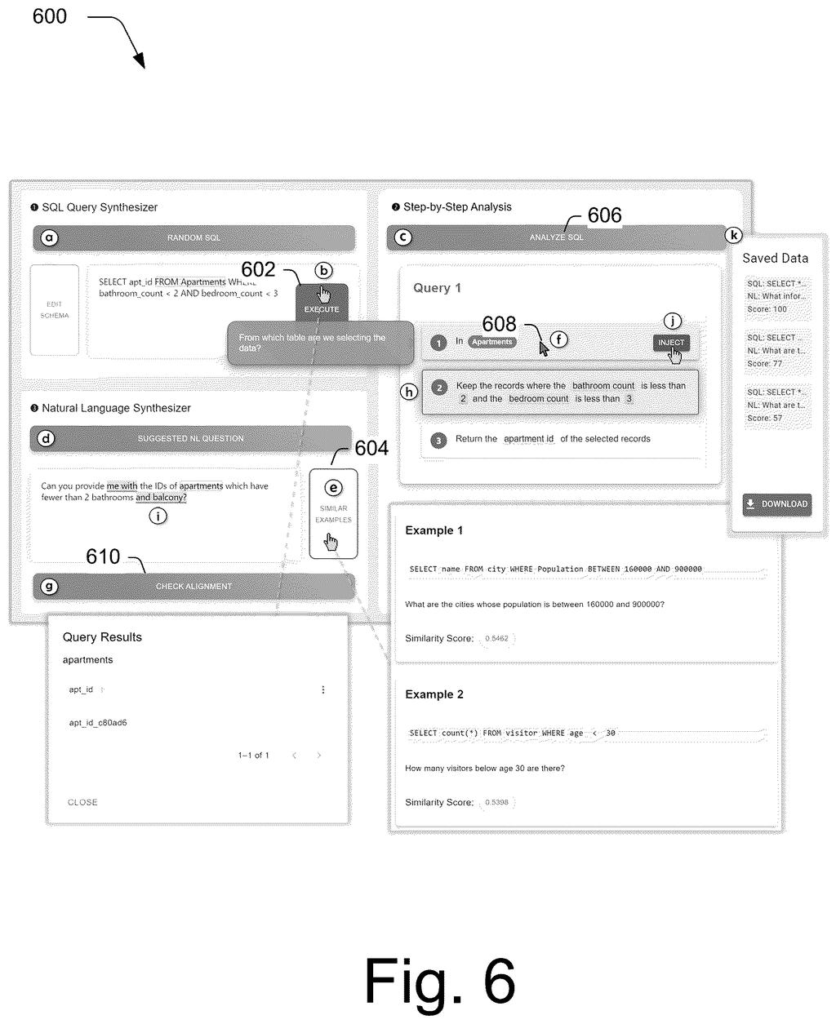
How Adobe's query translator learns from human corrections
Imagine you want to ask your company's database, 'How many customers bought something last month?' But databases don't speak English. They speak a formal code language called SQL. Unless you know that language, you're stuck asking someone else to run the query for you.
Adobe's patent describes a system that does the translation for you. You type your question in plain English, and the system converts it into the technical query the database needs. What makes this different is that it also shows you, step by step, how it arrived at that translation, so you can spot and fix any mistakes.
The clever part: every time a human editor corrects the output, the system learns from that correction. Over time, the tool gets better at translating questions it hasn't seen before, and it can adapt automatically when the database itself changes structure.
How the annotation loop turns edits into training data
Adobe's system tackles a well-known problem in data tools called text-to-SQL: converting a question written in everyday language into a formal database query a computer can run.
The process works like this:
- The system reads the database schema (the blueprint that describes how a database is organized, what tables exist, and what columns they contain).
- It generates a sample database query from that schema, then uses machine-learning models to write a plain-English version of that query.
- It produces a step-by-step annotation explaining how it made the translation, displayed in a user interface so a human reviewer can follow the reasoning.
- The reviewer can edit the plain-English phrasing. Those edits are fed back into a training loop that improves the underlying model.
By starting from the database schema rather than hand-written examples, the system can generate its own training data and update itself when the database structure changes. That's the core design advantage: it doesn't rely on a static library of pre-written question-and-query pairs, which go stale every time a table is renamed or a column is added.
What this means for non-technical database users
For large organizations, the ability to ask a database a question in plain English without writing code has been a long-standing goal. Tools that do this already exist, but they often fail when the database schema is custom or changes frequently. Adobe's approach of generating training data directly from the schema is a practical fix for that brittleness.
Adobe sells data and analytics tools to enterprise customers, so this fits squarely into that product line. If you use Adobe's analytics or data products at work, this kind of technology could eventually mean asking for a report the same way you'd ask a colleague, rather than waiting for someone who knows SQL to run it for you.
This is unglamorous but genuinely useful infrastructure work. The human-in-the-loop feedback design, where the model learns from corrected outputs rather than static training sets, is a sensible way to build a text-to-SQL tool that doesn't break every time the database changes. It's not a headline-grabbing idea, but it's the kind of patient engineering that tends to actually ship and get used.
There are more where this came from
We read every patent application Big Tech publishes and send you the ones worth knowing. Plain English, free, every week.
The drawings
16 drawing sheets from US 2026/0211877 A1 · click any drawing to enlarge


Want this weekly breakdown for a company we don't cover? Patentlyze Pro →
Be the first to weigh in