
Apple Patents a Low-Power Radio That Wakes Your Phone's Main Chip Only When It Has To
Your phone's cellular radio is one of the biggest battery drains you never think about. Apple has filed a patent for a tiny secondary receiver that keeps the main radio asleep until a precise, scheduled wake-up signal arrives.
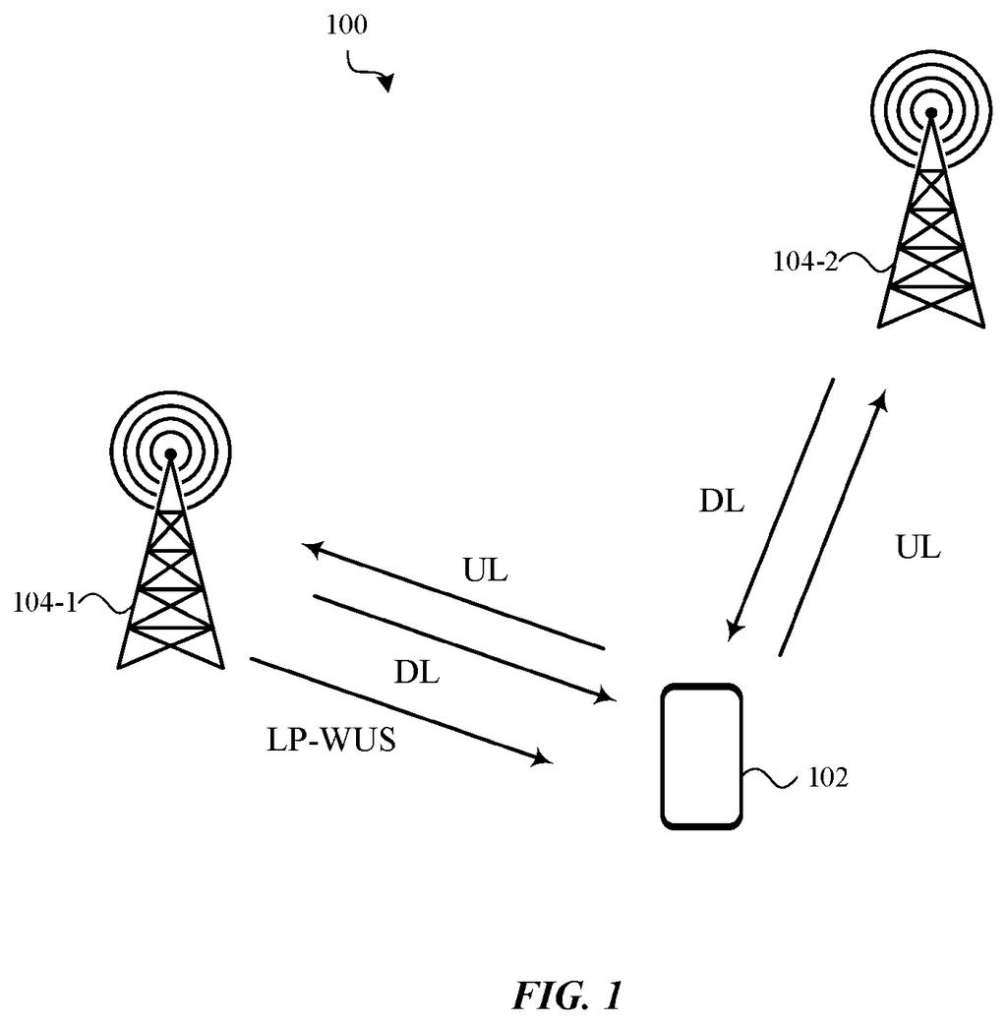
How Apple's wake-up radio keeps your phone's main chip asleep longer
You're out running errands, phone in your pocket, not on a call, not streaming anything. Even so, your phone's cellular chip stays on alert, ready to receive texts, calls, or app notifications. That constant readiness burns battery whether anything actually arrives or not.
Apple's patent describes a two-radio system designed to fix that. A small, low-power "wake-up receiver" stays on and listens in the background, using far less energy than the main cellular chip. The main chip is allowed to sleep. When the network has something for your phone, it sends a precisely timed wake-up signal. The small receiver catches it, taps the main chip on the shoulder, and the main chip wakes up just in time to receive whatever is coming.
The timing is the key detail. The patent describes calculating exactly when to listen for that wake-up signal based on a network-set schedule, so the small receiver isn't listening nonstop either. It powers up for a brief window, checks for the signal, and goes quiet again. The result is a phone that rests more deeply between notifications.
… transition a transceiver of the UE from a sleep state to an awake state upon detecting the WUS during the WUS monitoring occasion.
Translation: The low-power radio wakes up the main phone hardware only when it spots a wake-up signal.
How the WUR timing window is calculated and triggered
The patent describes a user equipment (UE, meaning any phone or cellular device) that includes three main components working together: a standard full-power transceiver, a low-power wake-up receiver (WUR), and a processor that coordinates between them.
The processor calculates a precise schedule for when to listen for a wake-up signal (WUS). That schedule is built from two inputs: a periodicity (a repeating interval, like "check every 320 milliseconds") anchored to a shared timing reference the network and device both know, and an offset (a fixed delay added to that interval to stagger different devices so they don't all check at once). Together these define a narrow WUS monitoring occasion, a brief window when the small receiver powers up.
During that window, the WUR alone is active. The main transceiver stays in a sleep state. If the WUR detects the wake-up signal during that window, it triggers the transceiver to power on and enter an awake state in time to receive the actual incoming data, such as a page (a network alert that a call or message is arriving).
If no signal arrives, the WUR returns to idle without ever waking the main radio. The design fits into the 5G NR (New Radio) paging framework, where base stations alert idle devices before transmitting to them.
… a wake-up receiver (WUR) operable at a lower power than the transceiver, and a processor.
Translation: A separate, ultra-low-power receiver stays on constantly to listen for incoming signals.
What this means for 5G phone battery life
Battery life on 5G phones has improved, but the cellular radio remains a persistent drain even in standby. A hardware approach like this, where a physically separate low-power chip handles the listening duty, can reduce idle power consumption in a way that software optimizations alone cannot reach.
For everyday users, the practical win would show up as a phone that lasts longer between charges without any change in how quickly calls and messages arrive. The tradeoff for network engineers is added complexity in timing coordination between the base station and the device, but that complexity is handled invisibly. the pattern in Apple's wireless-efficiency filings suggests the company is treating idle-mode power as a hardware-level problem, not just a settings menu one.
Apple's 463rd filing we've tracked since May in our Apple coverage continues a thread on wireless efficiency, following work on handing off between towers and phones finding each other without one.
The engineering tradeoff here is clear: you add a second radio to save power on the first. That only works if the WUR itself draws so little power that it more than offsets the cost of building, integrating, and running an extra chip. The patent doesn't publish the actual power numbers, which is where the real argument lives.
There's also a timing-precision cost. The whole system depends on the device and the network sharing an accurate time reference and agreeing on the schedule. If that reference drifts, or if the offset calculation doesn't account for real-world network jitter, the WUR listens during the wrong window and misses the signal. The main radio then doesn't wake up, and your call goes to voicemail. That's a meaningful failure mode to get right.
That said, this is a mature approach in low-power wireless design (similar ideas have been adopted in Wi-Fi and IoT standards) and Apple is applying it to the more demanding cellular context. The bet reads as worthwhile, but the patent's value will show up only in the implementation details, not in the concept.
There are more where this came from
We read every patent application Big Tech publishes and send you the ones worth knowing. Plain English, free, every week.
The drawings
10 drawing sheets from US 2026/0292694 A1 · click any drawing to enlarge


Want this weekly breakdown for a company we don't cover? Patentlyze Pro →
Be the first to weigh in