
Samsung Patents a Method to Track and Predict Movement in Video Frame by Frame
When a video is compressed and then played back, the decoder has to guess where moving objects went between frames. Samsung's new patent describes a more precise way to make that guess, working pixel by pixel rather than block by block, and staying within strict memory boundaries.
What Samsung's pixel-level motion fix actually does
A soccer player sprints across your screen. Your TV is actually reconstructing that motion from compressed data, guessing where each pixel should be based on two nearby frames. That guessing process is called motion compensation, and doing it well is the difference between crisp playback and blurry, blocky video.
Samsung's patent describes a method that combines two approaches at once: a coarser, block-level motion estimate and a finer, per-pixel estimate based on something called optical flow (a way of tracking how brightness patterns shift across frames). The trick is doing this without having to peek at pixel data stored outside the current working area, which saves memory and keeps the process efficient.
The result is a decoder that can sharpen up edges and fast-moving objects at the boundary of each block, where compression artifacts tend to be worst, without adding the kind of memory overhead that would slow down real hardware.
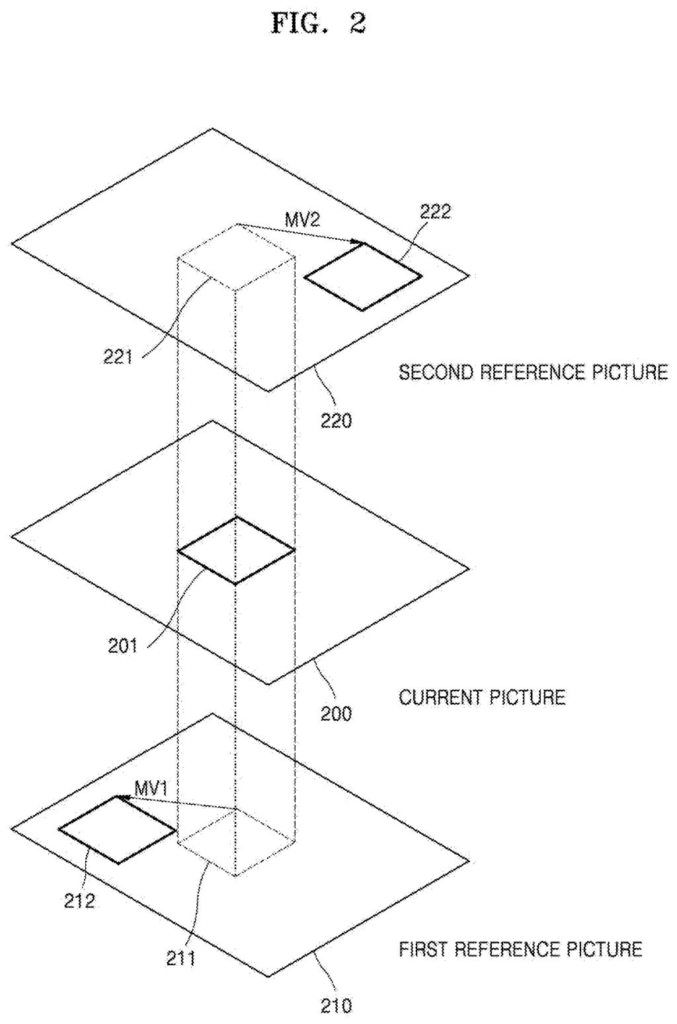
… obtaining a first extended reference block in a first reference picture using the first motion vector, and a second extended reference block in a second reference picture using the second motion vector …
Translation: The system grabs expanded blocks of pixels from two different reference frames using motion vectors.
How the extended reference blocks and clipping work
Video compression works by storing motion as vectors: instead of saving every pixel in every frame, a codec records where a block of pixels came from in a previous frame and where it went in a future frame. When playing back, the decoder uses those two reference blocks to reconstruct the current image.
This patent adds a refinement step called optical flow-based compensation. Optical flow (a technique borrowed from computer vision that measures how pixel brightness changes across frames) lets the decoder compute a small correction vector for each group of pixels, on top of the coarser block-level motion vector already in the stream. The closer to the edge of a block a pixel sits, the more it benefits from this fine-tuning.
To calculate the optical flow accurately, the decoder needs to know the gradient (the rate of brightness change) at each reference pixel. Gradients at the very edge of a reference block normally require reading pixels just outside that block, but this patent avoids that by fetching slightly enlarged "extended" reference blocks upfront:
- A first extended reference block is pulled from the past reference frame, including a small border region.
- A second extended reference block is pulled from the future reference frame, with its own border.
- Those border pixels are used only to compute edge gradients, not stored separately.
Finally, when the intermediate math produces a displacement value that is too large (a sign the estimate has gone wrong), a clipping operation (think of it as a hard ceiling and floor) brings it back inside a safe range before it is applied. The whole pipeline runs at the block level first, then at the pixel-group level, combining both for the final prediction.
… determining a displacement vector per unit time of pixels of a current block in a horizontal direction or a vertical direction …
Translation: It calculates exactly how fast individual pixels inside a video block are moving sideways or up and down.
What this means for video streaming and compression
For everyday streaming, better motion compensation means fewer blocky artifacts when action scenes get fast, or when you pause on a frame with lots of movement. The specific improvement here is at block boundaries, which is exactly where today's codecs tend to leave visible seams.
From a hardware perspective, the patent is written entirely as a software-level decoding algorithm. No new chip architecture is required; the extended reference blocks are just a different fetch pattern during normal decoding. That means Samsung's track record in video codec patents could translate into a software update to an existing decoder rather than a silicon redesign, shortening the path to any eventual product.
Samsung's 132nd filing we've tracked since May in our camera sensor push work builds on ideas like the blurry footage memory fix and the autofocus HDR chip.
The method described here lives entirely in software, which means no new chips or specialized hardware have to exist before this can ship. A decoder update, the code a device runs when playing back video, is the shortest path from this idea to a real product.
If a standards body folds something like this into a future video format, or Samsung builds it into its own players, the practical result is fast-moving video that looks cleaner without increasing file size. That is a small, real improvement for anyone watching sports or action films on a Samsung TV or phone.
The engineering discipline here, keeping memory reads strictly within safe boundaries while refining how motion is estimated, is exactly what separates a research idea from something stable enough to ship. Solving that problem is what makes the rest possible.
There are more where this came from
We read every patent application Big Tech publishes and send you the ones worth knowing. Plain English, free, every week.
The drawings
38 drawing sheets from US 2026/0292234 A1 · click any drawing to enlarge


Want this weekly breakdown for a company we don't cover? Patentlyze Pro →
Be the first to weigh in