
Qualcomm Patents a One-Step Image Correction Method for AR and VR Headsets
When you move your head in a VR headset, the display has to scramble to catch up and fix the image before you notice. Qualcomm's new patent describes a way to do that correction once, then share the result across multiple sub-frames, instead of computing it separately every time.
What Qualcomm's one-calculation display fix actually does
A runner crosses a finish line, and three cameras each capture a slightly different moment. The camera crew can either correct each photo from scratch or figure out the corrections once and apply them across all three shots. That second approach is faster and cheaper, and that's essentially what Qualcomm is patenting here.
Modern AR and VR headsets refresh the screen at very high speeds, often by splitting each full image into smaller "fields" shown in rapid sequence. Each field is captured at a slightly different moment, so if you move your head even a tiny bit, each one needs a position correction to look right. Today, that correction can require a separate, expensive calculation for each field.
Qualcomm's idea is to do one shared calculation for the whole set of fields, then adjust each field's individual correction using only its own lightweight position data. The shared calculation does the heavy lifting, and the per-field tweaks are comparatively cheap. The goal is to get the same quality result with less processing work.
determine a mapping comprising a set of motion vectors based on a single grid inversion to data representing a set of field images comprising a first field image, a second field image, and a third field image …
Translation: The system calculates movement coordinates across multiple image fields using one mathematical step.
How one grid inversion drives all three field corrections
The patent focuses on a technique called reprojection, which is how a display processor corrects a rendered image after the fact to account for head movement. In a field-sequential display (a screen that shows alternating partial images fast enough that your eye sees them as one complete picture), each "field" is captured at a slightly different moment in time.
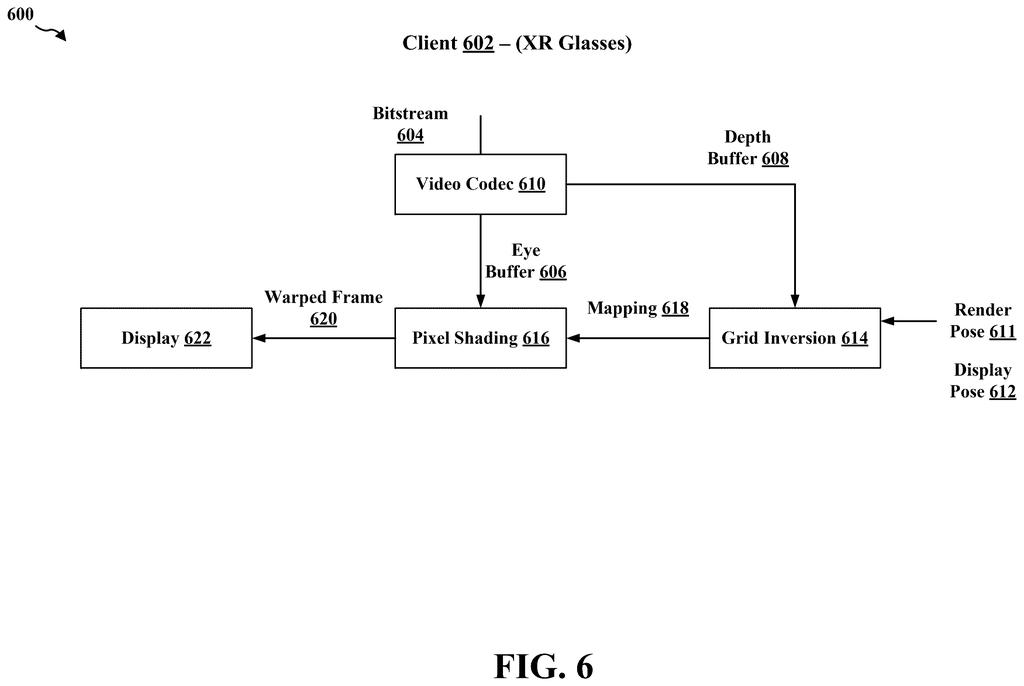
The core contribution here is what the patent calls a single grid inversion. A grid inversion is the process of building a lookup table that maps every pixel in the display back to where it should have come from in the original rendered image, accounting for lens distortion and head position. Normally, this would need to be recomputed for each field because each field has different pose data (position and orientation of the headset at the time of capture).
Qualcomm's approach does that inversion once, anchored to the first field's pose data. It produces a set of motion vectors (arrows that say "this pixel on screen maps to that pixel in the original render"). The processor then:
- Applies those motion vectors directly to the first field
- Applies the same vectors plus a small per-field offset for the second field's pose
- Applies the same vectors plus a different small offset for the third field's pose
The expensive part (grid inversion) runs once. The cheaper part (pixel shading with the pre-built vectors) runs three times. Qualcomm's interest in AR and VR display processing shows up repeatedly in its chip roadmap, and this filing fits squarely into reducing the compute budget per frame.
… indicate a point-to-point mapping from a display space to a rendered eye buffer space.
Translation: These vectors map the final screen display directly to what the user's eyes actually see.
What this means for AR headset comfort and battery life
For headset makers, every cycle spent correcting images is a cycle that could be used for sharper graphics or saved to extend battery life. If Qualcomm's approach works as described, it could let a chip do the same quality reprojection with a smaller processing load, which matters a lot in a device worn on your face that needs to stay light and cool.
For you as a potential headset user, this kind of work is what stands between a comfortable, crisp AR experience and the subtle blurring or judder that makes people take headsets off after ten minutes. Reprojection is one of the least visible but most important pieces of the pipeline, and shaving compute off it is a meaningful engineering goal, not a cosmetic one.
Qualcomm's 44th patent we've tracked since July in the AR glasses race adds to earlier work on a sound-aimed camera and per-person image quality.
Claim 1 covers a specific pipeline shape: one mathematical inversion operation, tied to the first image in a sequence, whose results get reused across all three images with per-image adjustments layered on top. That is a narrow description of a particular way to save computation when refreshing a display frame by frame.
The narrowness has real consequences. The claim blocks that exact sequence but leaves room for anyone who runs the inversion twice, anchors it to a different image, or structures the adjustments differently. Qualcomm is protecting a specific shortcut, not the general idea of sharing work across a sequence.
Whether that matters depends on whether this particular shortcut becomes the standard approach in headset chips. If hardware designers converge on this pipeline because it's efficient, the claim holds real value. If alternatives prove equally attractive, it covers a road less traveled.
There are more where this came from
We read every patent application Big Tech publishes and send you the ones worth knowing. Plain English, free, every week.
The drawings
11 drawing sheets from US 2026/0292119 A1 · click any drawing to enlarge


Want this weekly breakdown for a company we don't cover? Patentlyze Pro →
Be the first to weigh in