
Samsung Patents a Way to Keep VR Context Visible When Switching Apps
Stepping out of a virtual world to check a notification usually means the VR experience just ends. Samsung is patenting a way to keep a small window of that virtual space visible even after the headset switches to a regular app.
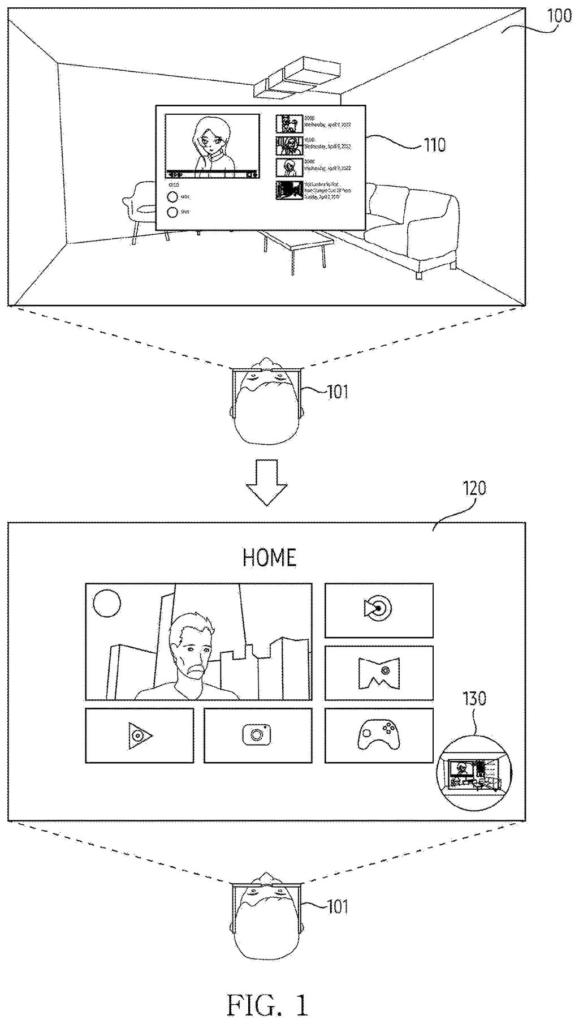
What Samsung's VR app-switching thumbnail actually does
Ever been deep in a VR game or meeting, only to get pulled out completely the moment a notification forces the headset to show a normal app? That jarring hard-cut is the problem Samsung is trying to fix.
The idea is straightforward: the headset tracks where you're pointing it in 3D space. As long as you're in a "safe zone" of movement, it keeps showing the full virtual environment. Move too far outside that zone and it knows a different app needs the screen, so it takes over. But instead of erasing the VR session entirely, it shrinks a little window of the virtual world down into a corner of the new screen so you don't lose your place.
Think of it like picture-in-picture on your TV, except the small window is a live slice of a 3D virtual space, not a football game. You can glance at your notification or app, then jump back in without disorientation.
… display, on the second screen, a visual object associated with the virtual space, the visual object having a reduced size on the second screen based on a portion of the display area.
Translation: It shrinks a piece of your virtual world onto the new app screen so you remember what you were doing.
How the headset decides when to swap screens and shrink the view
The patent describes a processor inside a wearable display device (think a VR headset or mixed-reality glasses) that constantly monitors orientation sensor data to figure out which direction the device is pointing.
It defines two spatial zones:
- First range: the area of movement where the headset is considered "inside" the VR session. Within this zone, the full display is devoted to the virtual environment, updated in real time as you turn your head.
- Second range: a separate zone outside that boundary. When the headset detects you've moved into this range, it hands the display over to a different, non-VR application.
The key mechanic is what happens on that second screen. Rather than simply replacing the VR view, the system displays a reduced-size visual object representing the virtual space on top of the new app's screen. The size of this thumbnail scales based on how much of the display area is available, so it doesn't crowd out the foreground app.
The claim set was canceled in this publication, meaning the application is likely being revised or continued, but the described behavior is clear: sensor-driven zone detection triggers an automatic, proportional picture-in-picture fallback from VR to a standard app screen.
What this means for mixed-use VR headsets going forward
For anyone using a VR or mixed-reality headset for anything beyond pure entertainment, this kind of context-switching is a daily friction point. Headsets that force a full exit from a virtual environment every time a system alert or second app needs attention make multitasking genuinely unpleasant. A system that preserves spatial orientation while handing screen control to another app lowers that cost meaningfully.
Samsung's track record in wearable display patents suggests the company is thinking carefully about how these devices fit into working life, not just gaming. If this behavior ships, it would make a VR headset feel less like a one-track appliance and more like a screen you can actually live in.
Samsung's 50th filing we've tracked since May in the AR glasses race builds on one sharpening video for XR and one speeding up location recognition.
Losing your place in a virtual reality session every time a message or alert demands attention costs more than a few seconds of frustration. In a headset, that interruption collapses the entire surrounding environment, which means rebuilding focus from scratch rather than glancing at a notification and moving on.
The approach here matches that cost proportionately. By reading where the headset is physically pointing, the device decides whether to keep the virtual environment running or surface the outside content in a corner of the view, with no new hardware required.
The canceled claims signal that Samsung is still negotiating the exact boundaries of what gets protected, so the final version of this patent may look different, or may not arrive at all. The underlying idea, however, addresses a friction point that anyone who has used a headset for real work will recognize immediately.
There are more where this came from
We read every patent application Big Tech publishes and send you the ones worth knowing. Plain English, free, every week.
The drawings
16 drawing sheets from US 2026/0277518 A1 · click any drawing to enlarge


Want this weekly breakdown for a company we don't cover? Patentlyze Pro →