
Google Patents a Way to Train AI Models on Your Phone Without Filling Up Its Memory
Training an AI model on your phone normally means unpacking the whole thing into memory at once, which most phones simply can't do. Google has filed a patent for a system that unpacks only the piece it needs right now, uses it, then tosses it before moving on to the next piece.
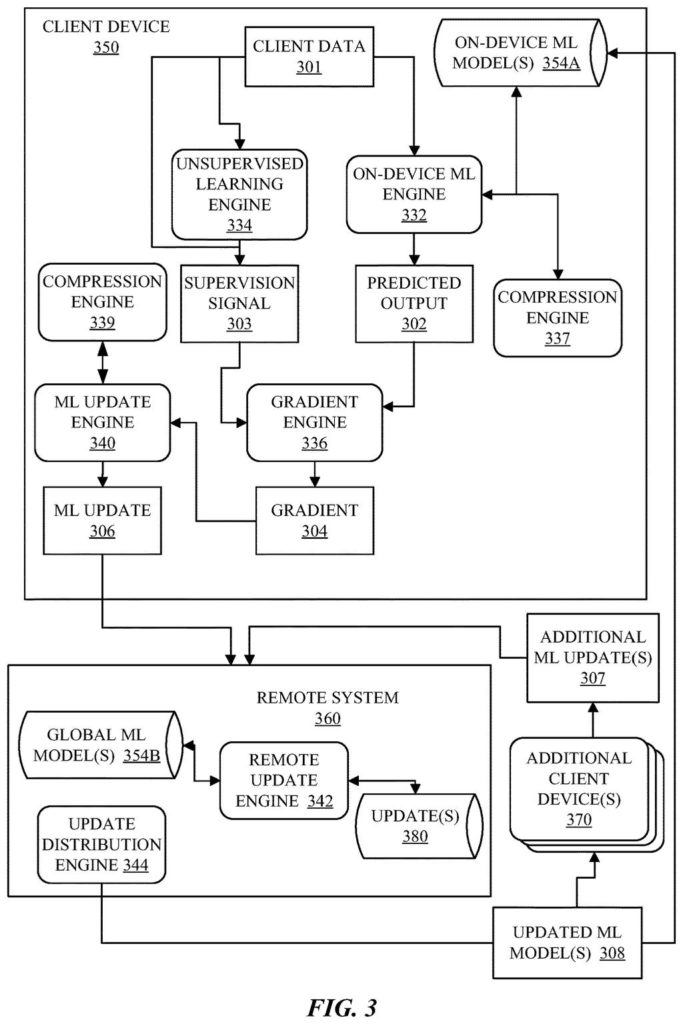
How Google keeps AI training from swamping your phone's memory
A phone sits in someone's pocket helping Google improve its AI without any of that person's data ever leaving the device. That's the idea behind federated learning, but making it work on a phone with limited memory has always been the catch.
Google's approach here is to keep the AI model compressed, like a zip file, and unpack only one small section at a time. The phone processes that section, then immediately discards the unpacked version to free up space, while the compressed version stays put. It cycles through every section this way, both when the model is making a prediction and when it's updating itself based on how wrong that prediction was.
The result is that a full AI model that would never fit in your phone's working memory can now be trained there, one bite at a time, without crashing anything else running in the background.
decompress the compressed subset of parameters to generate a corresponding decompressed subset of parameters; and process corresponding data using the corresponding decompressed subset of parameters to generate a next iteration of the corresponding data …
Translation: The phone temporarily unfreezes just one piece of the AI at a time to do math without running out of space.
How the slice-by-slice decompression loop actually runs
Federated learning is a way of training AI models across many devices without centralizing user data: each phone runs a local training loop, then ships back only the model's updates, not the raw data. The problem is that training requires holding the entire model in active memory, which can be several gigabytes, far more than most phones can spare.
This patent's core fix is to keep the model in a compressed format (think of it like a heavily compacted archive) and unpack only one subset of parameters at a time. During forward propagation (the pass where the model makes a prediction), the device decompresses one slice, runs the math, then deallocates that memory before moving to the next slice. During back propagation (the pass where the model figures out what it got wrong and corrects itself), the same slice-by-slice pattern repeats, but this time the device also recompresses each updated slice before discarding the unpacked version.
The claim specifies that all other subsets remain compressed while any single subset is live in memory. That constraint is the key: peak memory usage is bounded by the size of one slice, not the whole model.
- Receive a fully compressed model from Google's servers
- Unpack one parameter slice, run forward pass math, discard the unpacked slice
- Repeat for every slice until a prediction is made
- Repeat again in reverse for back propagation, recompressing updates as you go
- Return only the compressed, updated parameters to Google's servers
… after the decompressed parameters are utilized, they can be deallocated from memory (while their compressed counterparts optionally remain in memory) to enable allocation of memory for further decompressed parameters that will be needed next …
Translation: Once each small piece of the AI finishes its job, it is immediately erased from memory to free up space for the next piece.
What this means for private AI training on everyday devices
Memory is the single biggest barrier to running real AI training on phones. Most federated learning systems today either require expensive flagship hardware or skip on-device training altogether and just do on-device inference (letting the model make predictions without improving itself). A system that trains inside a compressed footprint could bring actual learning to mid-range and budget phones, which is where most of the world's population lives.
For users, the immediate upside is stronger privacy: if your phone can train locally, your personal usage patterns never need to travel to a server. Google's run of federated-learning filings suggests this is a long-term infrastructure investment, not a one-off idea. Whether compressed on-device training becomes standard will depend on how well the accuracy holds up when updates are constantly squeezed and re-squeezed.
Google's 50th filing we've tracked since May in our on-device AI privacy work follows earlier applications on keeping grid AI private and building fake datasets from real data.
The problem this addresses is real and has concrete costs. Running AI training on-device today often means the model is too large, the phone overheats, or the background process is killed by the operating system before it finishes. Those aren't theoretical annoyances; they're why federated learning tends to work well in papers and poorly in production.
The slice-by-slice decompression approach is a sensible match for that problem. It trades computation time (you decompress the same parameters multiple times) for peak memory, which is exactly the right trade on a phone where memory is the scarce resource.
That said, the compression-decompression overhead on every single pass could slow training enough to matter, especially on older hardware. The patent doesn't make claims about accuracy loss from repeatedly squeezing model updates, and that's the part that will determine whether this is a real advance or a clever paper exercise.
There are more where this came from
We read every patent application Big Tech publishes and send you the ones worth knowing. Plain English, free, every week.
The drawings
4 drawing sheets from US 2026/0290320 A1 · click any drawing to enlarge


Want this weekly breakdown for a company we don't cover? Patentlyze Pro →
Be the first to weigh in