
Nvidia Patents Software That Grows Small Textures Into Full Images
Getting an AI to tile a small texture across a huge surface without it looking repetitive or blurry is a harder problem than it sounds. Nvidia's new patent describes a neural network approach that handles both the fine-grain texture detail and the big-picture structure at the same time.
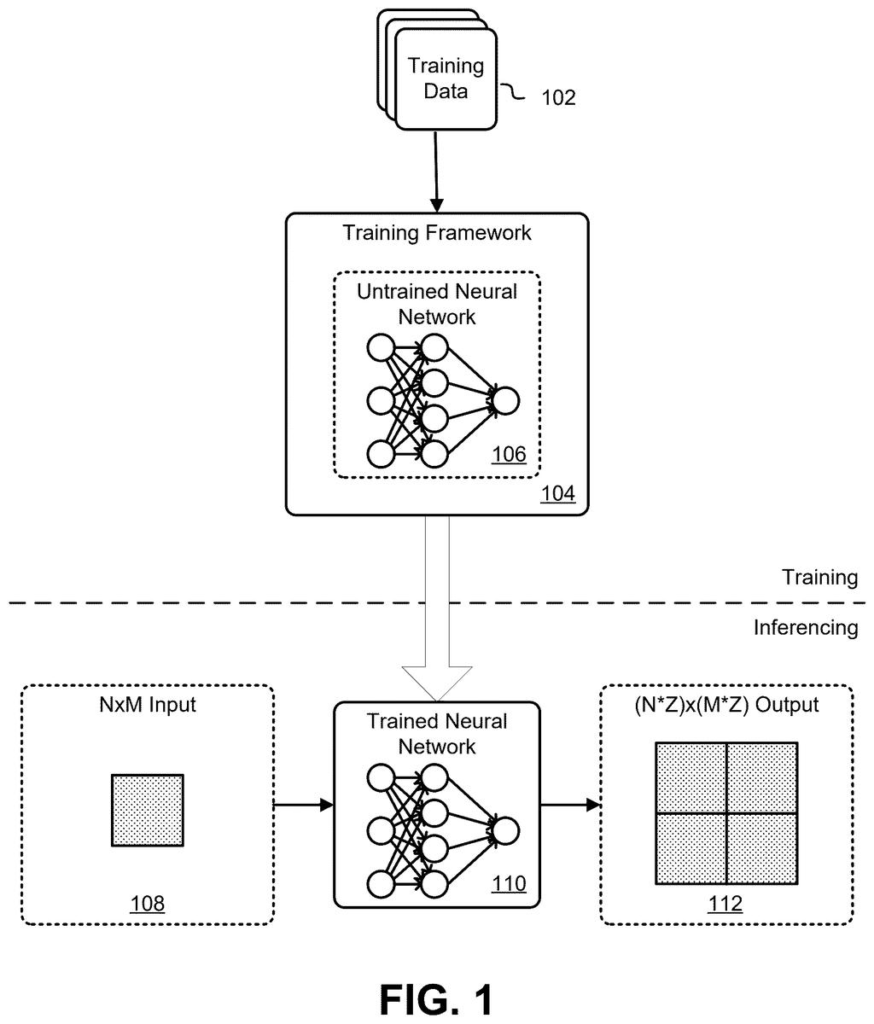
How Nvidia's texture-expansion AI actually works
When software needs to fill a large area with a repeating texture (think a stone wall, a fabric pattern, or a field of grass), it usually either tiles a small sample clumsily or requires artists to supply a much larger source image to begin with. That mismatch between available material and needed output is exactly the problem Nvidia is addressing here.
The patent describes a neural network that takes a small textured image and generates a much larger version of it. The key challenge is preserving two things at once: the fine local detail (the weave of a fabric, the grain of wood) and the overall global structure (how patterns flow across the whole image). Standard upscaling tends to blur one or both.
Nvidia's approach combines two types of processing layers inside the network, one that reads local detail and one that works in reverse to spread and reconstruct it at a larger scale. The result is a big output image that still looks like it belongs to the same texture as the small input.
… generate a large textured output image from a small input textured image while preserving global features and texture …
Translation: The software turns tiny graphics into full sized pictures without losing the original style.
How the convolutional layers scale a texture up
The system uses a convolutional neural network (CNN), a type of AI that processes images by scanning them in small overlapping patches to detect patterns. Those detected patterns are then passed through transposed convolution operations (sometimes called "deconvolutions"), which essentially run the detection process in reverse to reconstruct and expand the image at a larger resolution.
The combination is designed to solve a specific tension in texture synthesis:
- Local features: the fine grain, tiny color shifts, and micro-patterns that make a texture look real up close.
- Global features: the larger structural flow across the image that stops an expanded texture from looking like a cheap repeated tile.
By using both layer types together, the network learns to generate new texture content that is statistically consistent with the input rather than just copying and pasting it. The input can be small (a patch, a swatch) and the output can be substantially larger while still looking coherent.
The patent covers the apparatus, system, and techniques that make this synthesis work, with the neural network trained to balance those two feature scales simultaneously.
What this means for games, film, and AI image tools
For anyone building 3D environments, whether in games, film visual effects, or architectural visualization, sourcing high-resolution texture assets is expensive and time-consuming. A reliable tool that can take a small reference sample and expand it to fill any surface would cut that workload significantly. Nvidia's GPU hardware is already central to real-time rendering pipelines, so a texture synthesis method that runs efficiently on that hardware would fit naturally into existing production tools.
Nvidia's interest in AI-driven image generation extends well beyond this single filing. For end users, a practical version of this technology could eventually appear inside creative software, letting you drop in a small photo of a surface and generate a seamless large-scale version of it automatically.
Nvidia's 33rd filing we've tracked since July in our GPU rendering race, following one on spotting visual glitches and one on blending surfaces on screen, adds another piece to the picture.
Claim 1 through 20 are canceled, which means there are currently no active claims in this publication to evaluate. That is a significant caveat: a patent with no surviving independent claims is not an enforceable patent, and there is nothing in this document that would block a competitor from doing anything.
That said, the underlying disclosure describes a real and active area of computer vision research. Convolutional texture synthesis has been a live problem for years, and the specific combination of standard convolution layers with transposed convolution operations to preserve both local and global features is a recognizable and legitimate approach.
If Nvidia files amended or continuation claims later, the scope of what they could actually protect would depend heavily on how specifically those claims are written. Based solely on what exists here, there is no claim to assess for breadth or blocking power.
There are more where this came from
We read every patent application Big Tech publishes and send you the ones worth knowing. Plain English, free, every week.
The drawings
57 drawing sheets from US 2026/0289724 A1 · click any drawing to enlarge


Want this weekly breakdown for a company we don't cover? Patentlyze Pro →
Be the first to weigh in