
Nvidia Patents a Real-Time System That Animates Digital Faces Directly From Audio
Getting a virtual character's mouth, teeth, tongue, and eyes to move convincingly while someone talks is one of the hardest problems in computer animation. Nvidia thinks a specific type of AI model can do it fast enough to work live.
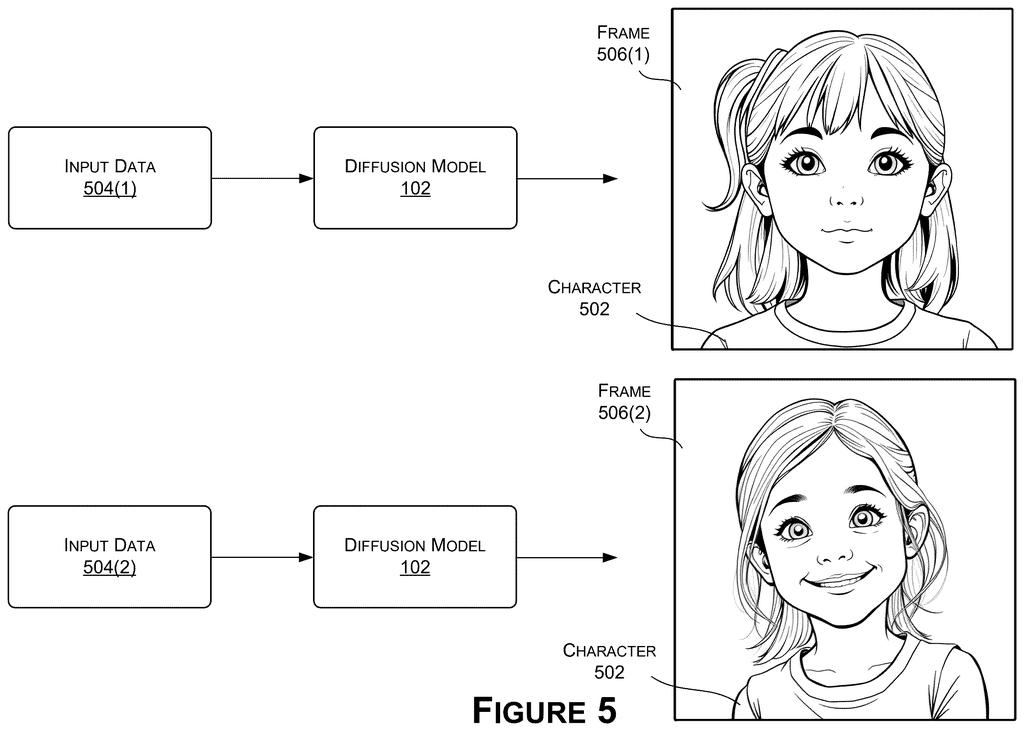
How Nvidia turns a voice track into a moving digital face
Ever watched a video game character's lips move in a way that looks just slightly wrong, like a badly dubbed foreign film? That disconnect happens because syncing every tiny part of the face to speech in real time is genuinely difficult.
Nvidia is filing a patent for a system that uses an AI model to do that job automatically. You feed it an audio clip and a character, and it produces animated frames showing the character speaking. The key twist is that the AI handles different parts of the face, your tongue, your teeth, your gums, your eyes, as separate items before combining them into a final image.
The system is also designed to be fast. Standard AI image generators take many processing steps to clean up a picture, but Nvidia's approach cuts that to ten steps or fewer, which makes it practical for live applications like real-time avatars in video calls or interactive game characters.
… generating, using the diffusion model and based at least on concatenating the second representations, one or more denoised frames depicting an animation of a pronunciation by the character of the portion of speech; …
Translation: It combines the facial parts to create the final animated video frames of the character speaking.
How the diffusion model splits a face into parts to sync speech
The patent describes a diffusion model (an AI that starts with a noisy, scrambled image and progressively cleans it up until a crisp picture emerges) trained specifically to animate a digital character's face based on incoming audio.
The process works in three broad stages:
- The model takes the current state of the character's face and the audio for a chunk of speech, then builds a shared internal representation combining both.
- From that shared representation, it generates separate representations for individual facial components, including the tongue, teeth (gums), and eyes, rather than treating the entire face as one blob of data.
- Those component representations are merged, and the model runs its denoising pass, producing clean animation frames that show the character pronouncing the spoken words.
To handle streaming audio without losing context between chunks, the model saves state information (a kind of short-term memory) that links each processing segment to the ones before it. That way, the animation stays continuous even as new audio arrives in pieces.
The speed target of ten or fewer diffusion steps is notable because typical high-quality diffusion passes can run into the dozens or hundreds of steps, each adding time. Fewer steps means lower latency (delay between input and output), which is what separates a tool useful for real-time use from one only practical for pre-rendered content.
… encode and/or decode components of the face—such as the tongue, the eyes, the gums, and/or the like—separately when animating the character to provide realistic character animation.
Translation: The system animates specific parts of the mouth and face individually to make the overall movement look natural.
What this means for real-time avatars and game characters
For anyone who has used a virtual avatar in a video call or watched an AI-generated talking head online, the mouth movement is almost always the part that gives it away. Tongue position and gum exposure during specific sounds are subtle cues that human perception is extremely sensitive to, and most systems flatten those details into a generic mouth shape. Handling them as distinct components is a direct attempt to close that gap.
Nvidia's track record in character animation patents suggests the company is building toward real-time digital human pipelines, not just research demos. If this system performs as described, it could reduce the manual animation work required for game characters, virtual presenters, and digital assistants significantly.
Nvidia's 21st filing we've tracked since May in our text-to-3D characters watchlist follows one turning scripts to storyboards and one cleaning up 3D scans.
Claim 1 is worth reading carefully because it is broader than the abstract suggests. The claim does not specify any particular face model, audio format, or even the number of diffusion steps. It covers the general sequence: take audio and a character frame, produce separate face-component representations, concatenate them, and output denoised animation frames. That is a fairly wide net.
In practice, if granted, a claim that broad could cover a wide range of real-time avatar and lip-sync systems that follow the same architectural pattern, regardless of whether they use Nvidia hardware. That is a meaningful defensive position in a space that includes game engines, video-call software, and AI video generation platforms.
The narrower technical contributions, the specific segment-state-memory trick for streaming audio and the ten-step diffusion limit, show up only in dependent claims. So the core filing protects the structure, not just Nvidia's particular speed optimizations. Whether the USPTO agrees that the combination is novel enough to grant it is a different question, but the company is clearly staking out territory here.
There are more where this came from
We read every patent application Big Tech publishes and send you the ones worth knowing. Plain English, free, every week.
The drawings
15 drawing sheets from US 2026/0278899 A1 · click any drawing to enlarge


Want this weekly breakdown for a company we don't cover? Patentlyze Pro →
Be the first to weigh in