
Sony Patents a System That Scores Your Gaming Clips with Your Own Music
Sony has filed a patent describing a system that automatically picks songs from your personal music library to soundtrack your gaming clips, matching the mood of the gameplay to the feel of the track.
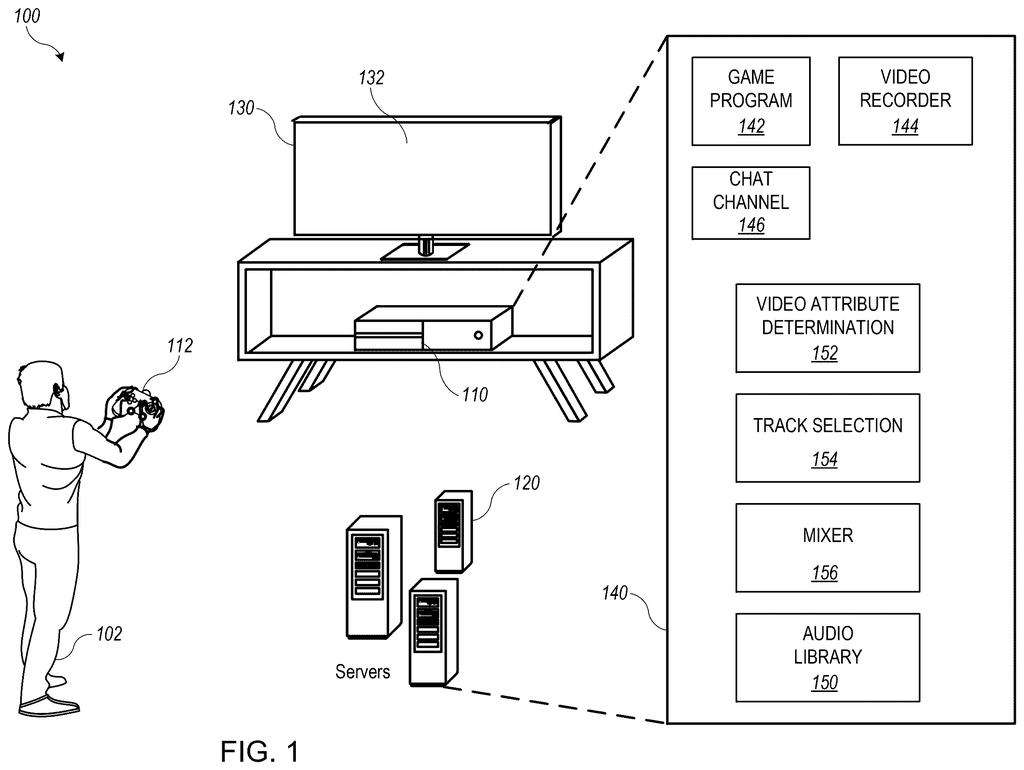
How Sony's auto-soundtrack for gaming clips would work
A gamer clips an intense boss fight, shares it online, and the background music is just the game's generic score. It doesn't exactly reflect their personality.
Sony's new patent would fix that by scanning a recorded gameplay clip, working out its character (fast-paced, tense, triumphant), and then pulling a matching song from your own music library automatically. The system blends your chosen track with the game's original audio so the final video sounds like something you actually curated.
The end result is a highlight reel that sounds like you put it together, without you having to manually drag audio clips around in a video editor.
… selecting, from a personal audio library associated with the user, an audio track to accompany the recorded video segment …
Translation: It picks a song from your own music collection to go with the video clip.
How the system matches video attributes to your library tracks
The patent describes a computer-implemented pipeline with four main steps:
- Recording input: the system receives a video segment of your gameplay, captured on a video game console.
- Attribute analysis: it analyzes the clip for one or more attributes, things like pacing, intensity, or scene type (a firefight versus a slow exploration sequence).
- Track selection: it scans your personal audio library, where each song has an associated set of properties (tempo, energy level, genre tags, and similar descriptors), and picks the track whose properties best match the clip's attributes.
- Mixing: it blends at least part of that song into the recorded video alongside the existing game audio, producing a final augmented clip.
The matching step is the core idea. Rather than letting you manually browse your library, the system finds the closest sonic fit automatically, using the similarity between the video's characteristics and each track's metadata. Think of it like a recommendation algorithm, but one that scores your own footage instead of suggesting what to listen to next.
The patent does not pin down a single analysis method, leaving room for the approach to use audio fingerprinting, tempo detection, or other signal-processing tools to characterize both the clip and the candidate tracks.
A video segment of video game play by a user can be augmented by the addition of a personalized soundtrack …
Translation: Your gameplay clips can be enhanced by adding a custom soundtrack made from your music.
What this means for sharing PlayStation highlight reels
Sharing gaming clips has become a major part of PlayStation culture, and the audio layer is often the weakest part. Game soundtracks are sometimes muted by rights-holders on upload platforms, and swapping in music manually takes real effort. A system that does this automatically, pulling from music you already own or stream, would remove a genuine friction point for anyone who posts clips regularly.
There is also a rights dimension worth noting. Using tracks from your personal audio library rather than a generic licensed catalog suggests Sony is thinking about how to keep users inside a music-service ecosystem, possibly its own or a partner's, rather than opening the door to arbitrary uploads that could create copyright headaches for the platform.
Sony's 545th filing in our Sony coverage since May adds to a run that includes applications on controllers as speakers and a physical reaction button.
The system trades user control for speed, and that trade has a real cost. When the algorithm decides your chaotic battle clip reads as "high energy" and pulls a song you associate with something completely different, the mismatch feels worse than no music at all. Automated matching has a long history of confident wrong answers.
The deeper problem is that the system has to define what makes a song fit a moment, and that definition does a lot of hidden work. Tempo is measurable; tension, triumph, and dread are not. Until those matching criteria are precise, results will be uneven in ways users experience as random rather than helpful.
Even so, most people who record gameplay are not video editors, and any friction removed increases the chance they actually share what they capture. If the system gets the match right often enough, the occasional misfire is a fair price. That "often enough" is the whole bet.
There are more where this came from
We read every patent application Big Tech publishes and send you the ones worth knowing. Plain English, free, every week.
The drawings
7 drawing sheets from US 2026/0284531 A1 · click any drawing to enlarge


Want this weekly breakdown for a company we don't cover? Patentlyze Pro →
Be the first to weigh in