
Qualcomm Patents an AI System That Verifies Your Identity Across Devices
Qualcomm has filed a patent for a way to verify your identity using an AI model that was trained across many devices without any of those devices ever handing over your personal data.
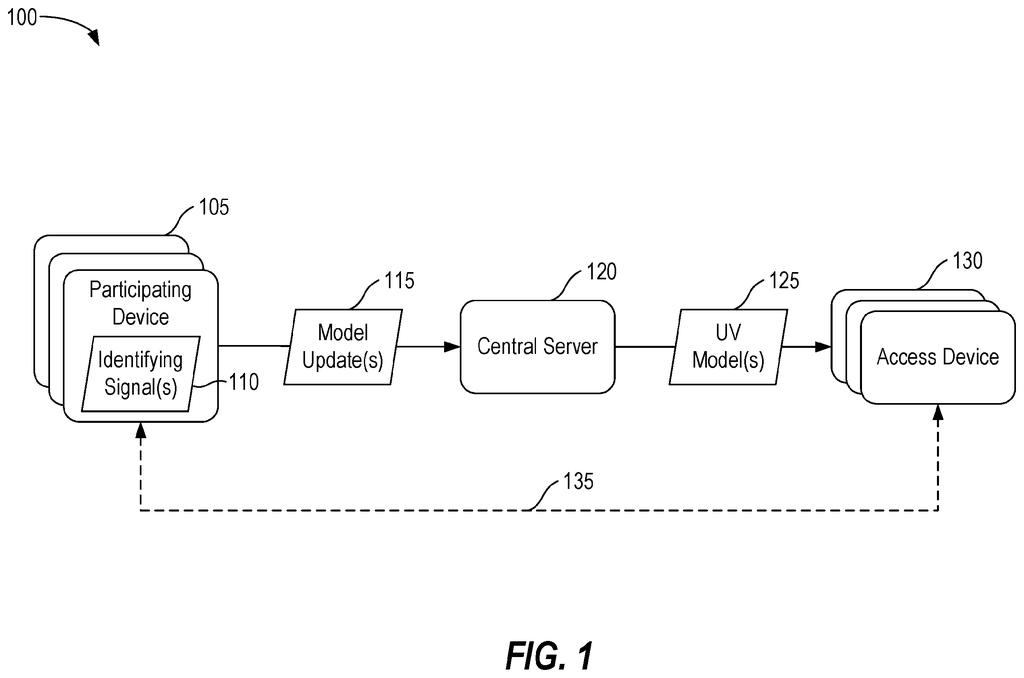
How Qualcomm's shared AI checks your identity privately
Every time you unlock your phone with your face or fingerprint, your device is running a quick comparison: does the person here match the person who set this up? That check is only as good as the AI behind it, and training that AI usually means gathering a lot of sensitive data in one place.
Qualcomm's approach breaks that bottleneck. Instead of sending your biometric information to a central server to train a shared model, the model gets trained across many devices separately, then shared back to your phone. Your raw data stays on your device the whole time.
When you try to verify your identity, your device runs your input through the shared model, produces a compact mathematical summary of it (called an embedding), and compares that to a stored summary from when you first enrolled. If the two summaries are close enough, you're in.
accessing, by a first computing device, a user verification (UV) machine learning model trained on at least one other computing device; receiving a first identifying signal corresponding to a first user; generating a first embedding by processing the first identifying signal using the UV machine learning model; …
Translation: Your phone uses an artificial intelligence model trained elsewhere to process your login details.
How the embedding score decides if you're really you
The system has three moving parts: a federated training process, an embedding generator, and a scoring step.
Federated training means the AI model is trained across many devices at once, but without pooling their raw data. Each device trains locally on its own data, and only model updates (the learned weights, not personal files) are shared back to a central coordinator. The result is a model that has absorbed patterns from many users without any of those users' data ever leaving their own phones.
The embedding is a compressed numerical fingerprint of an identifying signal, for example a voice sample, a face scan, or a fingerprint image. Think of it like a short code that captures the distinctive features of your input without storing the input itself. When you try to verify, the device generates a fresh embedding from your current signal.
The score is produced by comparing the fresh embedding to a stored one from enrollment. If the two are similar enough, the system outputs a pass. The patent leaves the exact biometric modality open, so the same architecture could back a face ID system, a voice lock, or a behavioral pattern check.
A score is generated based on the first embedding and a first stored embedding, and an output is generated based on the score.
Translation: The system compares your current digital fingerprint against saved data to decide if it is really you.
What this means for on-device biometric security
For users, the practical upside is that your raw biometric data never has to leave your device, even as the underlying AI keeps improving from patterns learned across a wide population. That's a meaningful privacy gain over older approaches where verification models were trained on data pooled in the cloud.
Qualcomm's bet on on-device AI makes this filing fit a clear pattern: the company supplies the processors inside a huge share of Android phones, and pushing more intelligence onto the chip itself is a long-running priority. A better on-device verification model is exactly the kind of feature that differentiates a chip platform, since it touches every unlock, every payment auth, and every app that checks who you are.
Qualcomm's 16th filing we've tracked since July in our on-device AI privacy push connects back to their training AI without sharing data and serverless AI training across 5G applications.
Qualcomm's patent describes phones learning to recognize their owners by coordinating that learning with other phones, without ever sending actual fingerprints or face scans anywhere. The underlying pieces already exist: chips that run AI locally and phones that can share anonymized lessons with each other.
The gap between this document and something you can actually buy is logistics. Getting millions of phones to learn together without draining batteries or burning through data plans requires a coordination layer this patent does not describe, and building that layer means a phone maker and Qualcomm have to develop it together for a specific device family.
That process takes years, which makes this a serious foundation for a future direction rather than a signal that anything is close to shipping.
There are more where this came from
We read every patent application Big Tech publishes and send you the ones worth knowing. Plain English, free, every week.
The drawings
9 drawing sheets from US 2026/0288920 A1 · click any drawing to enlarge


Want this weekly breakdown for a company we don't cover? Patentlyze Pro →
Be the first to weigh in