
Apple Patents a Tool That Adjusts Screens to Match Hospital Display Requirements
A radiologist's diagnosis can only be as good as what they see on their screen. Apple has filed a patent for software that walks users through calibrating a display to meet formal medical imaging standards, adapting its instructions based on whatever measurement device is plugged in.
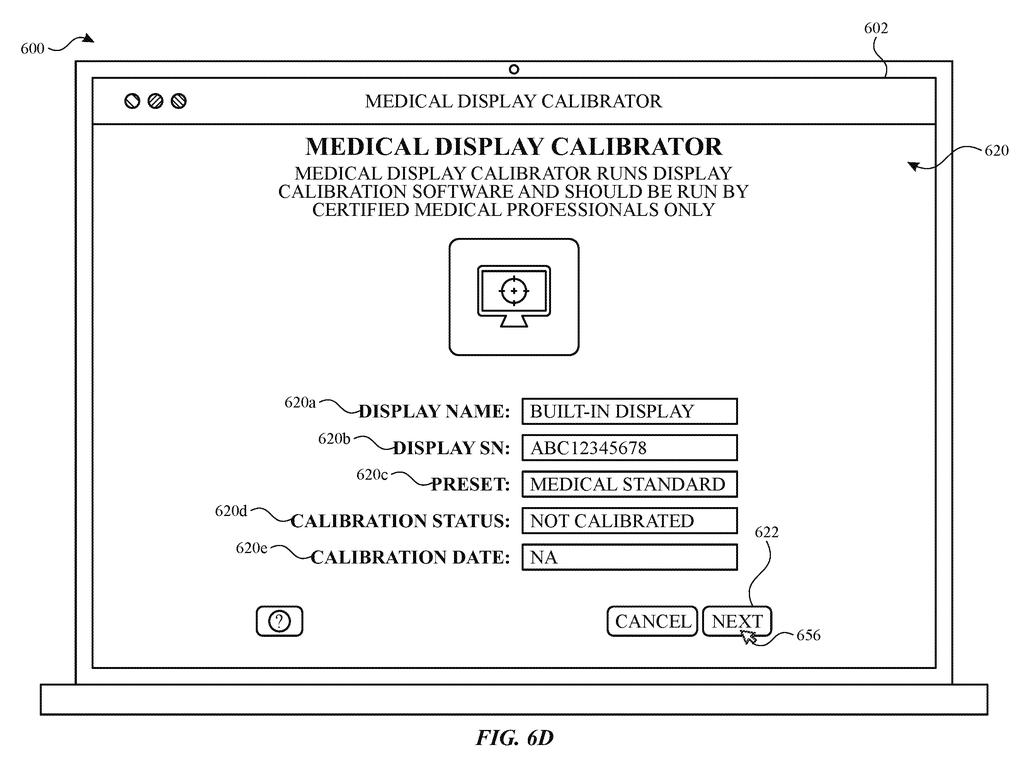
What Apple's medical display calibration system actually does
A radiologist sits down to read an X-ray on a monitor that hasn't been properly calibrated. The image looks fine to the naked eye, but the subtle gradations of gray that separate a small tumor from healthy tissue are slightly off. That gap between "looks okay" and "meets a clinical standard" is exactly what this patent targets.
Apple's system is a calibration application that connects a Mac to an external measurement instrument (a specialized sensor that reads color and brightness from the screen) and walks users through the process of adjusting the display's profile to meet medical imaging standards. It detects which measurement device you have plugged in and changes its on-screen instructions accordingly, so the steps you see match your specific hardware.
Once the process is done, the display profile is saved as formally compliant with the standard used for clinical imaging. You get a result screen confirming whether calibration passed or failed.
… modifying one or more visual display characteristics of the respective display profile based on the calibration process, wherein after modifying the one or more visual display characteristics of the respective display profile based on the calibration process, the respective display profile is compliant with the standard for display of medical imaging …
Translation: It updates the screen settings so they meet official medical imaging rules.
How the calibration app queries and adjusts for each instrument
The patent describes a calibration application running on a computer system (almost certainly a Mac) that communicates simultaneously with a display, input devices, and an external measurement instrument (a colorimeter or spectrophotometer, devices that physically read light output from a screen).
When a user launches calibration, the system queries the connected measurement instrument to identify what it is. Depending on the answer, the app displays different setup instructions. If you have instrument A, you see instructions for instrument A. If you have instrument B, you see a different set. This matters because different hardware attaches to a display differently and requires different steps to operate.
The calibration process itself shows visual test patterns on the display while the measurement instrument reads the screen's actual light output. That data is fed back to the software, which compares it against the requirements of a formal standard for medical imaging display (the patent references a standard for how clinical monitors should reproduce luminance and contrast).
If calibration succeeds, the software modifies the display's color profile so that future output matches the standard. A result screen confirms compliance. If it fails, the user can see what went wrong.
… methods and user interfaces for calibrating a display profile of a display based on a standard for display of medical imaging …
Translation: It covers software screens and steps for tuning monitors to meet medical standards.
What this means for doctors using Apple hardware in clinics
Radiology, pathology, and surgical planning all depend on clinicians seeing images exactly as they were captured. Regulatory bodies and hospital accreditation programs often require that diagnostic monitors be formally calibrated on a set schedule. Right now that process typically requires dedicated, expensive software and specialized IT support.
A built-in Apple calibration tool could lower the barrier for smaller clinics or remote practitioners who want to use Mac hardware for clinical work. It would also signal that Apple is serious about making its displays viable in regulated medical environments, not just creative and general-purpose ones. For you as a patient, a properly calibrated display anywhere in the diagnostic chain means less chance of something being missed because the screen made it invisible.
Apple's 38th filing in the Display patents we cover since May follows work on a self-flattening foldable hinge and dual touch-screen keyboard lid.
The problem this patent addresses is real and underappreciated. A miscalibrated clinical monitor isn't a minor inconvenience; it can make a subtle finding invisible or create an apparent abnormality where none exists. Medical imaging standards exist precisely because this has caused harm.
The size of the problem, though, is probably larger than a calibration wizard can fix on its own. Hospital-grade diagnostic monitors are purpose-built devices with hardware-level luminance controls and dedicated validation software. A Mac with a consumer or prosumer display, however well calibrated, still faces a regulatory hill before most hospitals will use it for primary diagnosis.
Where this filing makes more immediate sense is in secondary review, remote reading, or smaller clinical settings where the choice between a compliant workflow and no workflow at all is a real one. Apple's run of medical and health-focused filings suggests the company sees healthcare as a serious product territory, not a side experiment. This particular patent is a narrow infrastructure piece, not a headline feature, but the direction it points is clear enough.
There are more where this came from
We read every patent application Big Tech publishes and send you the ones worth knowing. Plain English, free, every week.
The drawings
25 drawing sheets from US 2026/0290279 A1 · click any drawing to enlarge


Want this weekly breakdown for a company we don't cover? Patentlyze Pro →
Be the first to weigh in