
Apple Patents a Head-Worn Display Where the Strap Holds the Processor
Apple's latest patent puts a processor inside the headset's strap rather than the main housing, a structural choice that reshapes how the whole device is assembled, worn, and potentially upgraded.
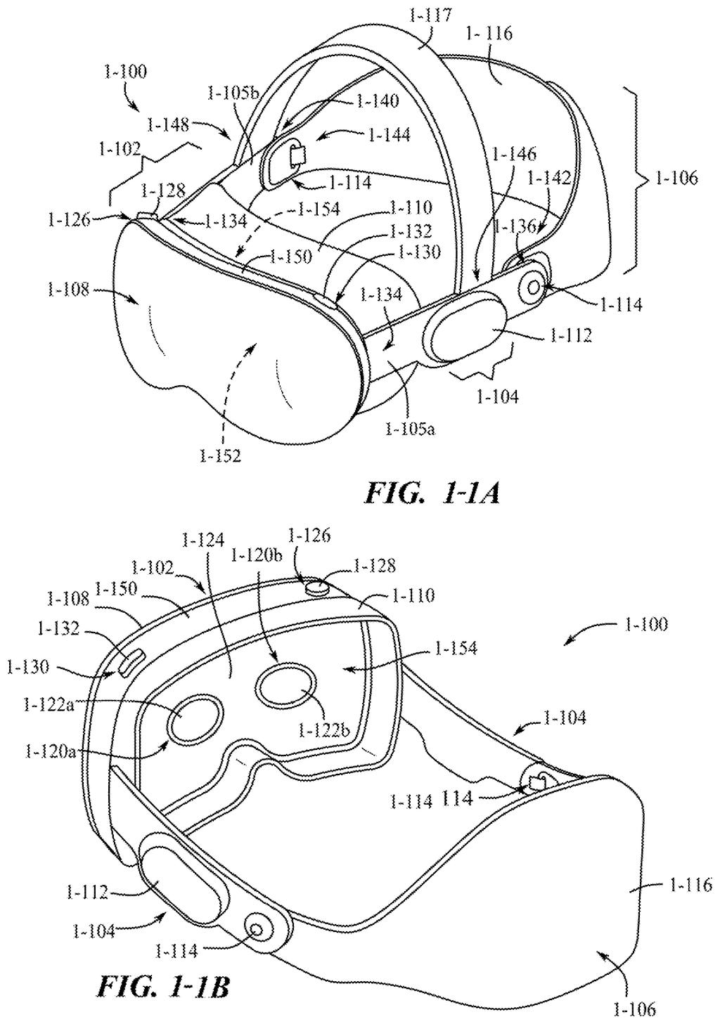
What Apple's strap-based headset design actually does
Every time you strap a headset to your face, you're dealing with a weight problem. Electronics are heavy, and piling everything into the front visor means the device tips forward and digs into your face after a few minutes.
Apple's patent describes a head-worn display that moves some of the computing work, specifically a processor, into the strap itself, rather than keeping all the hardware crammed into the front housing. The strap connects to the main body at one end, and a separate removable band clips onto the other end. That band presumably wraps around the back of your head to hold everything in place.
The front of the device has a curved transparent cover over the display, and a second display assembly sits at the rear opening. Together, the layout suggests Apple is thinking carefully about how weight, electronics, and fit interact across the whole headset, not just the visor.
… a strap comprising a first end connected to the housing; a processor disposed within the strap; and a band removably connected to a second end of the strap.
Translation: The processing chip lives inside the head strap rather than the visor.
How the strap, band, and display assembly connect
The patent describes a head-mountable display (basically a VR or AR headset) built around a central housing with two openings: one in the front, covered by a curved transparent screen, and one in the rear where a display assembly sits.
The key structural detail is the strap system. Rather than a simple fabric or rubber band, Apple's design splits the securing mechanism into two parts:
- A strap that connects to the housing at one end and contains an embedded processor
- A removable band that connects to the other end of the strap and wraps around the head
Putting a processor inside the strap (rather than in the main housing) distributes the electronics across the device. This could help balance weight front-to-back, and it separates certain computing functions from the main body. Earlier claims in the broader patent family also describe a second strap with its own electronic component and a band that bridges the two straps.
The curved transparent cover on the front is mentioned explicitly as a separate claim element, suggesting Apple considers its optical or structural properties meaningful enough to protect independently.
A first securement strap including a first electronic component, and a second securement streap can be coupled to the housing.
Translation: Electronic parts are built right into the straps that hold the headset on your head.
What a processor-in-the-strap means for wearable headsets
Putting a processor in the strap is an engineering trade-off with real consequences for you as the wearer. A lighter front housing means less forward pull on your face during extended use, which is one of the main comfort complaints about existing headsets. It also means the strap isn't just a passive fixture; it becomes a functional part of the computer.
The removable band is the other detail to watch. Swappable rear bands are already a feature of the Apple Vision Pro, so this patent may reflect ongoing work to refine that system, possibly making different band configurations carry different electronics. the pattern in Apple's head-worn display filings suggests the company keeps iterating on how hardware is distributed across the headset rather than treating the visor as the only interesting engineering surface.
Apple's 68th filing we've tracked since May on our AR glasses watchlist, building on a lens frame design and a thinner eye-tracking system, adds another layer to how the company may build its glasses.
Burying electronics inside the head strap moves weight off your face, which is the right instinct, but the strap is also the part that bends, soaks up sweat, and gets yanked every time the headset comes on or off. Hardware that lives inside something that flexes that many times over years of daily use has a reliability problem the patent does not address.
The removable band adds another cost: data has to cross a moving connection between the strap and the main body every time the headset runs, and every user who swaps bands tests that connection again. That joint is the most likely place the design fails over time.
The trade still reads as worth it. Long wear comfort is one of the sharpest complaints about headsets, and shifting weight off your face is a more direct fix than trimming ounces from the screen or lenses. The durability questions are real, but they are the right questions to be wrestling with.
There are more where this came from
We read every patent application Big Tech publishes and send you the ones worth knowing. Plain English, free, every week.
The drawings
592 drawing sheets from US 2026/0287909 A1 · click any drawing to enlarge


Want this weekly breakdown for a company we don't cover? Patentlyze Pro →
Be the first to weigh in